Sociogencia · the politics of the build

The infrastructure prime minister.

Andy Burnham is the runaway favourite to enter Number 10 as the UK’s ninth prime minister since 1997 – and the first to have spent ten years treating digital infrastructure as regional justice, not just national competitiveness.

The read

Analysis from the public record, written as Burnham takes office. Every quotation is his own words, sourced and graded; the politics are read for what they mean for the data-centre build, not for whom to back. Nothing is put in anyone’s mouth.

AuthorAdam Roberts
SubjectAndy Burnham
OfficeIncoming PM
LensUK digital infrastructure
Sociogencia · the 2029 question

2029

Three readings of one election: where the seats fall today, who can actually form a government, and the contest that settles it.

Constituency nowcast · proportional swing

Where the seats would fall now

A seat-by-seat projection on a hex cartogram – one hexagon per constituency, equal weight to each. Colour marks the projected leading party. Tap a seat for the read, filter by party in the key, or search by name. Reform the largest party, no majority – a hung parliament.

Estimated · proportional swing from the 2024 result to the 27 Jun 2026 poll average (Ref 26 · Lab 21 · Con 19 · Grn 13 · LD 12). Scotland and Wales swung on nation-level shares; Northern Ireland held at 2024; verified by-elections applied. One hex per seat · layout by Open Innovations. Not an MRP.

Reform wins the most seats. Burnham still forms the government.

On today’s numbers an election returns Reform as the largest party in a hung parliament. But Andy Burnham is the only leader in British politics net-positive with Labour, Lib Dem and Green voters at once – the exact coalition needed to keep Reform from power. The seats say Reform. Who can actually govern says Burnham.

Net favourability of Andy Burnhamby 2024 vote
Labour
+40
Lib Dem
+23
Green
+15
Conservative
−47
Reform
−56
All Britons
−4

Net positive across Labour, the Liberal Democrats and the Greens – the exact coalition he would need. Net negative only with the voters who were never going to back him.

YouGov, 21–22 June 2026 · favourable minus unfavourable Verified
The arithmetic
326seats needed for a Commons majority
299the anti-Reform bloc on the current nowcast – Labour, the Lib Dems, the Greens, the SNP, Plaid, the SDLP and Alliance
−27the gap a Burnham-led Labour has to close

The cross-bloc reach on the left, and the conditional “Burnham as leader” polling of May 2026, both say it can.

The call is conditional · EstimatedThis is the picture as it stands, and incumbency in this cycle is fragile. Keir Starmer won a landslide in July 2024 and reached this collapse in barely two years. A Burnham who stalls on the grid, on prices, or on a build people can see would watch the same favourability drain – and meet a 2029 contest harsher than the one this map projects.

A two-horse race, and a third outcome.

Start from the one fact that does not move. The grid-connection queue ran from about 41GW in late 2024 to roughly 125GW by mid-2025, and the pipeline could seek some 50GW, more than Great Britain’s entire peak demand of around 45GW. Energy is the binding constraint whoever governs. What an election changes is not whether Britain builds, but the conditions attached. On current form this is Labour against Reform, with a hung parliament now the likeliest outcome.

Labour · the incumbent
Andy Burnham
Interventionist and place-based. The build continues, but conditional.
Reform UK · the insurgent
Nigel Farage
Deregulation and net-zero scepticism. The discontinuity case.
vs2029
In the background
Kemi Badenoch
Kemi BadenochConservative · best-rated leader, electorally sidelined
Zack Polanski
Zack PolanskiGreen · the conditioner on the left
Labour · Burnham
The lens
Reform · Farage
Interventionist, place-based. CNI status kept, AI Growth Zones expanded with a regional framing, and a stated push for “strong public control” over AI and Big Tech. Verified
Stance
Deregulation, lower business taxes and net-zero scepticism. No published data-centre policy. Verified
The build continues, but conditional – social value, skills and Northern capacity become the price of entry. The question shifts to growth where, and for whom. Estimated
The build
Nominally the most developer-friendly on planning and cost: less red tape, lower tax, the private market in front. Estimated
Net zero retained, renewables-led, the AI Energy Council continued – favouring operators with genuine green-power procurement. Estimated
Energy & net zero
A net-zero rollback would cut energy cost in the short term but threaten the renewable supply chains the hyperscalers built their UK commitments around. Estimated
Highest near-term. A stated refusal to call an early election gives the sector a rare runway to 2029. Verified
Investor certainty
The discontinuity case. Reversing the renewable-procurement model is the sector’s single largest policy risk. Estimated
The likeliest outcome

No stable majority.

Hung parliament
Projected seat split · nowcast650 seats
Ref 206
Lab 135
Con 114
Majority line · 326

On current polling a fragmented parliament is the most probable outcome, and for the build it is the worst, because the damage is instability itself: policy that turns over every eighteen months is the constraint, not the direction. The churn already pushed UK investment behind Ireland and Germany.

It puts the coalition question centre stage. Farage has been the more conciliatory about a post-election arrangement, while Kemi Badenoch has ruled out a pact even as Tory voices press for a “unite the right” alliance. On the other side, the Greens under Zack Polanski would be the conditioner inside any Labour-led arrangement, tightening the water and emissions tests on every approval. Either bloc changes the terms of the build; neither changes the binding constraint, which remains the grid.

Each line is set out on its own terms, not as a recommendation. Grades mark how far each rests on the public record (Verified) versus reasoned inference (Estimated). Party leaders current to June 2026.

Dispatch · 29 June 2026

Eleven days that changed the subject

When this profile was begun, Andy Burnham was a mayor with a thesis. He is now the runaway favourite for Number 10, and on 29 June he set out his programme in his own words. Much of what follows, he has now said aloud.

Add photo
The by-election
18 Jun
The by-election
Add photo
Sworn in
22 Jun
Sworn in
Add photo
No. 10 North
29 Jun
No. 10 North
Add photo
People’s History Museum
The speech
People’s History Museum
The sequence
18 JunWon the Makerfield by-election with about 55% of the vote, returning to Parliament.Verified
22 JunKeir Starmer announced his resignation; Burnham was sworn in as an MP and confirmed his bid to succeed him.Verified
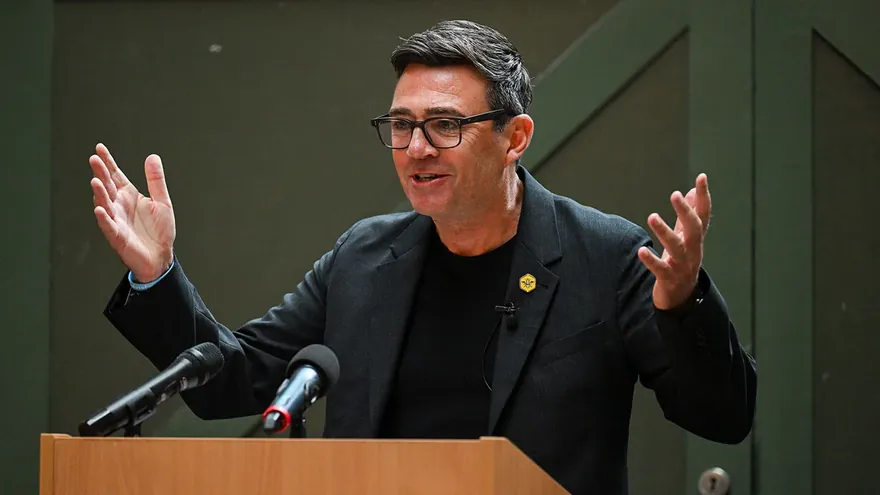
29 JunFirst major policy address as frontrunner, at the People’s History Museum in Manchester.Verified
AheadNominations open 9 July and close 16 July; if unchallenged, he takes office in roughly mid-July.Estimated
What he committed to · his own words
A new government hub in Manchester, “No. 10 North”, relocating part of the prime minister’s office out of London.Verified
The “biggest rebalancing of power” in modern British history, with authority handed to local leaders and mayors.Verified
A 10-year industrial plan under “Manchesterism”, with universities placed at the heart of local economies.Verified
Public procurement steered to British-based suppliers, applied in full to the Defence Investment Plan.Verified

The read. The thesis of this profile is no longer inference. Devolution, an industrial framing for infrastructure, and skills now sit at the centre of his stated programme, the exact levers that decide where a data-centre build lands and who it is for. “No. 10 North” makes the regional-not-national unit official: site selection, power negotiation and land value move with the city-regions.

Sourced from Burnham’s 29 June 2026 address and the reporting of it · graded against the public record · nothing is put in his mouth.

Nine prime ministers, one rising line

For twenty-five years the same office has shaped the UK’s digital infrastructure, from Blair’s broadband promise to Starmer’s data-centre boom. Burnham inherits all of it.

In office now
01 / 09

Read end to end, the line tells one story: the office moved from laying cable to protecting compute to, now, deciding where it lands. It also tells a quieter one. Nine prime ministers since 1997, seven of them since 2016, is the churn that has made hyperscalers and colocation operators wary of UK timelines; Burnham’s refusal to call an early election offers something the sector has rarely had – a three-year certainty window to 2029. What he does with it is the rest of this piece.

The conviction, built in a city

To understand what Burnham will do with Number 10, watch what he did with a city. Scroll the decade he spent turning digital infrastructure into the plumbing of a fairer economy.

01 / 04
2018
Scroll
The read

What a city taught him

Sociogencia · Adam Roberts

A decade in Manchester produced a megawatt number Burnham can point at – and a conviction he now carries into Number 10.

The discipline is the part Westminster rarely manages: a strategy set in 2020 and refreshed, not abandoned; targets named in public and then met; a mayor who turned up in person when the concrete was poured. It is the delivered-versus-announced test the rest of this report runs on every market, applied here on home soil.

The conviction is simpler, and sharper. Burnham’s decade says a data centre is only worth building if you can answer one question about it: who is it for. He treated digital infrastructure as regional justice, not just national competitiveness, and made the equity framing the metric rather than the rhetoric.

What he does not yet control is the harder half: the power, the grid and the price that decide whether a national build is even possible, and the politics that will test him by 2029. The question he spent a decade asking in one city, he now gets to answer at national scale – growth where, and for whom.

The cabinet file

Who actually builds it.

Dossier · UK-2026
Cabinet not yet formed
Names: reporting and inference
On the record Reported Contested
ABAndy Burnham
The apex
Andy Burnham
Prime Minister. Every lever below reports here.
DESNZ
Energy & Net Zero
Whether there is power to build on at all – the binding constraint on every UK campus.
Tipped to move
HMT
The Treasury
Whether the Exchequer signs the offtake and demand guarantees a hyperscaler needs to commit.
Contested
DSIT
Science, Innovation & Technology
CNI status, the AI Growth Zones, and which projects get fast-tracked.
Reported
MHCLG
Housing, Communities & Local Govt
Planning and the green belt – whether a campus clears the local wall.
Tipped to return
Ed Miliband
EXHIBIT · ED MILIBAND
tipped: Energy / Chancellor
Wes Streeting
EXHIBIT · CONTESTED
Miliband or Streeting
Liz Kendall
EXHIBIT · LIZ KENDALL
reported: Technology
Angela Rayner
EXHIBIT · ANGELA RAYNER
set the green-belt precedent
The read

A prime minister sets the direction. Four seats decide whether anything is actually built.

Nominations close 16 July and Burnham is expected in Number 10 by the 17th or 18th, so the cabinet here is not yet formed: the seats are fixed, the names are who the reporting currently places in them. Read the levers, not the faces. Energy decides whether there is power at all; the Treasury decides whether the guarantees that anchor a hyperscaler get signed; Technology holds the CNI and growth-zone fast-track; Housing holds planning and the green belt. Burnham’s own conviction sits above all four – but on the data-centre build, these are the chairs that turn intent into concrete.

What he will actually do

No manifesto yet, but a decade of speeches, a mayoral record and now a first major policy address as frontrunner point one way. Here is the programme they add up to, graded clause by clause, and what it changes for the councils who have to deliver it.

Reconstructed programme · not yet published
What a Burnham government is likely to do
Assembled from speeches, the mayoral record and recent commentary
June 2026 · graded claim by claim against the public record
Andy BurnhamThe Great North · 2026
01Strong public control. Tougher regulation of Big Tech and AI, and a state willing to intervene more widely in the economy. Critical compute is treated as something to govern, not only to attract.Announced
02Power pushed down. Funding, skills and decisions moved to the city-regions, with new ways to pay for growth-maximising infrastructure - business-rates retention and land-value capture pointed at the digital build.Announced
03Industrial strategy, not tech policy. Data centres framed as reindustrialisation - the “Manchesterism” five clusters, with digital, cyber and AI at the core - rather than a national competitiveness metric alone.Announced
04Continuity, with conditions. Keep the Starmer-era scaffolding - Critical National Infrastructure status, the AI Growth Zones - but tie each project to local skills, good work and a measurable social-value return.Estimated
05Digital sovereignty. A push towards open-source, more sovereign state infrastructure, reducing dependence on single US vendors and giving the NHS and local bodies more autonomy over their own data platforms.Contested
06Skills as the binding constraint. Technical education devolved to align local training with AI and data clusters, treated as the gate on the build rather than an afterthought to it.Announced
6 clauses · 4 announced · 1 estimated · 1 contestedMethod: claim by claim against the public record
Entelligencia read
The courtship now carries conditions
The shift is from “how do we attract you” to “what will you give back”. The investment thesis still holds; the diligence question changes.
Regional, not national, is the unit
Site selection, power negotiation and land value all move with the city-regions. The map that matters is no longer London versus Frankfurt; it is Manchester, the North East, and wherever the next growth zone lands.
He has governed before
Burnham sat in Gordon Brown’s cabinet and co-authored the 2009 Digital Britain report. He knows the machinery, which makes the continuity clauses more credible than the rhetoric suggests.
What it means for local authorities
01 / 04
Money

Fiscal tools for the build

Business-rates retention and land-value capture, the levers he leant on for Manchester transport, are the obvious model to extend to digital infrastructure, fibre and regional data-centre ecosystems, inside combined authorities.

Estimated
People

Skills, devolved

Burnham names skills as the blocker to growth and wants technical education devolved to align local training with AI and data clusters. Expect more programmatic funding, and more responsibility, pushed to FE colleges and combined authorities.

Announced
Strategy

A blueprint on every desk

The Greater Manchester Digital Blueprint becomes the template: five priorities, named indicators, clear ownership. A Burnham government is likely to encourage, or require, similar regional digital strategies, backed by central funds and shared data platforms.

Estimated
Sovereignty

Your own stack

Following Manchester’s federated health-data work, councils may gain room to adopt open-source, more sovereign platforms rather than lock into a single national vendor, a pivot civil-society groups are already pressing on a Burnham government.

Contested
Standing order
The override stays, and gets conditions. Verified

Angela Rayner’s 2025 decision to clear a 90MW data centre in Buckinghamshire’s green belt, over a local refusal, set the precedent: national digital-infrastructure grounds can beat a local no. Burnham is expected to keep that central override but tie it more explicitly to local benefit, jobs, training, community funds. Critical National Infrastructure status raises the baseline in parallel, with heightened security and resilience duties on operators and priority access to NCSC support in return. For a council, the question shifts from whether a campus can be stopped to what it must be made to deliver.

The read

More power, more exposure

Adam Roberts
Entelligencia · Adam Roberts

A Burnham government hands local authorities more of the build, and more of the blame if it lands badly.

More fiscal room, more strategy-making, more say over the stack – and, in the same breath, more scrutiny on who actually benefits. The interventionist instinct that makes him keen to push power down is the same instinct that will ask harder questions when the power arrives: good jobs, real training, a community return, not just a ribbon and a press release.

The catch is capability. Many councils are not yet resourced to model grid capacity, structure a hyperscaler deal or evidence social value to the standard this government would set. The scarce thing becomes the advice – the economic modelling, the power planning, the community-benefit frameworks that turn a national override into a local win. That gap, between the mandate and the means to meet it, is the one this report exists to close.

Andy Burnham reaches Number 10 as the first prime minister in a generation to have built digital infrastructure with his own hands, in his own city, and called it justice. The conviction is real and the record is long. What he does not control is the constraint – the power, the grid, the price – or the politics that will test him by 2029. The build continues whoever governs. The question Burnham has spent a decade asking, and now gets to answer at national scale, is the harder one: growth where, and for whom.

In conclusion

The case for a 2030s refresh

My own read goes further than the analysis above. Rising public discontent could force an election sooner than 2029, and what follows may be years of hung parliaments and shaky coalition governments that erode investor confidence in Britain further still.

That has to be set against a harder backdrop: a lessening global presence, and a services-led economy that is increasingly exposed just as the world it trades into fragments.

So this is where I make the case for a 2030s refresh: new faces, new ideas, candidates willing to cross party lines toward responsible, popular policy, and to communicate it far better than the current field. The build needs stability more than it needs any one party. The open question is whether the politics can supply it.
The Next Hotspot · dropping
Entelligencia

One study down. The map is next.

Losing the Room is a Sociogencia field study inside The Next Hotspot, an interactive read on where the world actually builds AI infrastructure. Chapters land through the summer, the full edition on 5 August, and new original analysis is already going live.

Live now · SociogenciaOriginal analysis is dropping already. Read the studies.Read the studies →
Strata · the cross-cutting layers
Seven analytical layers, read across all ten markets
With the full edition · 5 Aug →

Get each drop as it lands
One email per release: original analysis, the market chapters, the full report. No noise.

EntelligenciaThe Next Hotspot