Nigeria brings the scale, Kenya the speed, Morocco the stability. Three markets, one decade, and a single question underneath all of it: does the continent host its own compute, or keep routing around it?
NG · Nigeria~50MWLive IT load · the scale anchor
KE · Kenya~15MWLive IT load · the aggregator
MA · Morocco~5MWLive IT load · the pipeline bet
The analyst read · 4 Aug 2026
Why these three, and why now.
For most of the last decade these were three separate stories. In 2026 they became one: the same selection list, the same continental rail, three different ways of placing the same bet.
Read on the numbers alone, the three look like a sequence. Nigeria carries the largest installed IT load of the three, the deepest fintech demand, and the clearest claim to be West Africa’s scale market. Kenya is smaller in megawatts but richer in use, the East African aggregation hub where mobile money and digital government pull regional workloads into Nairobi. Morocco sits smallest today, yet leads the continent on announced future power capacity, on our reading of the renewable pipeline, a gateway play built on sub-20ms proximity to Europe.
What turned three stories into one chapter is ADAPT (Africa Digital Access and Public Infrastructure for Trade), the AfCFTA-backed programme for shared digital identity, payments and cross-border data exchange, delivered with the Tony Blair Institute, the IOTA Foundation and the World Economic Forum. All three were chosen as its first pilots in 2026. That is the convening event: not a merger of markets, but a shared decision about whether the continent builds the infrastructure to host its own compute, or keeps renting it from Europe and South Africa.
We open in the room where that question is loudest: The Group Chat dramatises Kenya’s regulatory fight in the form it actually takes, messages. The chapter then runs the comparison in two registers. The Success Index sets the markets side by side on the figures that decide who wins, with the controls to weigh them yourself. The Long Game reaches back, because none of this started in 2026 – and closes on the workers the build is meant to lift.
Kenya wants the world’s compute. It is also writing the rules and the bills that decide whether the world shows up. Here is that argument, in the form it actually takes: messages.
i
How to read this. A dramatisation of a real public debate. Messages marked on the record are verbatim public statements with their source named. The connective messages are illustrative, carried by role, and are not attributed to any named individual. The facts beneath sit in the panel below, graded the way we publish them.
Kenya · Digital Infrastructure
The regulatory group chat
KD
Kenya · Digital Infrastructure
42 participants · operators, TESPOK, KEPSA, ADCA
Live
Tap the thread to advance a message · switch chats above to change the room
What is actually at stake · the facts beneath the chat
Verified
The licence that bites
The Communications Authority folded commercial data centres into the Network Facilities Provider regime. The NFP-T2 class carries an initial fee of KES 15 million and an annual operating fee of 0.4% of gross turnover (or KES 800,000, whichever is higher). It behaves like a recurring sector levy, and it is the most direct data-centre-specific burden in the period.
Proposed
The 2026 bill, still moving
The Finance Bill 2026 (published 5 May 2026) proposes VAT on digital and platform financial services, pulls card interchange and merchant fees into the withholding-tax base, adds a virtual asset service provider framework, and would treat at least 60% of undistributed profits as dividends. As of 22 June 2026 it had cleared hearings and committee but was not yet assented. The tax already in force is producing: Significant Economic Presence collections more than doubled to KES 1.609bn in FY2025/26, from KES 807m, after the Finance Act 2025 removed the KES 5m threshold.
Reported
Why Olkaria paused
The Microsoft and G42 geothermal campaign at Olkaria, an initial $1 billion package for an Azure East Africa region, was reported suspended by May 2026. Power scale became the public headline, but the binding issue was commercial: the deal needed a government offtake guarantee to underwrite Azure demand, the anchor commitment a Gulf state makes and Kenya could not. Bloomberg reported talks broke down over those payment guarantees, and the National Treasury withheld clearance. The grid limit was real and politically useful; the demand structure was the deal-breaker.
Sources: Kenya Finance Act 2025 and Finance Bill 2026 (National Treasury, KRA, Kenya Law); Communications Authority market-structure and licensing documents; TESPOK statements (Feb and Apr 2025); KEPSA Finance Bill 2026 memorandum (May 2026); CA stakeholder submissions; ADCA 2026 Economic Report and Code of Conduct statement (Jul 2025); Microsoft and G42 announcements (May 2024) and 2026 reporting on the Olkaria pause; KenGen and EPRA power data. Connective messages are illustrative and carried by role; only items marked on the record are verbatim public statements.
In conversation · the African build, in their words
In conversation · contributedContributed · graded against the record
Contributed · the operator’s seat
Stephane Duproz
President · SDC Consulting
Not ten years behind. A different trajectory.
Stephane Duproz built and operated data centres in Europe before doing so in Africa, which is the comparison this chapter keeps reaching for. His answer is that the comparison itself is wrong. Europe moved through enterprise IT, then cloud, then AI in distinct waves; Africa is compressing them into a single decade. Nine files on what that changes for design, capital, connectivity and talent, and on why he thinks the continent is developing its own model rather than a smaller version of anyone else’s.
85/100
toward Africa as a first-mover market
Following EuropeFirst mover
Contributed by Stephane Duproz, President, SDC Consulting, 12 August 2026, named with firm and title at the contributor’s request · passages inside quotation marks are reproduced from his written submission; his other positions are reported in the desk’s house style · supporting evidence and grading are Entelligencia’s and were gathered independently
The operator’s seat
Heading
The map
Three gateways, three power stories.
Morocco, Nigeria and Kenya are the continent’s gateway and edge markets – far apart on the map, bound by the same question of power. Casablanca is the Europe-facing cloud gateway; Lagos is the cable-rich West African hub running on diesel; Nairobi is the carrier-neutral East African base where a one-gigawatt geothermal megaproject was suspended by the president in May 2026 because it would have needed a third of the national grid. Each glowing node is a real site, colour-coded by what it is: verified, announced, or contested. The three countries are highlighted on a real continental outline, and every site sits on its true coordinates.
Africa gateway map · live
ENT-KMN-MAP-2026.06 · 6 sites plotted
Market
Overlays
Subsea cables
Power model
Verified · live or in build
Announced
Contested · early-stage
Verified · live or in build
Select a site
Tap any site to open its file
Markets in view
3 markets
Posture
Gateway + edge
The shared question
Power: grid vs diesel vs steam
One campus, five numbers.
On 7 September Digital Realty opened NBO2 at its Karen campus in Nairobi and retired the iColo brand in Kenya and Mozambique. The announcement travelled with five different figures attached to the same site, and they measure five different things. Only one of them is live IT load. This is the clearest example in the chapter of why a megawatt needs a basis before it means anything.
Nairobi · Karen campus · announced 7 September 2026
Bars scaled against the 23 MW campus design · the first row is an area and is drawn as an outline
The word doing the most work is “acquisition”.
The announcement was read as a purchase. It is a rebrand of a business Digital Realty has controlled for six years. No public source discloses a 2026 price, a change from the roughly 70 per cent held since 2019, or a buyout of the minorities. Until the company says otherwise, this is integration, not acquisition.
Mar 2016
Interxion makes its initial investment in iColo, founded in Kenya the year before.
Dec 2019
Interxion agrees a controlling interest, about 70 per cent, with PRIF and management holding the rest.
Mar 2020
Digital Realty takes control of Interxion, and with it iColo, in a deal valued near $7.0bn.
Feb 2023
MPM1 opens in Maputo, the platform’s first facility outside Kenya.
Sep 2026
NBO2 opens and the iColo brand is retired in Kenya and Mozambique.
The playbook works. The evidence for it is in Johannesburg.
iColo publishes no standalone revenue, occupancy, bookings or price per kW, so the Nairobi opening cannot yet be judged financially. Teraco can, because Digital Realty discloses it to investors. Four years from the 2022 acquisition reference point to 31 March 2026:
$174m → $352m
Revenue, roughly 19% compound annual growth
75 → 126 MW
In-place IT capacity, about 14% a year
22k → 29k
Cross-connects, about 7% a year
19 → 41 MW
Under construction, about 21% a year
Revenue grew nearly three times faster than cross-connects. That gap says the growth is power and hyperscale mix, not only interconnection, which is the part of the model that travels to Nairobi least automatically.
What a 6.4 MW opening looks like, and what it does not show.
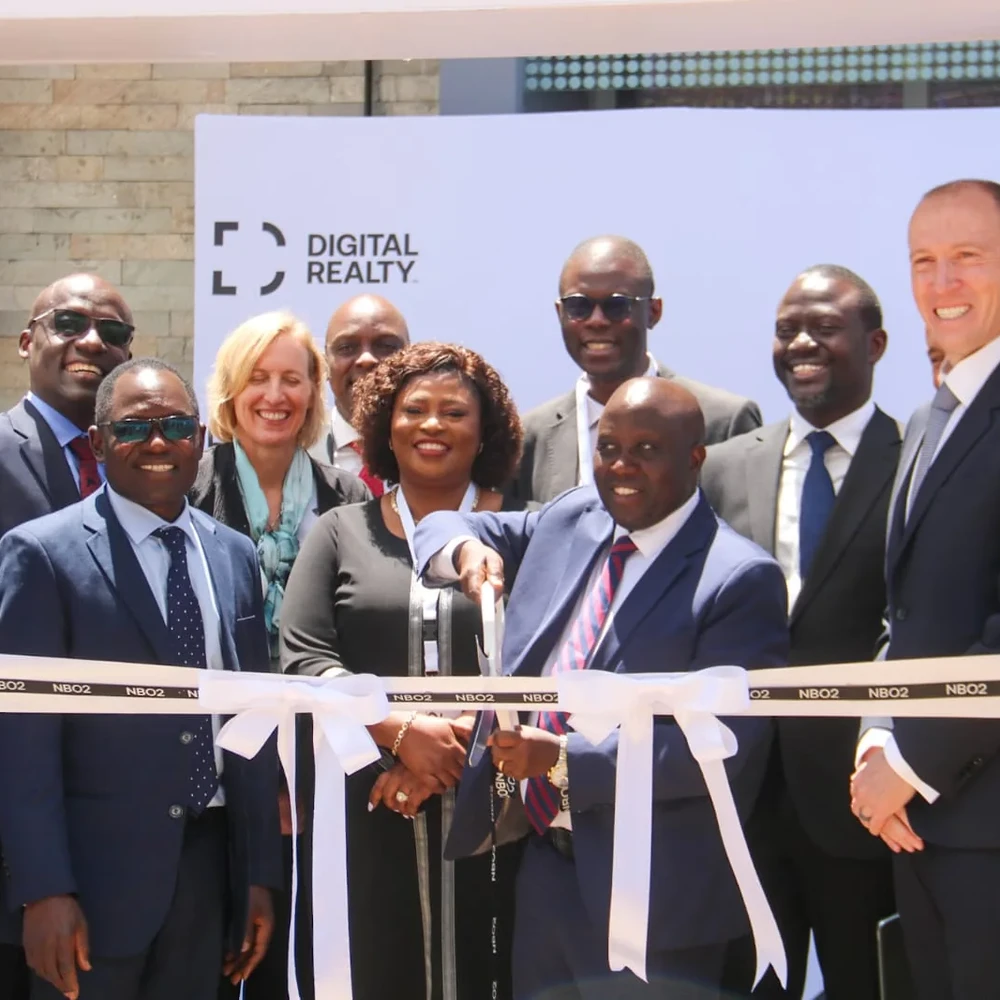
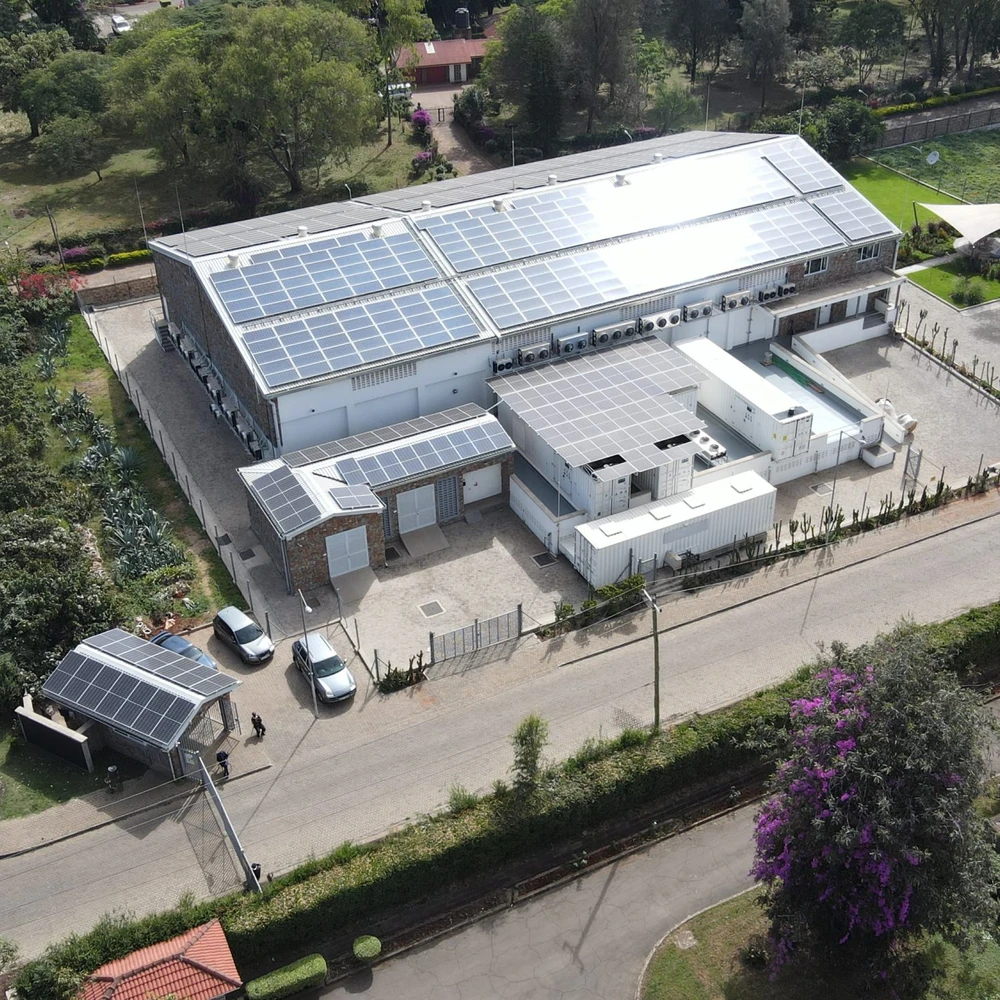
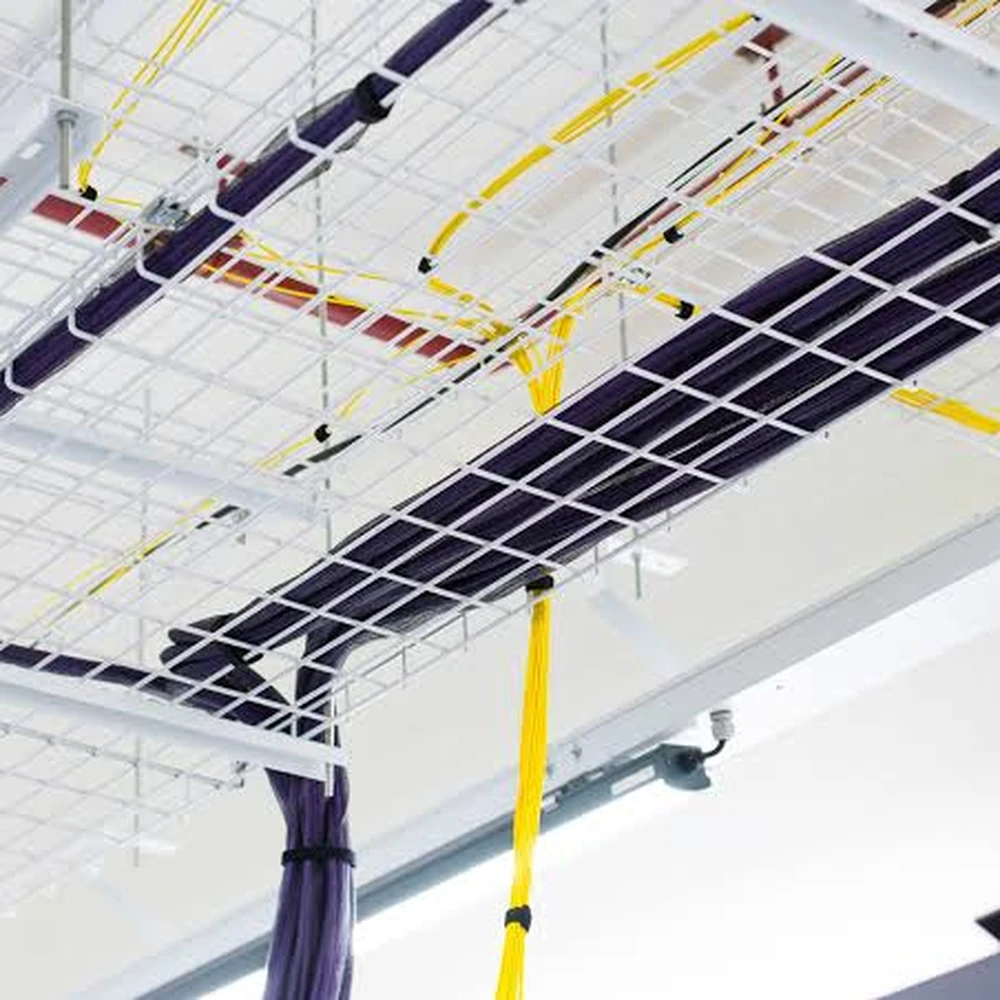
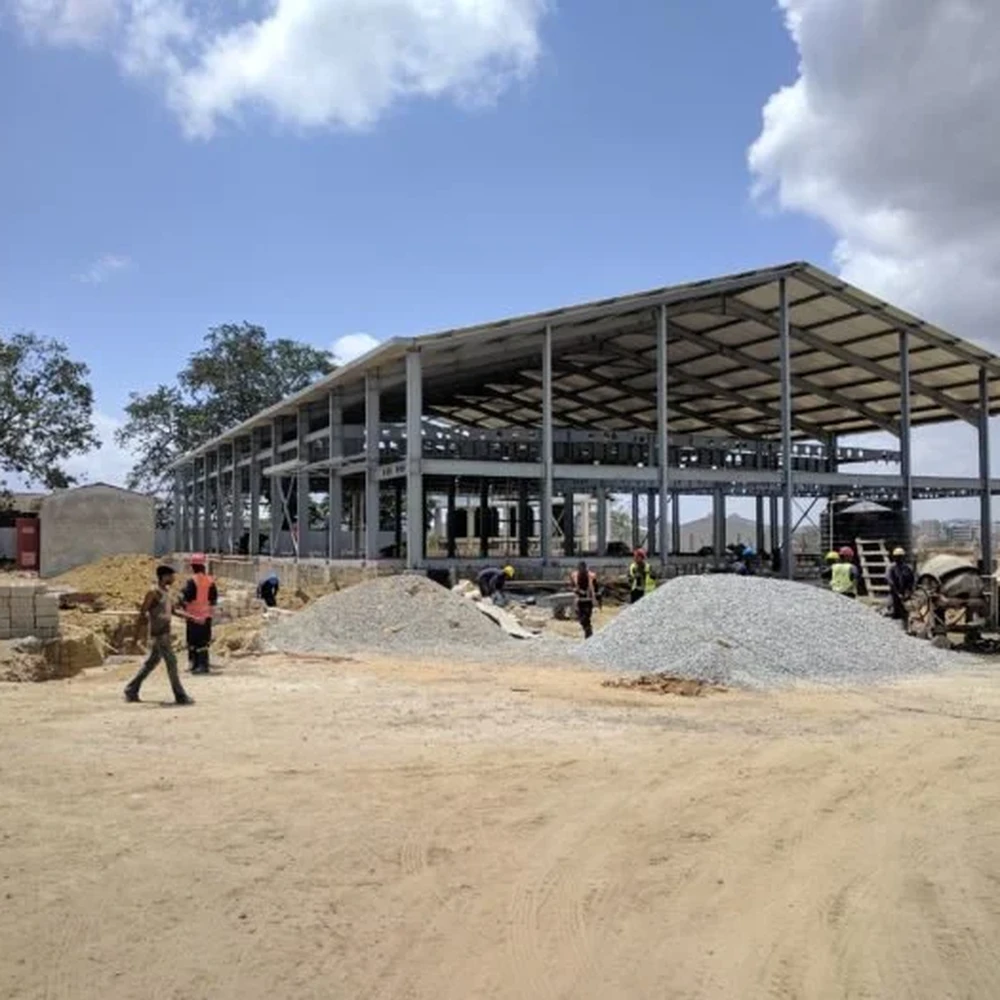
Four plates against the five numbers above. A ribbon and a room are evidence that a building exists. Neither is evidence of leased load, and the distinction is the whole section.
The opening, 7 SeptemberThe ribbon at Karen, under a Digital Realty backdrop rather than an iColo one. Dated, attributable, and the clearest evidence that the building is open.
Verified · event
Where it started, and what it runs onNBO1 from the air. The 2024 rooftop array is 450 kW against a building originally configured at 825 kW of UPS, and the plant yard behind it is the rest of the answer.
Verified · site and array
The asset is overheadContainment and fibre, not floor. More than 100 networks and two exchanges are what the campus actually sells. Note what this is not: it is no evidence at all on the disputed square metres.
Illustrative · interconnection
Mombasa, mid-buildNot Karen. The east-coast half of the platform going up, where seven subsea cables land. Five facilities across two countries now, from two in 2019.
Verified · Mombasa, under construction
Wouter van Hulten
Digital infrastructure leader and a key figure in Africa’s data centre market. Involved with iColo from 2015 and later founded PAIX Data Centres. No longer involved with either company.
Interest declaredInvolved with iColo from 2015, as Kenya’s first carrier-neutral facilities took shape. The investment decision was not his. Later founded PAIX Data Centres and began developing its Nairobi operation in 2019. He holds no current position at either company. Answers are his own, unedited except for length. The framing under each is ours and is his to disagree with.
What the first Kenyan build was actually underwritten on.
Five questions to a key figure in Africa’s data centre market, who was there from the beginning of the carrier-neutral build in Kenya. He holds no position at either company today, which is why he can describe plainly how the case was assembled. It was not assembled on the number in the announcement.
“In 2015, the investment case was based primarily on fitted capacity in phased builds, combined with an assumed utilisation ramp and early customer interest, not on underwriting the full campus potential from day one.
The Series A plan envisaged a Kenya pilot of roughly 400 racks across four phases and two sites, Mombasa and Nairobi. For Mombasa, the civil infrastructure was designed for 150 racks, but Phase 1 was only primed for 75, with the additional investment in Phase 2 largely relating to power upgrades. The financing model similarly assumed a gradual sell-through rather than immediate full occupancy.
The broader upside came from the expectation that Kenya’s colocation market would grow from around 450 racks to 1,200 to 1,500 racks over five years, with iColo targeting roughly one third of that market.”
“We underwrote phased fitted capacity and market absorption, supported by early anchor-customer interest. We did not underwrite the full campus potential.”
The desk
This is the answer to the ladder above, from someone who watched the case being assembled. The money was underwritten against the smallest number on the board, phase-one fitted racks, and an absorption curve. Eleven years later the announcement travels on the largest. Nothing has changed about which number is real; only which one gets published.
“What transferred was the basic principle: when multiple international networks converge in one location, there is value in creating a genuinely carrier-neutral facility where those networks, content providers, enterprises and other operators can interconnect.
Marseille had demonstrated that a cable-landing city could become much more than a place where submarine cables terminate and traffic simply transits. At the time, we thought of it as analogous to a container port: ships arrive and depart, while factories nearby process the goods. Data arrives, is exchanged, processed, cached or hosted locally, and then distributed onwards.
What did not transfer one for one was the market depth. Marseille already sat inside a large European connectivity and enterprise market. Mombasa had significant subsea connectivity, but the local demand base was much smaller and much of Kenya’s commercial and technology demand was concentrated in Nairobi. You could not simply copy a European data-centre business plan and expect the same utilisation curve.
There were also practical challenges: incomplete land-registration information, an evolving regulatory framework, and the need to establish reliable infrastructure data. Interestingly, Mombasa already had a fully digitised overview of its power infrastructure.”
The desk
The container-port framing is the most useful thing anyone has said to us about cable-landing markets, and it explains the split this chapter keeps running into. The port is not the economy. Note the last line: the constraint was not power data, it was land registry.
“Because submarine cable capacity and end-user demand are two different things. Mombasa was the international gateway, but Nairobi was where most of Kenya’s corporate headquarters, banks, technology companies, government institutions and the larger concentration of users were located. The fibre carried capacity inland to where the economic activity was.
That does not diminish Mombasa. It is strategically important precisely because the cables land there, and a carrier-neutral facility close to those landing points improves resilience, interconnection and the economics of moving traffic onwards.
Nairobi also had a climatic advantage: at around 1,800 metres above sea level it is significantly cooler than tropical Mombasa, which can reduce the cooling burden.”
“Cable landings create an opportunity. They do not automatically create a data-centre market.”
The desk
We had inferred the Mombasa-to-Nairobi shift from fibre economics and caching. He adds a variable we had not priced: altitude. Nairobi at 1,800 metres is a cooling subsidy that no capacity table records, and it is worth more in an AI-density market than it was in 2015.
“One, anchor customer or credible demand. Two, power and grid connection. Three, suitable land and fibre connectivity. Four, capital.
The anchor customer comes first because without credible contracted demand it is increasingly difficult to raise either equity or debt for a greenfield project. Power is then a fundamental constraint: you need sufficient capacity, reliability and a credible timetable for connection. A data-centre site without dependable power is simply not a viable site.
Land matters, but it is not only about acquiring a plot. It needs the right power access, fibre routes, security, planning environment and expansion potential.”
“There is plenty of capital interested in African digital infrastructure. There are far fewer genuinely investable projects.”
The desk
Capital last is the finding. Every forecast in this chapter is denominated in dollars required, McKinsey’s $10bn to $20bn among them, and he is saying the money is not the binding constraint. That reorders what a shortage in this market actually looks like.
“The test should be whether the market has the same combination Kenya had around 2015: improving international connectivity; rapidly growing domestic internet demand; limited existing carrier-neutral capacity; a sufficiently large commercial centre; improving fibre; credible power availability; regulators willing to enable competition; and enough early customers to support the first facilities.
Several markets have some of those characteristics today, but I would hesitate to call any one of them the next Kenya. If I had to nominate one to watch, Morocco is interesting, although it is not a perfect comparison. It combines strong international connectivity, a sizeable commercial economy, proximity to Europe and an evolving digital infrastructure market.
The relevant question is less which country is the next Kenya, and more where connectivity, power, demand, regulation and execution start to come together.”
“Infrastructure can be built relatively quickly. Ecosystems cannot. A submarine cable can be landed in a few years and a data centre built in twelve to eighteen months, but building the customers, networks, capital, skills and trust around them can take a decade.”
The desk
He declines the question as posed, which is the right answer, and then names Morocco anyway. Note that this chapter already carries Morocco: he is not describing a market we would have to go and find. The closing line is the one to keep. It is also the strongest available argument against reading any opening, including NBO2, as an arrival.
Verified where a figure is company-disclosed and dated: NBO2’s 6.4 MW opening capacity, NBO1’s technical configuration, the Teraco investor series and the ownership chronology. Contested on the space figures, because Digital Realty’s metro page markets 2,500 m² of colocation across both buildings while iColo’s own January 2026 construction note described 3,600 m² of white space in NBO2 alone, and the two have not been reconciled publicly. The 23 MW campus figure is third-party interconnection data, not a company disclosure. Nairobi’s competitive set is moving on the same axis: iXAfrica’s NBOX1 is 4.5 MW live at 30 kW a rack inside a 22.5 MW campus, with 18 MW and a separate 53 MW site announced; Africa Data Centres holds 3.6 MW built against 37.5 MW of utility headroom. Contributed seat: Wouter van Hulten, answering five questions in writing on 9 September 2026. Graded Contributed; his interest is declared on the card. Plates: opening photography via East Leigh Voice; NBO1 aerial and Mombasa construction via iColo; containment illustrative. Third-party images, reproduced as record. ENT-AF-KAREN · compiled 7 September 2026
Consultant readAn advisor’s read, contributed to The Next Hotspot
The ConsultantENT-CONSULT / KMN · DIF
The advisor’s read on Africa’s bankability.
Africa does not lack announced projects. It lacks financeable ones. This contributed brief reads the gap between the two: why the anchor tenant, not power, is what stalls a deal, where the missing capital actually sits, and how to sequence an entry. Open any file for the read, each closing with what it means for capital, and open the interactive to score a project yourself.
Ville Wacklin
Digital infrastructure investment advisor · formerly Digital Investment Facility
South Africa holds roughly 70 per cent of Africa’s live capacity. Then the drop. Capital has landed where demand was already contracted, not where the pipeline is largest.
Contributed analysis, produced from Ville Wacklin’s contribution to The Next Hotspot; his framework drives the interactive. Data · Xalam Analytics for the Digital Investment Facility, 2026 edition. It is not investment advice. Contributed via the Entelligencia briefing survey; lightly edited for length and house style.
The Consultant
Heading
For capital
Interactive · the readiness signals
Press release, or financed?
Toggle the five signals a development-stage lender actually looks for, or load a market. Where demand is contracted, capital arrives.
0of five signals
Press release
A project without contracted demand stays an announcement. Toggle the signals, or load a market.
InterviewThe same engineer, on the three markets in this chapter
The continental seatENT-ENG / KENYA, MOROCCO, NIGERIA · CONNECTION, PORTS AND PEOPLE
The Gulf has the money. Africa has the demand.
Heath Andersen’s interview runs across this chapter as well as
South Africa’s, because a good deal of what he said is not South African.
Grid connection does not generalise: Nigeria gets direct connections while operators
elsewhere face nuisance rates. The long-lead problem is customs rather than
distance. The capability gap is in operations, and the people trained here are hired away.
And his pick for the most underrated market on the continent is Morocco, on one line we have
asked him to expand. Five files. His South African material, on load shedding, water and air
cooling, sits in that chapter.
Heath Andersen
Mechanical engineer and data centre project director · DCDesign.Africa
Grid connectionPorts and customsOperations
Contributed analysis, produced from a live interview with Heath
Andersen, twelve questions, the same conversation that produces his seat in the South Africa
chapter. Nothing on this page is a verbatim quotation. The text is the desk’s
account, written up from notes rather than transcribed, and his phrasings appear as reported
speech for that reason. All five findings are graded Contributed. The Morocco answer
is printed at the length it was given; a follow-up has been requested and is not yet in.
The continental seat
Heading
The desk’s note
The comparison
FILE AF-03 · COMPARATIVE INDEX
The Success Index: what actually decides the race.
One booming industry, three contenders. This is the full comparative file behind the chapter: the data-centre base, the economy, power, people, resources, institutions and the operators on the ground – now tracked over a decade where the data allows. Switch the chapter, choose who to compare, and read the trend, the figures and the long view side by side.
VOL · AF Markets · 3 Chapters · 07 Span · 2010–26
At a glance · the directory
One shape per market.
Each spoke is one of the seven dimensions, scored 0 to 10 for like-for-like comparison – indicative editorial weighting, not a published index. The bars rank the composite. Click any spoke, or a tile below, to open that factor. Toggle a market to add or remove its shape.
Compare
In depth
The numbers, side by side
READ
Figures compiled from World Bank, IMF, AfricaDCA, Wesgro and McKinsey sources, 2010–2026. Verified = reported or measured. Estimated = directional projection. Indicative = editorial 0–10 scoring for like-for-like comparison, not a published index. Trend lines are drawn through the reported years; intervening points are interpolated for shape only.
Data note. The new multi-year series for GDP, GDP per capita, population, electricity access, inflation and debt are now wired into the trend charts. The remaining gaps worth filling: a clean annual data-centre MW history before 2021, capacity by named operator, and generation-mix percentages for power. Send those and we will turn the last snapshot panels into full time series too.
Predictive modelling
Six scenarios to 2030.
Not a single forecast but a scenario model: the race turns on a handful of big uncertainties – power reliability, hyperscaler timing, FX and sovereign risk, connectivity, regulation and conflict. Pick a scenario and each plays out differently in each market through its own country overlay. Illustrative and modelled, not a forecast.
Usable IT MW to 2030
delivered × power-reliability, by market
Estimated
NigeriaKenyaMoroccodashed = base case
How the model works. A three-layer engine – country attractiveness (macro, institutions, power, people, connectivity, regulation), operator execution (pipeline, capital, neutrality, cloud on-ramps, delivery record) and demand conversion (how much national digital growth becomes local colocation) – so GDP growth is not assumed to become data-centre demand automatically. Each scenario shocks demand, supply, economics, regulation and conflict, with a separate overlay per country. All figures are editorial and illustrative, directional rather than precise.
The boardroom
The people who will settle it.
A market is not won on a spreadsheet. It is won by the operators, financiers and platform-builders who decide where the next megawatt and the next rack actually land. We are convening the people closest to that decision. Each seat below opens to their file – and, once we have spoken with them, to their answers on the questions that decide this race.
FILE AF-03 · BOARDROOM Seats · 09 Status · CONVENING
[ LIVE ] dossier on record[ INVITED ] profile expands once we speak
The question on the table
Three heirs, one crown. Where does the capital, the power and the talent concentrate first?
Nigeria has the scale. Kenya has the grid and the hub. Morocco has the balance sheet and the bridge to Europe, now proven: Oracle’s Casablanca cloud region went live in 2026, hosted by N+ONE, on roughly 14 ms to Madrid against South Africa’s 110 ms. We are asking the people building across all three which advantage compounds, and which one fades.
Illustrative convening · the nine figures and portraits are representative and do not depict the named individuals; affiliations are invited and unconfirmed. Tap a node to open the file.
Why this table
Read together, the nine seats trace the whole chain that decides a data-centre market: the operators placing long-lived capital and breaking ground (Skjødt at Raxio, Coker at OADC, Duproz, formerly of Africa Data Centres, van Hulten on platform capital), the connectivity carrier choosing which coast the cables land on (Wood at WIOCC), the hyperscaler whose demand anchors a region (Masu at Meta), the industry body that sets standards and convenes policy (Mittal at AfiDA), the Europe-facing gateway that defines the Moroccan thesis (Kandil at N+ONE, now host to Oracle’s live Casablanca cloud region) and the critical-infrastructure partner that keeps power and cooling standing up. Between them they cover the capital, supply, connectivity, demand and regulation that the model upstream turns into megawatts. When their answers are on record, this section becomes the human counterweight to the Index above.
Seventy years, three trajectories. Why does Nigeria default to scale, Kenya to the hub, Morocco to the bridge? Each instinct was set decades ago – by an independence, an oil boom, a payment, a cable, a port, a policy. Three tracks run from independence to today; each node carries a datapoint and its consequence. Tap any node to open the record.
NigeriaKenyaMorocco
Tap any node to open the historical record. Each record carries representative imagery, marked asset to source.
Why they diverged
Six drivers, four decades.
The same six forces decide a data-centre market. Scrub the decades to see why Kenya owned the clean-hub moment, why Morocco’s stability compounded into the bridge, and why Nigeria’s scale keeps waiting on power. Indicative editorial scoring, 0–10.
How the path resolves
The same three instincts now decide where the racks go.
The histories are not background colour; they are the operating logic each market still runs on. Read down each column for the national equation that produced today’s instinct, and how the path resolves for the data-centre race.
Best East African aggregation: a hub that pools neighbours’ demand.
A green, geothermal-led grid suits ESG- and AI-sensitive workloads.
Smaller home market; the edge is first-and-clean, not size.
Morocco
State stability → logistics → Europe corridor → digital policy → gateway cloud
Strongest Europe-facing optionality: roughly 14 ms to Madrid and 21 ms to Marseille, against about 110 ms from South Africa.
Oracle’s Casablanca cloud region is live, hosted by N+ONE, with a second in the Casablanca area and a third planned at Settat; demand is sovereignty- and enterprise-led.
Modest domestic demand and coal-heavy generation; the play is the near-shore bridge, with a near-1 GW pipeline still to prove out.
The dividend
The race is also a chance to lift the people who build it.
Whoever wins, the construction sets off something larger: a wave of skills, jobs and local capability that outlasts any single campus. The most interesting story in the three markets is not only where the racks land – it is who gets trained, hired and promoted to run them.
Skills, not just shells
Operators and equipment partners increasingly run local academies and technician programmes – electrical, mechanical and network skills that transfer well beyond the data hall. Specific programme names and intake numbers are attributed per operator where confirmed.
Local hiring and supply
Each build pulls in local contractors, engineers and operations staff, and a longer tail of facilities, security and logistics roles once live. The split of local versus expatriate roles is a number worth pinning down per project.
The jobs above the floor
The infrastructure is a platform. Reliable, affordable compute is what lets local developers, fintech firms and AI start-ups build and hire – the East African and West African digital economies already employ at real scale.
It would be easy to tell this chapter purely as a contest between balance sheets. But the more durable outcome is human. A data-centre campus is one of the few pieces of heavy infrastructure that trains a workforce able to operate any advanced facility – power, cooling, networks, security and the discipline of uptime – and that capability stays in the country long after the ribbon is cut.
Kenya’s services economy, Nigeria’s fintech boom and Morocco’s industrial near-shoring all point the same way: the countries that pair the buildout with serious training and local hiring will not just host the racks, they will own the talent that the next decade of African technology runs on. That, more than any single megawatt figure, is the prize worth measuring.
01The academies under the floor
Operators are building academies, not just buildings.
A first wave of named training programmes is forming around the three markets – certifications, internships and source-train-place pipelines aimed squarely at the data-centre skills shortage. Select a programme to open its file.
02From campus to career ladder
A campus is small to run, but large to build.
A live data hall sustains only a few dozen permanent roles, yet each build wave drives hundreds of construction, engineering, facilities and ecosystem jobs – and a career ladder that climbs well beyond the floor. Illustrative figures, adapted from sector jobs research; graded Estimated.
Jobs created per 10 MW campus Illustrative
The career ladder it opens
250,000IT professionals Africa needs by 2030 to support AI and data-centre growth, with skills already cited as a binding constraint.
40%of tasks in Africa’s tech-outsourcing sector could change by 2030 – a shift that can lift workers into higher-value roles if skills keep pace.
30–50permanent roles per live campus – small on its own, but the multiplier sits in construction, ecosystem and the digital economy above it.
03Talent ownership scorecard
The race is for skills as much as megawatts.
A simple 0–10 read on who is building the workforce, not just the shells: the scale of data-centre-specific academies, the strength of the wider digital-skills ecosystem, and the early evidence of local versus expatriate hiring. Select a market to open its file. Indicative editorial scoring; the hiring axis stays qualitative until per-operator numbers are sourced.
Editor’s note. The themes above are well documented across the sector; the specific programmes, headcounts and local-content figures are attributed per operator and partner, and graded where confirmed. Named programmes (IBTC Data Centre Academy, the Africa Data Centre Talent Project, Skills for Africa, iXAfrica × Moringa) are drawn from public announcements; cohort sizes and outcomes are as stated by their backers and to be confirmed. We will not attach numbers we cannot stand behind. See also our cross-cutting Strata layer, The Talent Crunch, which sets this African picture against the UK, Asia-Pacific, EMEA and the Gulf.
The Next Hotspot
Ten markets. One question.
Where the build actually happens, and what is in the way.