Ask most investment committees what decides an AI data-centre deal and they will say power. She sits across many of Europe’s largest digital-infrastructure transactions, and thinks that answer is now only half right. The missing half is quietly failing projects that looked bankable in the model.

Boards still put delivery risk behind power, because it is harder to price, harder to hedge and harder to allocate. In the UK that instinct has become a liability.
Asked to place delivery risk on a scale running from behind power to on a par with it, Barnes puts it at 89 out of 100. Her formulation is the cleanest statement of the distinction in this report: power tells you whether the revenue case is attractive, and the delivery-risk stack tells you whether that revenue case is reachable within the proposed timelines.
The mistake she sees most often is structural rather than analytical. Investment committees approve capital assuming risk matures in a straight line: consent, then grid, then contract, then build. The UK system is not a line. It is a circle, and once you draw it that way the true constraint shows up much earlier, and it is rarely the one on the front page.
She answered twelve questions for this report. Six resolve into something the desk can put a number against and are set out below as instruments, each paired with evidence sourced independently by Entelligencia. The rest are judgement, and they are printed as they arrived. This is contributed analysis, not legal advice.
Her central argument, run as a reel. Follow one pan-European campus through the sequence a diligence pack assumes, then watch the sequence close on itself. Every frame is a step a committee signs off separately, and the closing is the reason so many of them fail together. Scroll to run it.
Qualified in 1995 at Burges Salmon in Bristol, after an LLB in English and European Law at the University of the West of England. Nearly seven years there, then acquisition finance and corporate banking at CMS Cameron McKenna from 2002.
The formation matters for what follows. She did not come up through construction. She came up through lending.
Partner at Gowling WLG from May 2006, in banking and finance, for thirteen years and seven months of mid-market transactions in the London market.
A mid-market practice is a particular education. You meet the same failure modes repeatedly, at a scale where one wrong assumption is visible in the recovery.
To Simmons & Simmons in November 2019 as partner and head of Transactional Banking, and now Global Co-Head of the firm’s Data Centre and Digital Infrastructure practice, acting for financial institutions, corporate borrowers and private equity sponsors on international and syndicated transactions.
Which is why her reading of delivery risk is worth having. It is not a site view. It is the view of the person who writes down what the lender is exposed to, and has to be right about it.
That is the order a diligence pack is written in, the order a committee reads it in, and the order the financing model assumes risk matures in. Four boxes, ticked in sequence.
It is also, in her account of the UK, wrong.
Where the network has headroom is where a scheme can argue national need. The connection strategy is therefore not a downstream engineering matter. It has already decided how the planning case reads before anybody drafts it.
Contributed · Simmons & SimmonsA consent that lands late pushes the order for transformers and switchgear into a queue that is already long, and a long queue is a price. The cost line in the model was set by a date on a planning decision nobody costed.
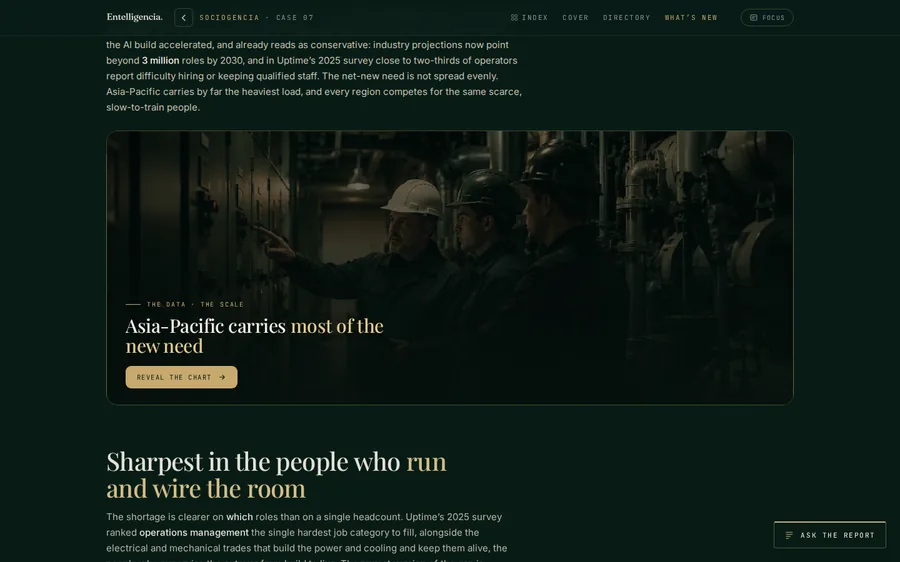
The data-centre build is colliding with the energy-transition build-out, and both are chasing the same people: electricians, high-voltage engineers, protection and control engineers, commissioning engineers, M&E supervisors.
All of them are forecasting critical shortages out to 2030. The documents have not caught up. They flag talent at the risk level, and almost never make workforce capacity a measurable project input the way they do for power, grid access or water.
A late programme does not stay a construction problem. It moves the ready-for-service date, which moves the customer contract, which moves the revenue, which moves the financing case that authorised the whole thing.
Read as one stack rather than five boxes, the true constraint shows up earlier, and it is rarely the one on the front page.
If the stack is circular, a connection offer is not a power pathway. European connection timelines can run seven to fifteen years against buildings that go up in eighteen months to three years, and no credit regime calibrated to programme slippage prices a multi-year absence of grid capacity.
On her own weighting of the stack, workforce sits second: ahead of construction, planning, contract and offtake, and behind only power itself. It is the line in the table she is keenest to defend, and the one boards are least equipped to diligence.
Each tile carries one of her positions as the heading. Open it for the answer in her own words, then the evidence the desk has put beside it. The evidence is ours, not hers. She was not shown it before she answered.
No chart improves these. They are printed as a question and an answer, in the order they were asked, with quoted passages reproduced from the written submission.
89 out of 100. Note that she does not say power has been displaced. She says a second question of nearly equal weight has appeared beside it, and that most processes still only ask the first one.
Test the signed connection status and queue position, whether reinforcement and commissioning sit on the critical path, and whether the power ramp matches customer ready-for-service, drawstop and liquidated-damages dates.
Test planning status and challenge risk, whether water, cooling, backup, emissions, heat reuse and fibre are covered by existing consents, and whether the construction programme aligns to power works and commissioning.
Test contractor covenant and bonding, who owns interface risk, labour availability for the specialist trades, long-lead procurement for transformers and switchgear, and whether the customer contract exposes the operator to service credits before it controls commissioning.
Three questions, and the common error is answering them separately. For AI campuses they are one delivery stack, which is the argument the Arc above runs in full.
Not a connection offer. A stack of aligned agreements reconciling power, planning, programme and contracts, with clear milestones: megawatts by phase, specific energisation dates, and a hard distinction between the connection-offer date, the energisation date and the usable IT load after commissioning.
In the UK, she notes, the regulator is now doing some of that filtering itself, tightening queue entry and retention to clear out speculative projects. A credible pathway therefore also has to include the ability to stay in the queue and be prioritised, which is a governance question as much as an engineering one.
Treating AI as infrastructure, in her view, means accepting that the biggest risks cannot be transferred at all. They cannot simply be pushed down to contractors. They have to be sequenced, shared and managed, aligned to what each party can actually control, especially around grid, timing and capacity.
Make labour a diligence item rather than a construction detail, in other words, and treat the local labour pool as explicitly in the term sheet as power and water. The scale of the shortage is set out in The Talent Crunch.
It is the sentence the whole edition is built around, and it is why the Arc is drawn as a circle rather than a queue.
Sociogencia · Case 06
The Talent Crunch
The shortage she weights second in the delivery stack, measured across seven markets.
Read the case →
Market chapter
Europe
Her six briefs in full, read against the European power ceiling.
Read the chapter →
The A Roll · Edition 02
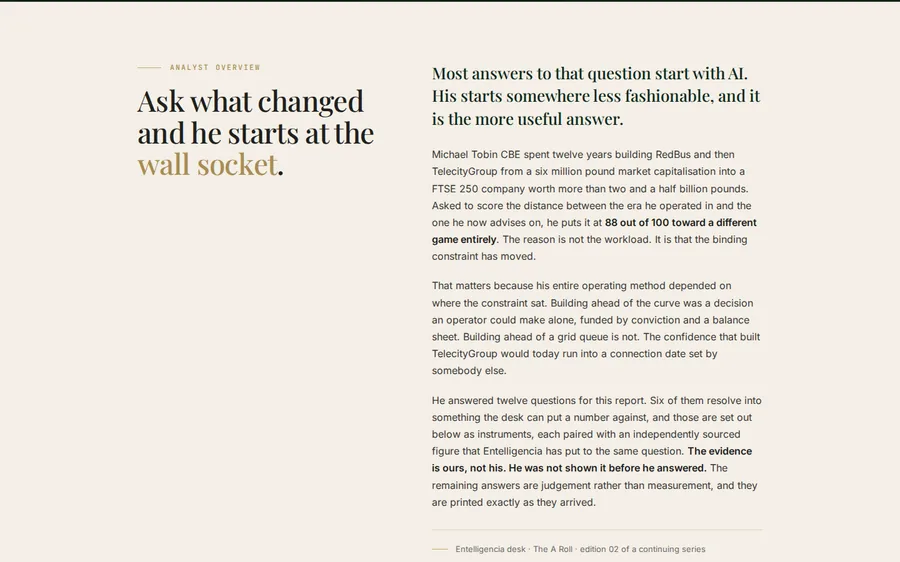
Michael Tobin CBE
The next edition. He says power is the constraint; she says power is only half of it.
Read the edition →
In conversation with Kirsty Barnes, Global Co-head of Data Centres and Digital Infrastructure at Simmons & Simmons. Contributed to The Next Hotspot via the Entelligencia briefing survey and attributed by name, with firm and title, at the contributor’s request.
Her positions are her own. The surrounding framing, the paired evidence, the grading and the editorial selection are Entelligencia’s. This is contributed analysis, not legal advice.
The Arc is her argument rendered as a sequence, not a biography. Its content is drawn entirely from the submission; the circle is a diagram of the coupling she describes, not a published model. Imagery is atmospheric rather than documentary.
Portrait and firm wordmark are used with permission.
Where the build actually happens, and what is in the way.