Europe’s AI build, and the power it cannot find.

Capital is abundant and demand is contracted years ahead, yet grid-connection queues now run seven to ten years against a roughly two-year build. Power, not capital, is the binding constraint.

FLAP-D · Q4 2025 6.3% Colo vacancy, a record low
Grid queue · core hubs 7-10yrs To connect, vs a 2-year build
Demand · 2030 150TWh DC power use, approx 35 GW (modelled)
Investment · to 2030 250USD bn+ Capex the build implies (modelled)
Analyst overview

The incumbent that has run out of room on the grid.

Europe is not a next hotspot; it is an incumbent that has hit a wall. The four core markets – Frankfurt, London, Amsterdam, Paris, plus Dublin – doubled to about 3.6 GW of live capacity since 2019, vacancy has fallen to a record-low 6.3%, and roughly 83% of the pipeline is pre-let before it is built. The scarce input is no longer money. It is megawatts.

The grid is the gate. Connection queues in the core hubs now run seven to ten years, against a build that takes around two; Italy drew 30 GW of connection requests by end-2024, and in March 2026 Denmark’s system operator paused new connections amid roughly 60 GW of requests it calls a “fantasy queue.” Where power is scarce, price follows: CBRE expects core-market pricing up about 12% in 2026, and a powered-land plot in a primary market trades at up to 1.7 times a secondary one.

Ireland is the bellwether. Data centres reached 22% of national electricity in 2024, around half of it in Greater Dublin, and in December 2025 the regulator ended the Dublin moratorium – but only for sites that bring their own dispatchable generation and back it with additional Irish renewables. That is the European template forming in real time: you may build, if you can power yourself and prove it does not crowd out everyone else.

Over the build sits a thickening rulebook – EU energy-efficiency reporting, Germany’s EnEfG, water fights in Spain, a sovereignty push against roughly 70% US cloud share – and a wave of capital and technology answering it. Five instruments read Europe: The Regulatory File, the rules that decide the decade, compiled with our legal partner; The Document, a primary source annotated line by line; The Brief, the liquid-cooling hardware now gating density, mapped to its supply chain with our technical partner; Finance, the global deal tracker and Europe’s operators; and The Map, where the megawatts actually sit. Every modelled figure is tagged, and every projection is framed as such.

Entelligencia desk · Europe · chapter 10 of 10
The file

The rules that decide the decade.

Regulatory dossier · EU-10
Compiled May 2026
Standard: verify before publish
Verified Announced Contested Click any card to open the evidence
The central question
Can you power it, and will they let you?
Six findings, graded against the public record.
F01
The EU now meters the build, and a rating scheme is about to grade it.
VerifiedAnnounced
Open
F03
Ireland makes you bring your own power before it connects you.
Verified
Open
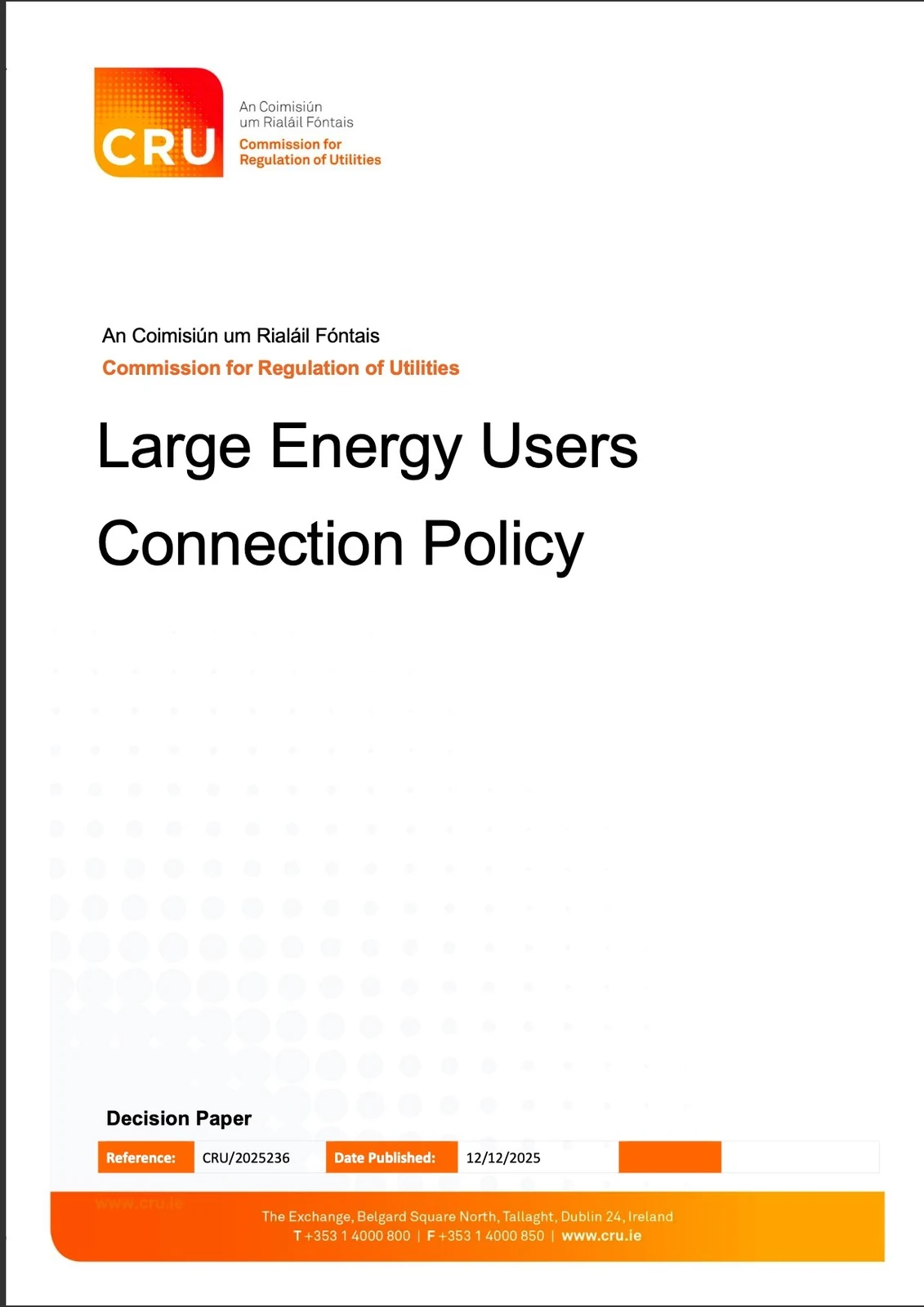
CRU Large Energy Users Connection Policy decision paper cover
EXHIBIT A · CRU
read the annotated decision →
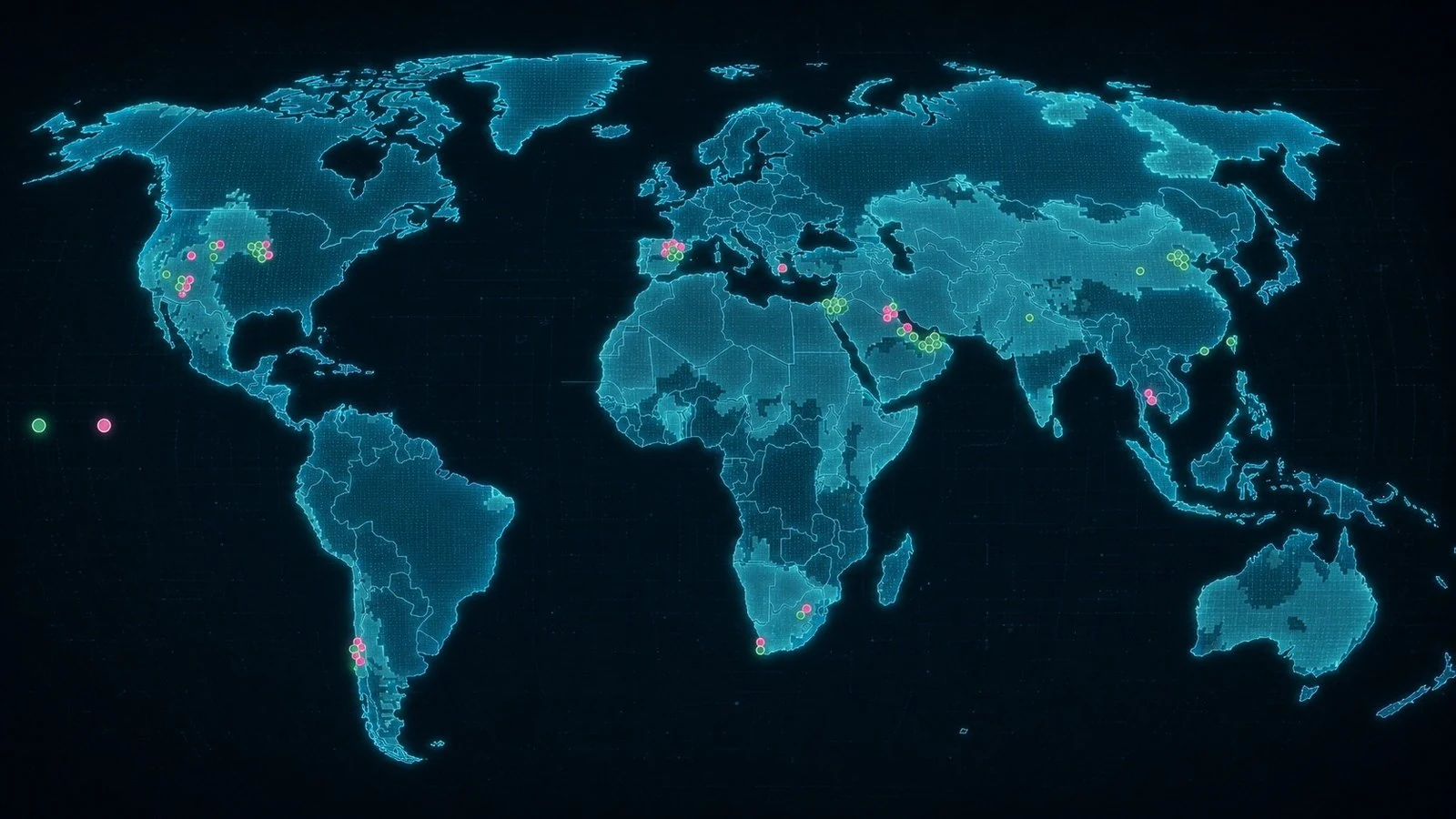
World map of water-stressed data-centre clusters
EXHIBIT E · WATER
the world’s scarcity points
Analyst margin
Read the rulebook as a cost of connection, not a cost of compliance. The PUE meter is cheap; the dispatchable generation, the additional renewables and the water permit are what move the model. Track conditions of connection, not headline targets.
Entelligencia desk
F04
The grid is the real regulator: it says no, or it says wait ten years.
VerifiedContested
Open
Method
Every claim graded Verified, Announced or Contested. Nothing publishes until it is traceable to a primary source, and the legal read is reviewed by counsel.
The standard
F02
Germany has legislated the PUE, then started to relax it.
VerifiedContested
Open
F06
Sovereignty pulls the other way: build more, but build it European.
AnnouncedContested
Open
F05
Water has become the new social licence, and it is being refused.
Contested
Open
Persons of interest
Who controls the grid, the codes and the connection.
Click a figure to open the file
P.01 Portrait of Kadri Simson
Kadri Simson
European Commission · Energy
Sets the agenda
P.02 Portrait of Zbynek Boldis
Zbyněk Boldiš
ENTSO-E · President
Plans the grid
P.03 Portrait of Annegret Groebel
Annegret Groebel
CEER · Chair
Sets the codes
P.04 Portrait of Ed Miliband
Ed Miliband
UK · Energy Security & Net Zero
Steers the UK
P.05 Portrait of Ursula von der Leyen
Ursula von der Leyen
European Commission · President
Sets the package
Exhibit B · where the rules bite
Different markets, different binding rule.
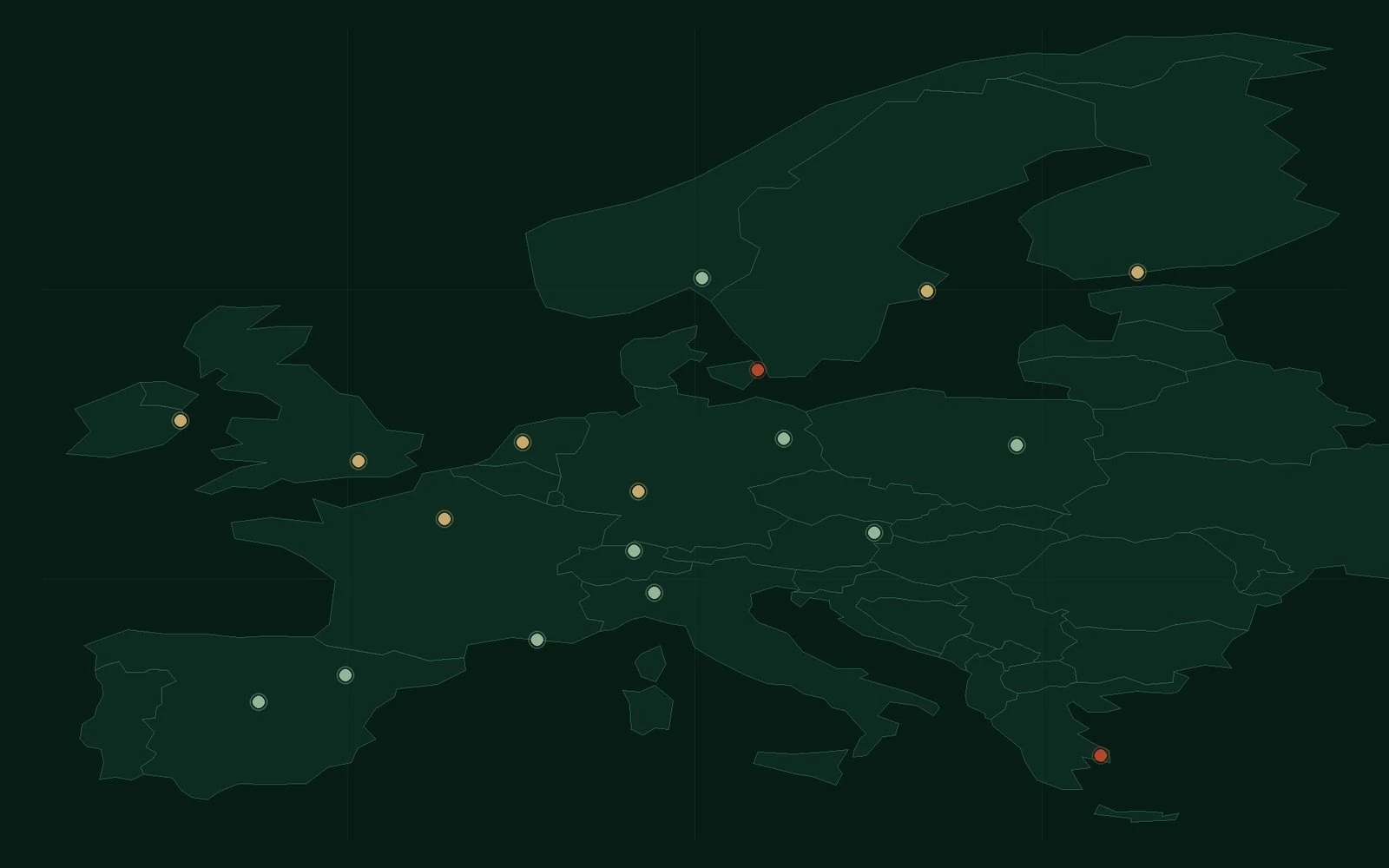
The constraint is not the same everywhere. Ireland binds on connection conditions, Germany on the PUE, the Netherlands on energy-savings payback, Spain on water, Denmark on the grid queue. Drawn on real European geography, the clusters read against each market’s binding rule and the projects sitting behind it.
Open the finding
Exhibit C · a regulated campus
What the rulebook looks like on the roof.
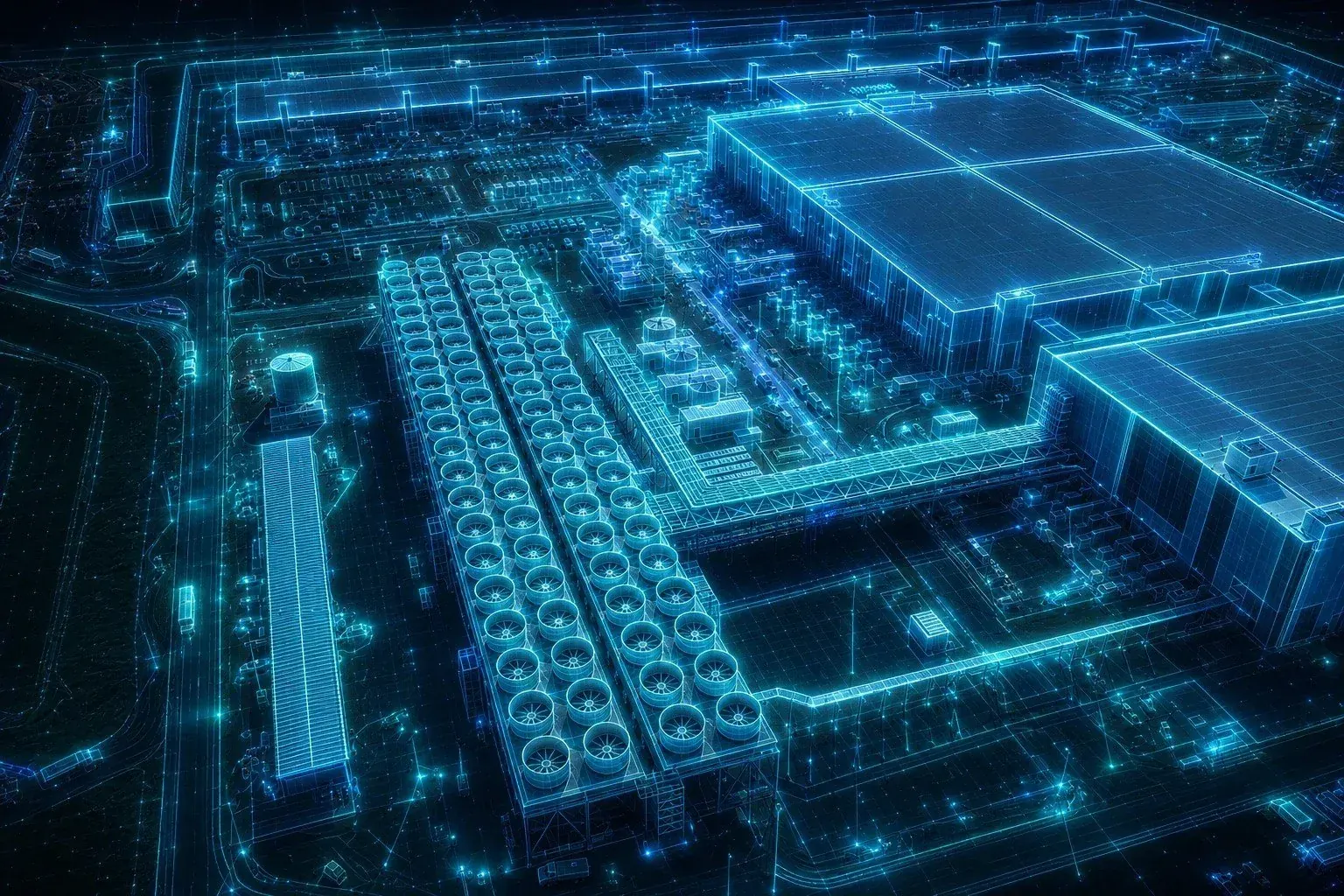
A representative aerial of a European AI-ready campus, read against the rules that govern it: the heat-reuse offtake the German and EU regimes increasingly require, the efficiency metering that feeds the EU database, the on-site substation that gates the connection, and the water intake now contested in southern Europe. Compliance is physical.
Open the deep dive
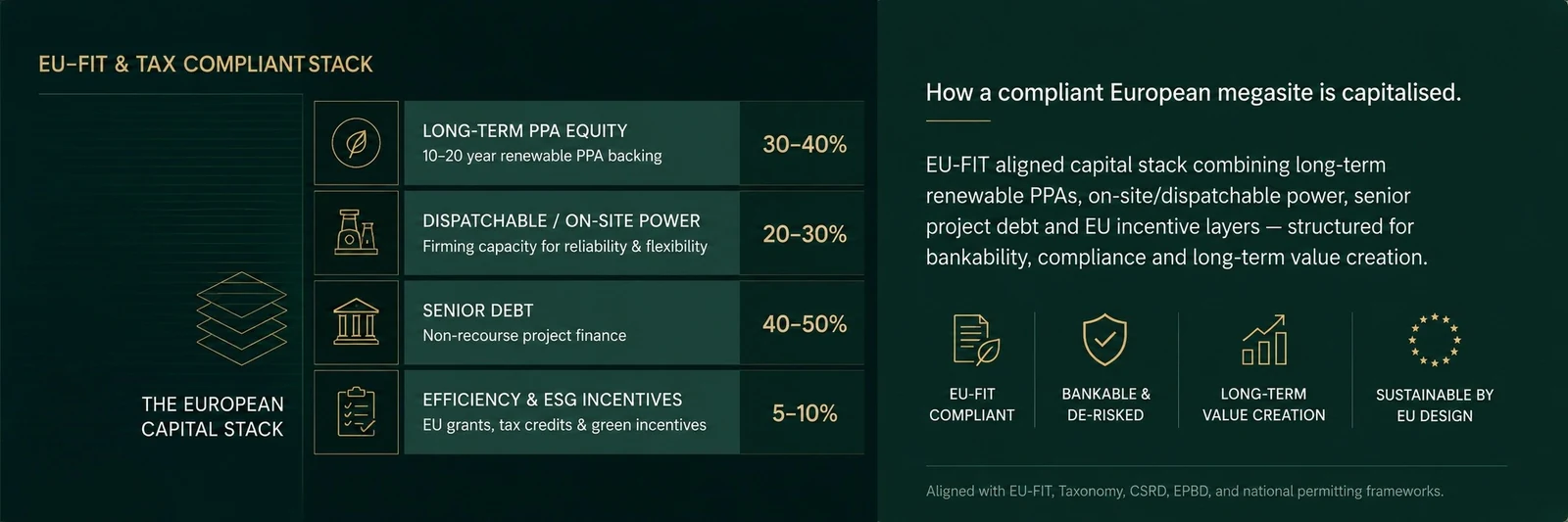
Exhibit D, the compliance and capital stack
Exhibit D · the compliance stack
How a compliant European megawatt is structured.
The rulebook reshapes the deal. A bankable European campus now layers a power strategy (PPA plus on-site or dispatchable generation), a heat-reuse offtake, an efficiency-reporting obligation and a water permit on top of the capital stack. Open the exhibit for how the obligations wire into a single project.
Open the mechanism
World map of water-stressed data-centre clusters
Exhibit E · the Aragon question
Water is the new social licence.
Plotted globally, the build keeps landing in water-stressed places, and Europe’s south is squarely among them. In Aragon, a multi-year hyperscale expansion has been tied to a sharp rise in water allocation while a neighbouring town moved to bar new sites. The map reads the world’s data-centre clusters against water scarcity; open the finding for where the licence is being refused.
Open the finding
What would have to be true
For the European build to clear, three things have to move at once.

The grid has to energise capacity faster than demand piles onto it, which means connection reform, faster substations and operators bringing firm power rather than waiting in the queue. The social licence has to hold, which means water, heat reuse and community benefit are designed in rather than fought over after the fact. And the rulebook has to converge rather than fragment, so that a developer is not solving Ireland, Germany, the Netherlands and Spain as five separate countries. The demand is not in doubt, and the capital is not in doubt. Power, consent and a coherent rulebook are the open questions.

From the file to the counsel

Entelligencia’s reading of Europe’s data-centre rulebook as it stands in mid-2026. The throughline: regulation has moved from disclosure to conditions of connection. Operators are no longer just asked to report efficiency; in a growing number of markets they must bring firm power, prove additionality and earn a social licence before a megawatt energises. For the capital-markets read on what that means in practice, see The Counsel, below, with Simmons & Simmons.

Partner content In partnership with
The Counsel ENT-COUNSEL / EDITION 01 · SIMMONS & SIMMONS

The lawyer’s read on Europe’s build.

The chapter has shown the constraint: power, not capital. This brief, contributed by our partner Simmons & Simmons, reads what that constraint does to the deal, from how risk is allocated to how pan-European platforms are financed and why the rulebook now sits on the term sheet. Open any file for the partner’s view, each closing with what it means for capital.

Kirsty Barnes, Partner at Simmons & Simmons
Kirsty Barnes
Partner · Banking & Finance, Digital Infrastructure · Simmons & Simmons
Band 1 · Chambers Digital Infrastructure firm of the year DATA4 · approx 3.3bn euro
Partner content, produced with Simmons & Simmons. This brief is contributed analysis, in draft and subject to review and approval by Kirsty Barnes and Simmons & Simmons before publication. It is not legal advice. Selected recognition is drawn from the public record and the firm’s published materials, and the portrait and wordmark are used with permission to be confirmed before publication.
The document

The paper trail, annotated.

Three primary sources behind the European power question, each graded claim by claim with our legal partner. Click a tab to bring a document forward, click any underlined claim to see the read, or filter by grade. These are annotated representations of each source.

Source · CRU-2025236 · marked by Entelligencia
Filter
Source document · annotated
Commission for Regulation of Utilities: Large Energy Users connection policy
Decision Paper CRU/2025236 · December 2025 · public record
Public
record
01The decision ends the effective moratorium on new Dublin data-centre grid connections1.
02But a large user at or above 10 MVA must now provide dispatchable on-site or proximate generation, separately metered, matching its import capacity on a de-rated basis2.
03It must also procure additional renewable generation equal to about 80% of its demand, on a six-year glide path3.
04The regulator notes data centres reached about 22% of national electricity use in 20244.
05Critics argue the dispatchable-generation condition risks locking in fossil-gas capacity for decades5.
06Thresholds tier the rules: light-touch below 1 MVA, an autoproducer obligation from 1 to 10 MVA, and the regulator may aggregate split applications to stop projects gaming the limits6.
6 claims marked · 4 verified · 1 announced · 1 disputedMethod: claim by claim against the public record
Analysis · Entelligencia read
Click a row to locate it in the text, or a claim to locate its analysis.
Verifiedline 01 · ref 1
The headline is “Dublin reopens.” The substance is that it reopens on conditions few other European markets impose at this scale. This is the template to watch.
Verifiedline 02 · ref 2
Bring your own power. A campus must be able to run on its own generation matching full import capacity, so it does not add to the peak the grid cannot serve. This is the single most material clause for the model.
Announcedline 03 · ref 3
Additionality, phased. The renewables requirement glides in over six years, so the near-term cost is real but the full burden is forward-dated. Treat as a rising obligation, not a one-off.
Verifiedline 04 · ref 4
The number that drove the policy. The CSO records the data-centre share rising from about 5% in 2015 to 22% in 2024; the regulator’s own forecast has demand climbing further to 2034.
Disputedline 05 · ref 5
The tension at the heart of it. Requiring dispatchable on-site power may, in practice, mean gas engines, which campaigners and some academics warn entrenches fossil capacity even as the renewables clause tries to offset it.
Verifiedline 06 · ref 6
The structure is graduated, and gaming it is closed off. Below 1 MVA is light-touch; 1 to 10 MVA needs a market-participating autoproducer; 10 MVA and above needs dispatchable matched capacity. Splitting one project into many applications can be assessed on an aggregated basis.
Source document · annotated
Recast Energy Efficiency Directive, Article 12, and Delegated Regulation (EU) 2024/1364
Directive (EU) 2023/1791 · Delegated Reg 2024/1364 · Official Journal
EU
law
01Data centres with installed IT power at or above 500 kW must report energy performance to an EU database1.
02The first report covering 2023 was due by 15 September 2024, then annually by 15 May2.
03The delegated act defines four key indicators: PUE, WUE, ERF and the renewable-energy factor3.
04A Data Centre Energy Efficiency Package, with a Union rating scheme and minimum standards, is slated for adoption on 3 June 20264.
05As drafted, the framework is transparency-first: it measures and grades, but stops short of hard EU-wide limits5.
5 claims marked · 3 verified · 1 announced · 1 disputedMethod: claim by claim against the public record
Analysis · Entelligencia read
Click a row to locate it in the text, or a claim to locate its analysis.
Verifiedline 01 · ref 1
The compliance floor. Almost every commercial facility clears 500 kW, so in practice the obligation is universal. The data, once collected, is what every later rule will be calibrated against.
Verifiedline 02 · ref 2
The clock has already run once. The first cycle closed in September 2024; the Commission published its first analysis in mid-2025. The dataset exists and is growing.
Verifiedline 03 · ref 3
Four numbers now travel with every facility: power-usage, water-usage and energy-reuse effectiveness, plus renewable share. They are the vocabulary of the rating scheme to come.
Announcedline 04 · ref 4
The pivot from measuring to grading. Re-verify the date and scope at build; a labels-and-minimum-standards regime is the difference between disclosure and enforcement.
Watchline 05 · ref 5
Whether the EU sets hard limits or leaves them to member states is the open question. Germany has already answered it nationally; see the next tab.
Source document · annotated
Energy Efficiency Act (Energieeffizienzgesetz, EnEfG), data-centre provisions
In force November 2023 · supervised by BAFA · 9 April 2026 draft amendment
National
law
01New data centres from 1 July 2026 must achieve a PUE of 1.2 or better1.
02Energy-reuse factors rise to 10% in 2026, 15% in 2027 and 20% in 20282.
03Operators must source 100% renewable electricity from 20273, with fines up to 100,000 euro for breaches4.
04Frankfurt’s data centres now use more electricity than Frankfurt Airport5.
05A draft amendment of 9 April 2026 would relax the PUE targets and waive heat reuse where no district network is within five kilometres6.
6 claims marked · 5 verified · 1 disputedMethod: claim by claim against the public record
Analysis · Entelligencia read
Click a row to locate it in the text, or a claim to locate its analysis.
Verifiedline 01 · ref 1
The hardest number in European law. A 1.2 PUE for new build effectively mandates advanced cooling, which is why the liquid-cooling brief and this file are the same story from two ends.
Verifiedline 02 · ref 2
The heat-reuse ramp. Rising energy-reuse factors force operators to find an offtaker for waste heat, which is feasible in a Helsinki or Stockholm and far harder on a greenfield site.
Verifiedline 03 · ref 3
A 100% renewable-electricity obligation from 2027 pushes operators into long-dated PPAs and on-site generation, and ties the data-centre build to the pace of the renewable build.
Verifiedline 03 · ref 4
The enforcement teeth. Capped at 100,000 euro per breach and supervised by BAFA, the fine is modest against project economics, so the real cost is the engineering the standard forces, not the penalty.
Verifiedline 04 · ref 5
The image that made the politics. When a city’s data centres out-consume its airport, the grid and the planning system stop treating them as ordinary tenants.
Disputedline 05 · ref 6
The walk-back. A draft amendment would soften the PUE path and waive heat reuse without a nearby network, a sign the toughest standard in Europe is being tested by the cost of meeting it. Re-verify status at build.

Three primary documents in the file. Click a tab to bring one forward. Suggested sources to license for production: the CRU Decision Paper CRU/2025236; Directive (EU) 2023/1791 with Delegated Regulation (EU) 2024/1364; and the EnEfG consolidated text with its 2026 draft amendment.

Voices of the industry

The counsel, in their own words.

Nine voices from across the global digital-infrastructure value chain, spanning capital, the hyperscalers, silicon, sustainability and the edge. Each opens a pop-out setting out their perspective on the forces reshaping the market. Three panels, three perspectives in each. Tap any portrait to read on.

01Capital & power
Capital & power
Waldemar Szlezak
Partner, Global Head of Digital Infrastructure · KKR

The flagship capital-plus-power voice: AI-driven demand, integrated infrastructure platforms, and the move from stand-alone data-centre bets to combined power, data and network strategies.

Open
Global funds
Manjari Govada
Managing Director, Investment Management · DigitalBridge

Where the trillion-dollar capital question meets shifting risk: how investors now price data centres as core infrastructure rather than niche real estate.

Read
Hyperscale capex
Austin Dowling
VP, Capacity (OCI) · Oracle

Inside the hyperscaler capex engine: how a major cloud allocates more than $10bn a year across GPUs, servers, data centres and power, and what it needs from partners and grids.

Open
02Cloud, silicon & demand
Cloud expansion
Alfonso Aranda Arias
Cloud Expansion & Operations · AWS

A hyperscaler insider on how cloud expansion decisions are actually made: region selection, power constraints, and what providers expect from their data-centre partners.

Read
Platform tech
Chris Sharp
Chief Technology Officer · Digital Realty

Where AI inference actually lives: why dense interconnection near city centres matters, and how the large colos position between hyperscalers and enterprises.

Open
Silicon vendor
Jaap Zuiderveld
Vice President EMEA · NVIDIA

The silicon-vendor view of what an AI-grade facility requires: liquid cooling, the right power, and specialist AI clouds working with the right operators.

Read
03Sustainability, edge & delivery
Zero-carbon build
Doug Mouton
Advisory Board · Fidelis New Energy · ex-Meta, ex-Microsoft

Hyperscale build meets zero-carbon power: embodied carbon, construction methods, and tying multi-gigawatt clean generation to AI campuses.

Read
Silicon & ESG
Jen Huffstetler
Chief Sustainability Officer · HP · ex-Intel

Sustainability designed into silicon, not bolted on: how chip and platform choices change data-centre energy use and embodied carbon.

Open
Edge & OTT
Marcello Brescia
Head of OTT & Edge Ecosystem · HGC Global Communications

The edge and OTT angle, especially across APAC: distributed infrastructure close to users for content, gaming and interactive workloads.

Read
The Brief

The rule is written in water and copper.

ENT-EU-BRIEF / 2026.06
Tracks · 4
View · the device, then its supply chain

A PUE of 1.2 is not a spreadsheet target; it is a piece of hardware. To hit the efficiency the German standard and the AI chip both now demand, the heat has to leave the server in liquid, not air. Scroll each track left to right: the projection resolves into the part as it is installed today. The first three tracks take apart a direct-to-chip liquid-cooling system; the fourth follows that same device back down its supply chain, to the metals and chemicals it is made from. Figures are reported or modelled and contested where noted.

Technical partner · contributed engineering
DCX Liquid Cooling

This brief takes apart a representative direct-to-chip liquid-cooling system with our technical partner. The point: the same regulation that meters efficiency upstream lands, physically, on a cold plate, a coupling and a coolant, and pulls a new supply chain of metals and chemicals into Europe’s data-centre story.

Engineering description is representative and in draft, subject to review by DCX Liquid Cooling. Renders are placeholders; license real device imagery before publication.
The loop
Stage 01 / 03
Drag, scroll or use the arrows · projection fades to installed
Cold plate & manifold
Copper microchannel plateCopper: Chile, Zambia, DRC · machined in EU/Asia
Distribution manifoldStainless / polymer · EU fabrication
Couplings & tubing
Dripless quick-disconnectsStaubli (CH), CPC
Hose & sealsEPDM / fluoroelastomer
Heat exchange & pumps
Brazed plate heat exchangerAlfa Laval (SE), SWEP (SE)
Circulation pumpsGrundfos (DK), Wilo (DE)
Coolant chemistry
Single-phase PG25Water and propylene glycol, biocides
Two-phase dielectricsUnder PFAS scrutiny · ties to the file
Assembly & controls
CDU assemblyIntegrated in Europe
Sensors & controlsLeak detection, telemetry
The full brief · longer reads The tracks above are the summary. Open any brief for the full arc, with a build-reality node behind each claim.
All four briefs carry representative imagery; the supply-chain brief flashes a montage of several images per beat. Figures are reported or modelled and contested where noted. Representative visuals; final device imagery to be sourced from DCX. Re-verify at build.
How the pattern resolves

Read efficiency as a supply chain, not a setting.

The European efficiency rules do not just change how a hall is operated; they change what it is built from. A 1.2 PUE pulls liquid cooling into the base case, and liquid cooling pulls in copper, brazed stainless, precision couplings and a coolant whose chemistry is itself becoming a regulatory question. For an investor the discipline is to price the cooling system and its supply chain as part of the asset, not as a line item. The megawatt is only efficient once the metal and the chemistry behind the cold plate are secured.

The Playbook ENT-PLAYBOOK / EDITION 02

How capital buys into a market it cannot build fast.

Edition 02 · The operators and the deals · Europe’s leading platforms on file

In Europe the money is the easy part. Pension and sovereign funds, infrastructure private equity and the hyperscalers themselves are competing to own the megawatt, while a new class of neocloud borrows against GPUs. Set the operators, the archetypes and the biggest cheques side by side, and the contest reads as a single question: who can convert capital into powered capacity fastest.

Five modules · tap a panel to open · imagery is placeholder, to be sourced before publication
Module 01

Five archetypes hold the top twenty.

Europe’s leading platforms cluster into five strategies. Open each for what the model is, who runs it, and the names on file.

Dense, carrier-neutral exchange points where networks and clouds meet. The asset is the interconnection, not the floor space, which makes these the stickiest and highest-margin sites in Europe.

Who runs itEquinix, Telehouse (KDDI), Global Switch, Interxion (now Digital Realty).
The edgeConcentrated in the FLAP-D cores, where vacancy is lowest and pricing is rising fastest.

Large build-to-suit campuses leased to hyperscalers and AI tenants on long contracts, increasingly designed around liquid cooling and gigawatt-scale power.

Who runs itDigital Realty, Vantage, STACK Infrastructure, CyrusOne, NTT GDC, VIRTUS, Iron Mountain.
The edgePipeline is roughly 83% pre-let; the constraint is power and land, not tenants.

The hyperscalers building their own capacity, and increasingly their own sovereign-cloud regions, rather than leasing it. The largest single force in the market.

Who runs itAWS, Microsoft Azure, Google, Oracle.
The edgeAround 70% of European cloud, and the capital to build through the grid queue rather than wait in it.

Operators chasing the more-than-half of AI growth heading to the Nordics, Iberia and central and eastern Europe, often on a sustainability or sovereignty pitch.

Who runs itDATA4, OVHcloud, atNorth, NorthC, AtlasEdge, Ark.
The edgeCheaper, cleaner power and shorter queues, traded against latency and ecosystem depth.

Telcos monetising estate and connectivity, and pension and sovereign capital forming purpose-built platforms to own European capacity at scale.

Who runs itOrange and SFR (telco); the CPP and Goodman European venture; GTR (KKR and Oak Hill); plus the neoclouds Nebius and Nscale and CoreWeave.
The edgePatient, long-dated capital underwriting twenty-year positions in a scarce asset.
Module 03

The biggest cheques in the industry, Europe lit.

A live tracker of the largest data-centre and AI-infrastructure commitments. European deals are highlighted; filter to compare the European book against the global one.

Values as reported · mix of equity, programme and contract sizes · re-verify at build
DealBackersValueWhereYear
Aligned Data Centers acquisitionLargest-ever DC deal; Aligned is Americas-onlyAI Infrastructure Partnership (BlackRock, GIP, Microsoft, MGX; Nvidia, xAI)USD 40bnGlobal2025
Data4 recapitalisation and build-outTriple French capacity by 2030; Cambrai mega-projectBrookfieldEUR 20bnEurope2025
AWS Aragon expansionThree data centres and regional expansion to 2033Amazon Web ServicesEUR 15.7bnSpain2025
Northumberland campus (Cambois)Up to approx 720 MW, water-free cooling, GBP 110m local fundBlackstone and QTS, with USSGBP 10bnUK2024
CPP and Goodman European venture435 MW across Paris, Frankfurt and AmsterdamCPP Investments and GoodmanEUR 8bnEurope2025
Microsoft AragonHyperscale region in north-east SpainMicrosoftEUR 6.9bnSpain2025
UK Tech Prosperity DealMicrosoft USD 30bn, Nvidia GBP 11bn, Google GBP 5bn, CoreWeave GBP 1.5bnUS hyperscalers and chipmakersGBP 31bn+UK2025
GTR greenfield platformLondon, Barcelona, Zurich and IsraelKKR and Oak HillUSD 1.9bnEurope2026
CoreWeave and OpenAIMulti-year capacity contractCoreWeaveUSD 22.4bnGlobal2025
Blackstone and AirTrunkPrior largest DC deal; APAC platformBlackstoneUSD 16bnAPAC2024
CoreWeave Meta and UK buildMeta contract approx USD 14.2bn; GBP 1.5bn UKCoreWeaveUSD 14bn+UK / Global2025
Nebius hyperscaler contractsMicrosoft multi-billion; Meta approx USD 3bn over five yearsNebius (Amsterdam-HQ)USD 3bn+Europe2025
European deals shaded blue. The largest single transactions are global, but the densest deal flow now runs through Europe’s grid-constrained cores and the next-wave Nordics and Iberia.
Module 04

Six platforms, five dimensions.

How the leading operators differ on archetype, footprint, AI readiness, ownership and the green pitch.

ArchetypeFootprintAI densityOwnershipGreen pitch
Equinix
The anchor
Interconnection hubFLAP-D and globalLiquid-cooling readyListed (REIT)Renewable PPAs
Digital Realty
incl. Interxion
Wholesale and hubPan-EuropeanHigh, build-to-suitListed (REIT)Renewables, heat reuse
Vantage
AI campuses
Wholesale and hyperscaleCore and next-waveGigawatt AIDigitalBridge-backedWater-free designs
DATA4
France and beyond
Regional next-waveFR, IT, ES, PLScaling AIBrookfield-ownedCircular, heat reuse
atNorth
Nordic
Regional next-waveIS, NO, SE, DK, FIHPC and AIPartners-backedRenewables, heat reuse
OVHcloud
Sovereign cloud
Cloud self-buildFR-led, EuropeanOwned cloudListed (FR)Own water cooling
Entelligencia reading of public positioning, May 2026. Cells are indicative summaries, not investment advice; ownership and footprint should be re-verified against current filings before publication.
Module 05

One market, many hands.

Each operator plotted by what it sells, interconnection or wholesale power, and where it builds, the primary cores or the next wave. Tap a point for the full operator file.

The strategy space
Where each operator sits.
Tap a point for the full operator file
Next-wave interconnectNext-wave wholesale Core interconnectCore wholesale InterconnectionWholesale power Primary coresNext wave Equinix Digital Realty Vantage DATA4 atNorth OVHcloud

How to read it

The horizontal axis is what the operator sells, from pure interconnection to raw wholesale power. The vertical is where it builds, from the saturated primary cores up to the next wave of Nordic, Iberian and eastern markets.

Where the value is moving

The cores are where margin sits today; the next wave is where the megawatts are easiest to add. The platforms that win own a foot in both, which is why the wholesale and regional operators are converging toward the centre.

Positions are Entelligencia’s qualitative reading of each operator’s public positioning, for orientation rather than precise measurement.
The platforms
Six operators, profiled.
Tap a banner for the full operator file
The read
Capital is the easy part; powered capacity is the prize.

Europe’s operators are not short of money. The hyperscalers self-build, the wholesalers pre-let four-fifths of their pipeline, the neoclouds borrow against GPUs, and pension and sovereign capital are forming twenty-year platforms to own the megawatt. What separates the winners is not the cheque but the ability to convert it into energised capacity, which is why the most valuable operators are the ones closest to firm power, heat offtake and a workable grid connection. The deal flow is real. The constraint is still the grid.

Compiled by the Entelligencia desk, May 2026. Operator strategies, ownership and deal values are drawn from the public record and are illustrative; figures should be re-verified against current filings and announcements before publication. Directory imagery is placeholder and to be sourced.
The map

Where the megawatts actually sit.

Europe’s capacity is not spread evenly; it pools where power, fibre and pre-let demand meet. The FLAP-D cores – Frankfurt, London, Amsterdam, Paris, plus Dublin – still do most of the work, while the next wave runs to the Nordics, Iberia and central and eastern Europe in search of power the cores cannot find. Each glowing node is a real cluster, colour-coded by status: verified live, announced, or contested where a grid pause or water fight is live. Select a region to read it against its binding rule, and toggle the overlays for the FLAP-D core, the grid-constrained hubs and the next-wave zones. The outline follows real European geography and every cluster sits at its true coordinates.

Europe cluster map · live
ENT-EU-MAP-2026.06 · 18 clusters plotted
Region
Overlays
FLAP-D core
Grid-constrained
Next-wave zones
Verified · live or in build
Announced
Contested · pause or dispute
FLAP-D CORE · PRE-LET, LOW VACANCYGRID-CONSTRAINED · 7–10 YR QUEUESNEXT WAVE · NORDICS, IBERIA, CEELondon / SloughDublinAmsterdamFrankfurtParisZurichStockholmOsloHelsinki / EspooCopenhagenMadridAragon / ZaragozaMilanMarseilleAthensBerlinWarsawVienna
Verified
Select a cluster
Tap any node to open its file
Clusters in view
18
Pipeline pre-let
83%
Binding constraint
Power and the grid
At a glance · the index

Europe’s preconditions, scored.

Each spoke is one precondition, scored 0 to 10 for like-for-like reading – indicative editorial weighting, not a published index. Select any spoke or row to read the factor.

The people

Who actually decides Europe’s build-out.

Five named figures: two who help write Europe’s energy and AI rules, and three chief executives building the capacity. Each card carries a public-record position, never an invented quote; named roles and figures should be re-verified against current institutional and company records before publication. Portraits are reference images and remain subject to licensing clearance before publication.

Representative portrait of Ursula von der Leyen
Flip
Commission · policy
Ursula von der Leyen
President · European Commission
Profile · 01 of 05
Ursula von der Leyen
President, European Commission
Influence
Sets the European AI-infrastructure agenda. Launched the InvestAI and AI Continent initiative aiming to mobilise around 200 billion euro and triple EU data-centre capacity.
Working on
An AI Continent Action Plan, AI gigafactories, and a Cloud and AI Development Act intended to scale sovereign European capacity.
Public position: von der Leyen has argued Europe must rapidly scale its own AI and compute capacity to remain competitive and sovereign.
Paraphrase of public statements at the Paris AI Action Summit · February 2025.
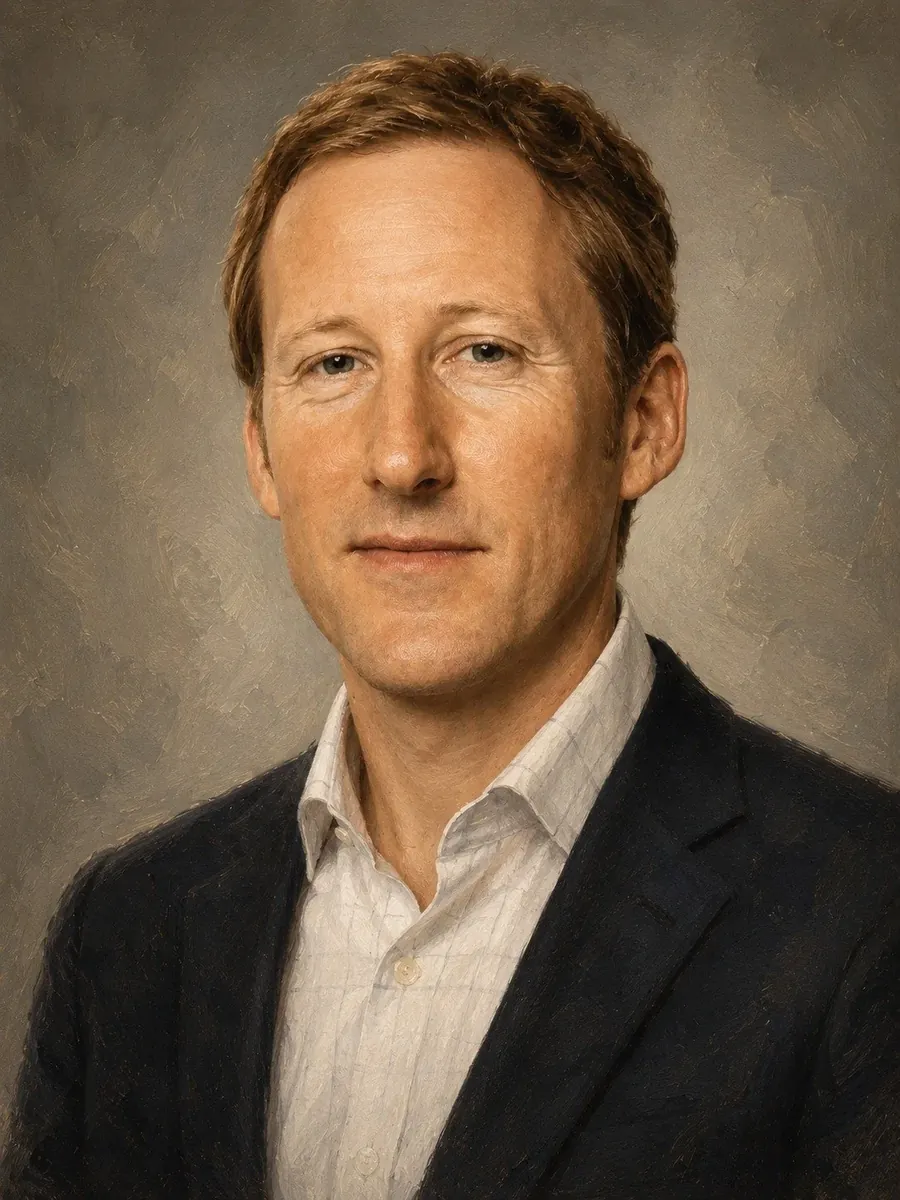
Representative portrait of Ed Miliband
Flip
United Kingdom · energy
Ed Miliband
Energy Security & Net Zero · UK
Profile · 02 of 05
Ed Miliband
Secretary of State for Energy Security and Net Zero, United Kingdom
Influence
Steers the UK’s energy and grid agenda, where data centres are now classed as critical national infrastructure and AI Growth Zones and the Tech Prosperity Deal sit behind a fresh wave of capacity.
Working on
Accelerating clean power toward 2030 and reforming the connection queue, the grid build that gates sites such as the RAF Elsham Wolds scheme of up to 1,000 MW approved in 2026.
Public position: Miliband has championed accelerating clean power and reforming the grid-connection queue.
Paraphrase of public statements · 2025 to 2026. Re-verify current office before publication.
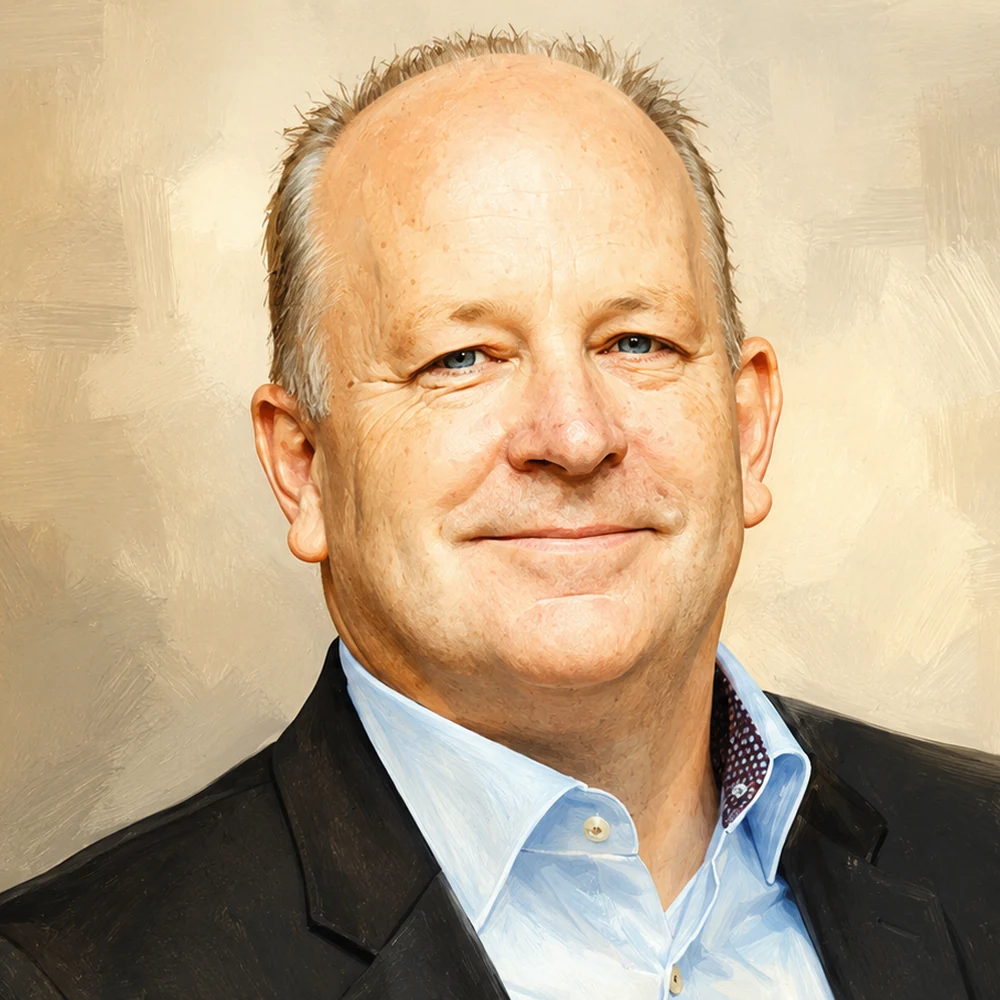
Reference portrait of Olivier Micheli
Flip
DATA4 · operator
Olivier Micheli
President & CEO · DATA4 Group
Profile · 03 of 05
Olivier Micheli
President and Chief Executive, DATA4 Group
Influence
Leads a Brookfield-owned pan-European platform, France-led and expanding into Italy, Spain and Poland on a circular-economy and heat-reuse pitch.
Working on
A large French build-out, reportedly tripling capacity by 2030, with waste-heat offtake and renewables designed in to clear the rulebook.
Public position: Micheli has positioned DATA4 as scaling sustainable, sovereign European capacity with heat reuse at its core.
Paraphrase of public statements and company materials · in post since 2014.
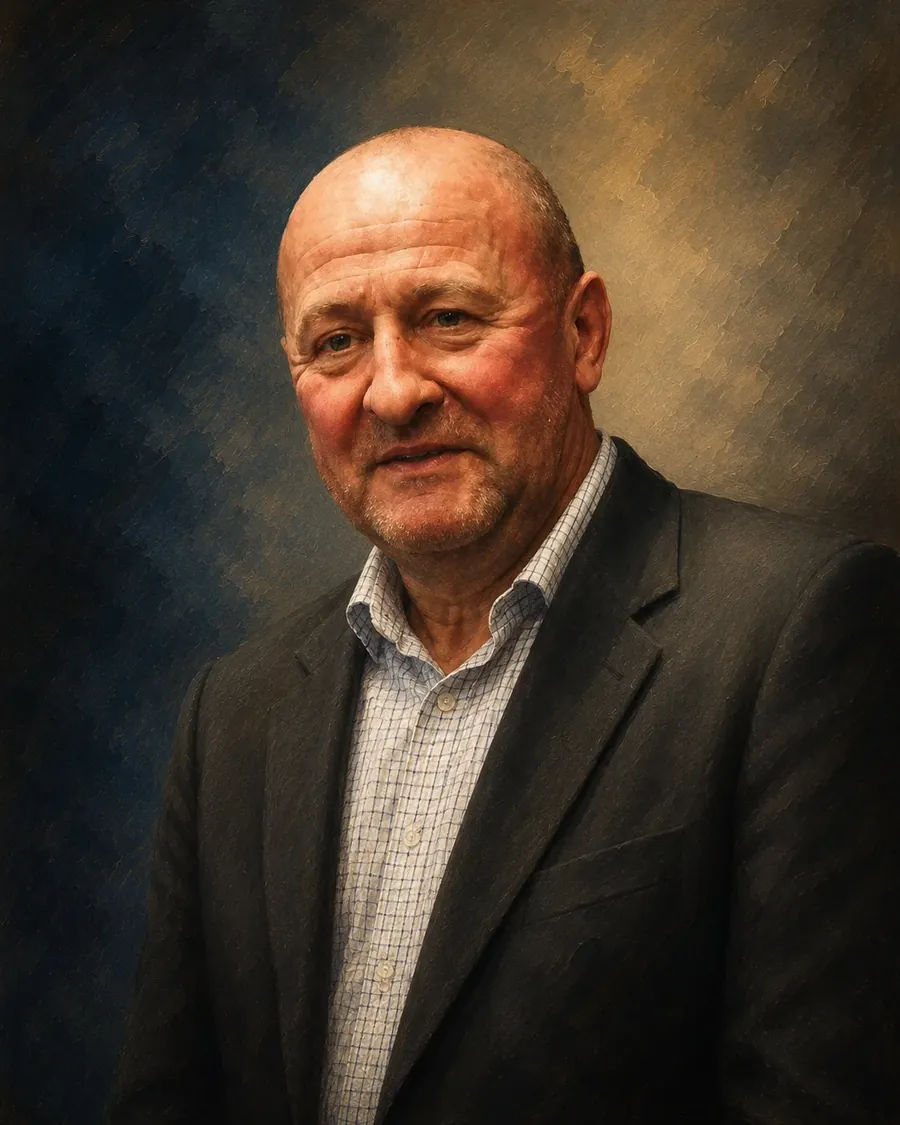
Reference portrait of Adam Eaton
Flip
VIRTUS · operator
Adam Eaton
Chief Executive · VIRTUS Data Centres
Profile · 04 of 05
Adam Eaton
Chief Executive Officer, VIRTUS Data Centres
Influence
Runs the UK’s largest pure-play colocation operator, London-anchored, at the centre of Britain’s hyperscale and AI demand.
Working on
Leading the next phase of UK and European expansion after his appointment in early 2026, against the grid and power constraints this chapter maps.
Public position: Eaton was appointed to drive VIRTUS’s UK and European growth, succeeding an interim chief executive.
Paraphrase of public announcements · appointed 2026.
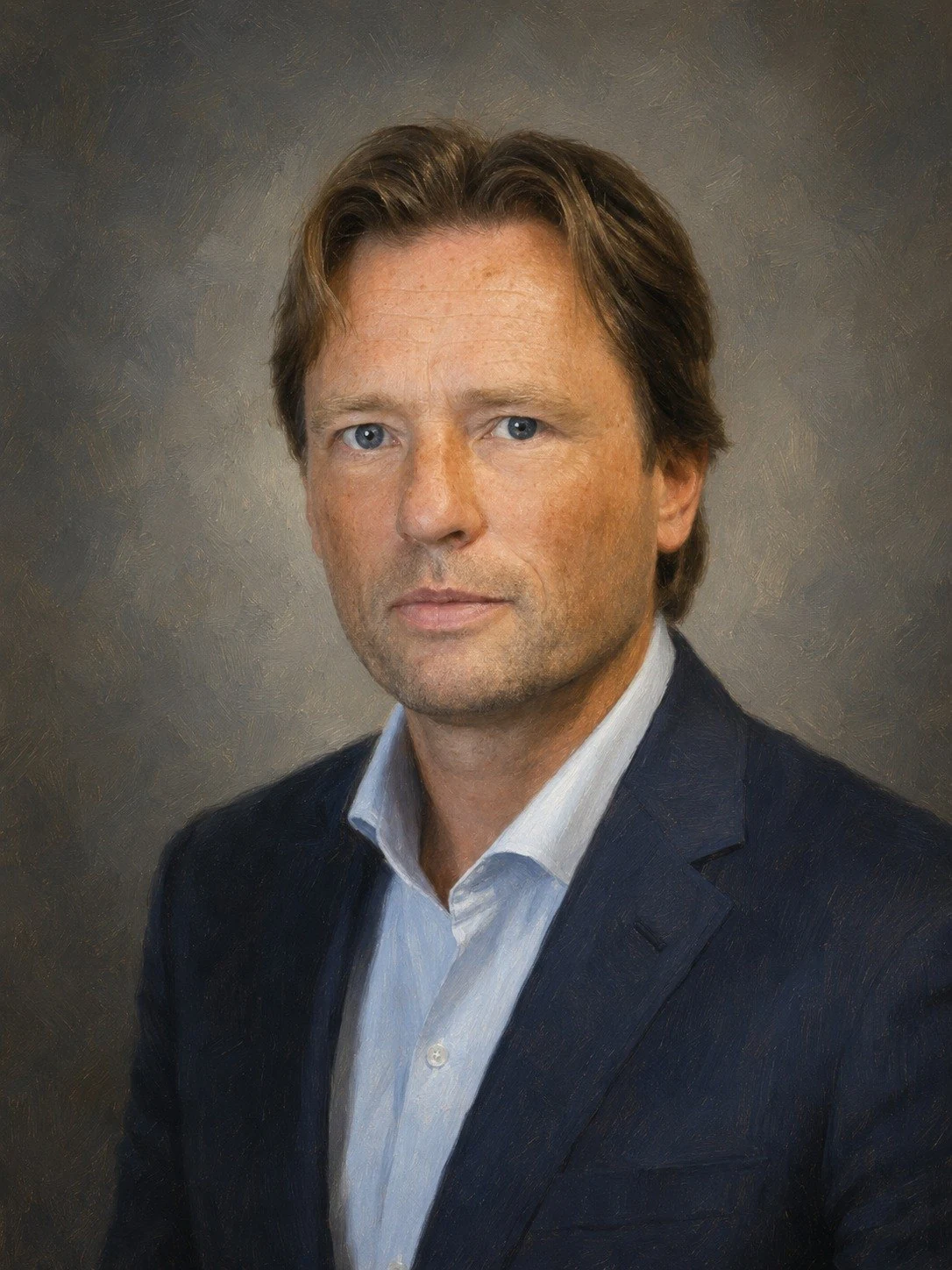
Reference portrait of Eric Boonstra
Flip
KevlinX · operator
Eric Boonstra
Chief Executive · KevlinX
Profile · 05 of 05
Eric Boonstra
Chief Executive Officer, KevlinX
Influence
Leads a new pan-European data-centre platform building AI-ready capacity across continental hubs.
Working on
Standing up KevlinX’s European sites since his appointment in late 2023, competing for power and connection in the markets this chapter maps.
Public position: Boonstra has framed KevlinX as a new pan-European platform built for AI-scale demand.
Paraphrase of public statements and profile · appointed late 2023.
Partner content In partnership with
The Continuum: Sector convergence opportunities. Who funds the future? A partner report from Simmons & Simmons on how private credit, tokenisation and innovation are reshaping the funding landscape.
Partner report · in partnership with Simmons & Simmons

Who funds the future?

A companion report on sector-convergence opportunities: how private credit, tokenisation and innovation are reshaping the funding landscape behind Europe’s digital infrastructure.

Read the analyst take
Partnership · editorial independence retained · cover is a placeholder