Sociogencia · The narrative, lost to the attention economy
Hosting the Backlash
Clip farms have made data centres the internet’s favourite villain, one viral post, one protest, one moratorium at a time. Every one of those posts is served from a data centre.
The irony
Anonymous clip accounts now out-reach the BBC and the trusted press, farming outrage the facts never catch. And the machine attacking data centres, the feed, the protest chat, even the tools that built the anti-data-centre ad, all of it runs inside the buildings under attack. The sector is losing a war it is physically hosting.
Entelligencia·July 2026·Sociogencia
The dispatch
Off the planet,onto the feed
They are building data centres in space to escape a fight they are losing on the ground. That is not a metaphor.
In the first half of 2026, the richest companies on Earth committed real capital to putting AI compute into orbit and under the sea, and when they explain why, the engineering comes second. The first reason, said out loud, is that up there and down there, nobody objects.
We spent a fortnight inside the accounts that farm this fight. This is what we found on the ground. It opens with the science fiction, because the science fiction is the tell. It moves to where the argument is actually being had, which is not where the industry is having it. Midway, it goes inside a clip farm, with a real operator, recorded, walking through the machine one move at a time. And it closes on the uncomfortable conclusion for anyone with capital in the sector: being right is not enough, because the room where perception becomes policy has moved, and the industry stayed behind. The companion brief The Wrong Numbers shows the facts are on the sector's side. This one is about why that has not been enough.
Clarity kills momentum. You want tension. Strong framing.A clip-network operator, recorded · read the intercept →
Science Fiction, Funded
The wildest ideas in data centres are pulling in public attention, serious money and, as they travel, a little misinformation. Space and the sea are both real, both funded, and both distorting on the way to your feed.
The escape is real. SpaceX has filed to put up to a million data-centre satellites in orbit; Google, Blue Origin and the startup Starcloud are close behind; China is scaling a state-backed constellation and has already run a model in space. The pitch, said out loud, is that up there nobody objects.
The sea is the same move. China switched on a wind-powered underwater data centre off Shanghai this year; Microsoft proved the idea with Project Natick, then walked away. And this spring Peter Thiel led a nine-figure round into Panthalassa, an Oregon startup building wave-powered, ocean-going compute nodes. It has since raised again: Naver invested on 13 August 2026, taking the cumulative total to about $210m, against an Ocean-3 pilot this year and commercial operation targeted for 2027. That target is a year ahead of the 2028 SpaceX has indicated for its first orbital compute launches, and the ocean pitch is being made on cost, at roughly two cents a kilowatt hour and a capacity factor above 90 per cent. That last one is exactly where attention, money and misinformation meet.
socket.ai · reel · 351k views
Exhibit · the reel
“Elon Musk wants data centres in space. This startup says, just put them in the ocean. $140m raised. Peter Thiel backed it.”
VerifiedThe post is accurate. Thiel did lead a round near $140m into Panthalassa, a wave-powered ocean-compute startup. The orbit and ocean projects are real, funded and filed. The caption gets its facts right.
ContestedThe distortion is in the replies. Boiled oceans, drained aquifers, pre-cooked fish. The claims are being fought in the comments, and the correction is the one reply nobody upvotes.
Accurate at the top. The fight is beneath it.
The live dashboard
The escape route, on the instruments.
Five flagship projects moving compute off the planet and under the sea. Each opens to its filing detail, the money and the claim, tagged Verified, Announced or Estimated.
Orbit and sea monitor · live fileas of July 2026ENT-DC-ESC-2026.07
VerifiedEstimatedAnnouncedContested
VerifiedThiel led a ~$140m round into Panthalassa; China’s Shanghai underwater data centre is operational; Microsoft shelved Natick in 2024.
AnnouncedSpaceX’s million-satellite, 100 GW orbital plan is a regulatory filing and a vision, not built capacity.
The comment wars
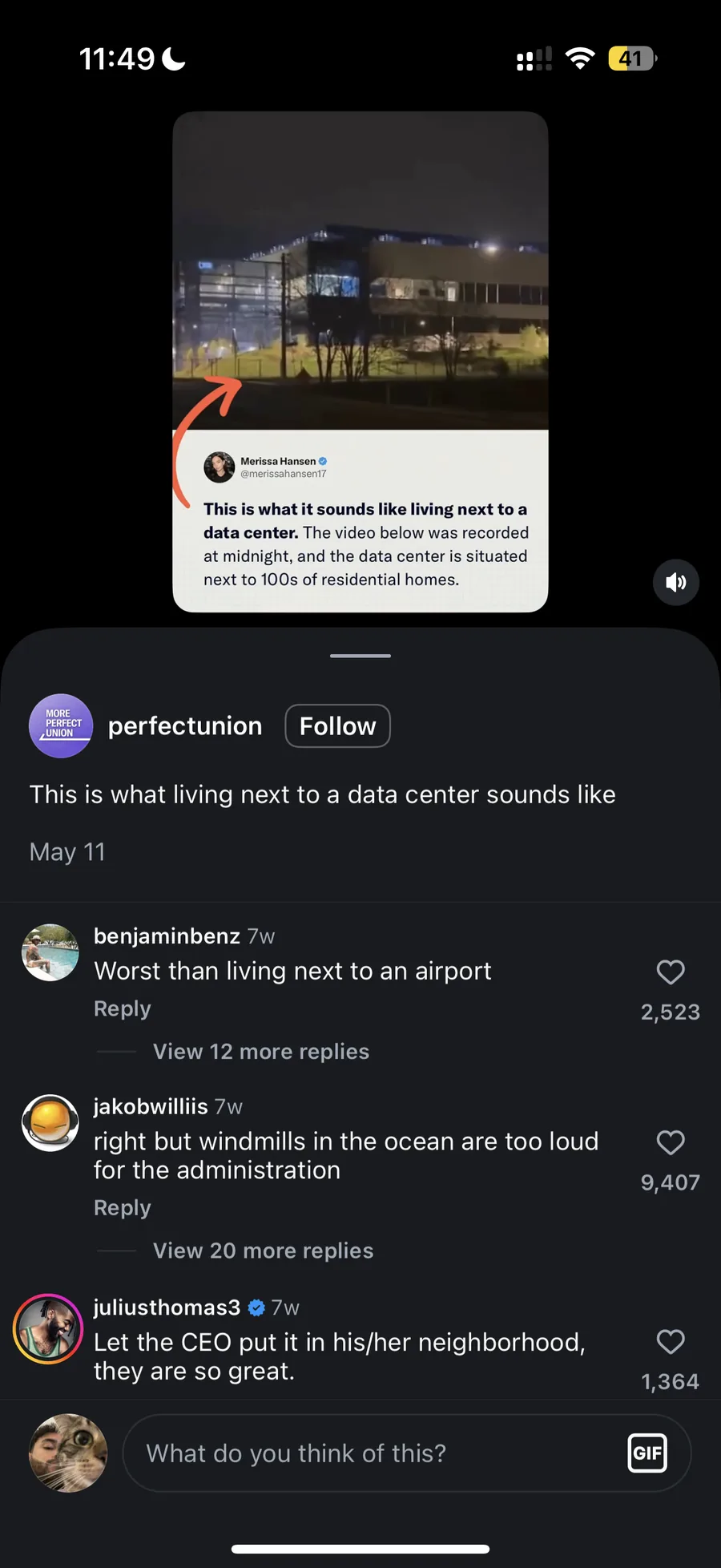
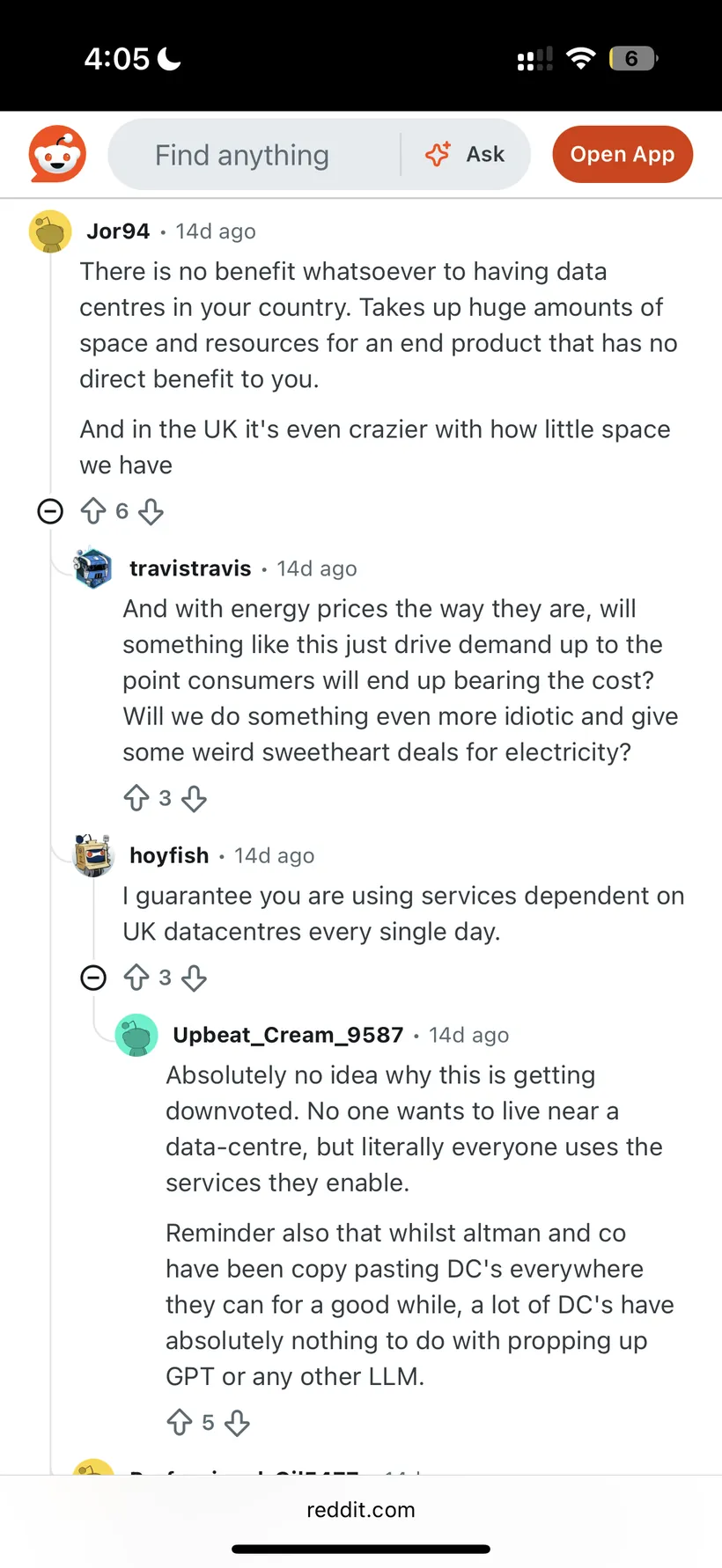
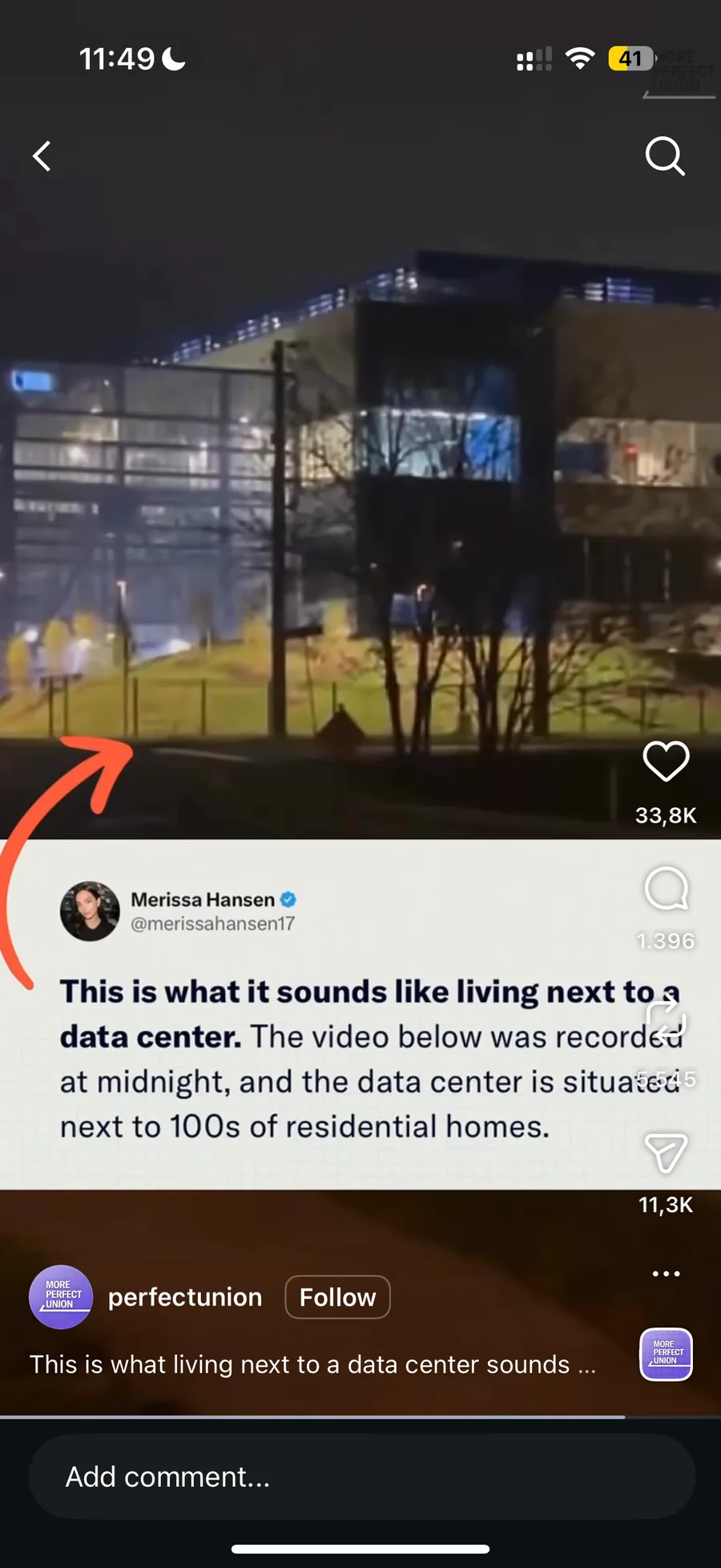
While the industry issues statements, the argument is being won and lost in the replies. And the industry is not in the replies.
The same fight, on three different feeds. The panic runs hot at the top; the correction sits at the bottom, unread.
socket.ai✓
Reel · 351k views
socket.ai Elon Musk wants data centres in space. This startup says, just put them in the ocean. $140M raised. Peter Thiel backed it.
Comments
the_malaway
Wait until the dispersed heat warms the ocean a few degrees and we get apocalyptic tsunamis
2d303 likesReply
niki_k1x
after that you can catch the fish pre cooked 🤗
1w107 likesReply
ross.brand
Or how about we don’t have AI data centres
1d4 likesReply
ludovicdocao correction
they’re not putting them in space cause of heat. You have to understand how data centres work
32m2 likesReply
mayoral candidate
alvintedjo ✓
NO. NEW. DATA CENTRES. The demands if this mega centre were to be built. #nodatacentre #vote
♪ original sound · alvintedjo
♥1774
💬82
➤218
futureshock.daily✓
@futureshock · 3h
Serious question 🎪 why does ONE AI data centre need MILLIONS of litres of water a day just to answer chatbot questions?? someone explain this because it is insane
3.4K reposts11K likes2.1M views
Replies
dry_creek_ted
because the billionaires building them do not care if your town runs dry. simple as that
2h3.1KQuote
reservoirrunning
draining our reservoirs so people can make ai selfies. make it make sense
1h2.4KQuote
grid_nerd correction
most UK and EU sites are closed-loop, the water recirculates. the “millions of litres” number is US evaporative cooling, a design choice, not a rule. this is engagement bait
36m22Quote
Instagram and TikTok posts are real, accounts hidden. The X example is typical of the format.
More from the feed
Real posts from public feeds, mid-2026. The same few claims, restated until they read as fact.
The sci-fi does not stay in the business press. It gets harvested. Faceless accounts run the streaming era’s content-farm playbook on data centres: clip, caption, repost, farm the outrage. The reach dwarfs anything the sector’s own channels manage. One collective’s reel on a Google data centre hit 2.6 million views before India had it restricted, and 404 Media has traced hundreds of AI-generated “Life in [State]” pages inventing farmers who fight data centres, purely for ad revenue. Across the platforms, the genre runs to an estimated 50 to 150 million views a month.
Figure The reach gap.
Follower counts, public profiles, mid-2026. The firms that run the internet barely register on the feed that judges them.
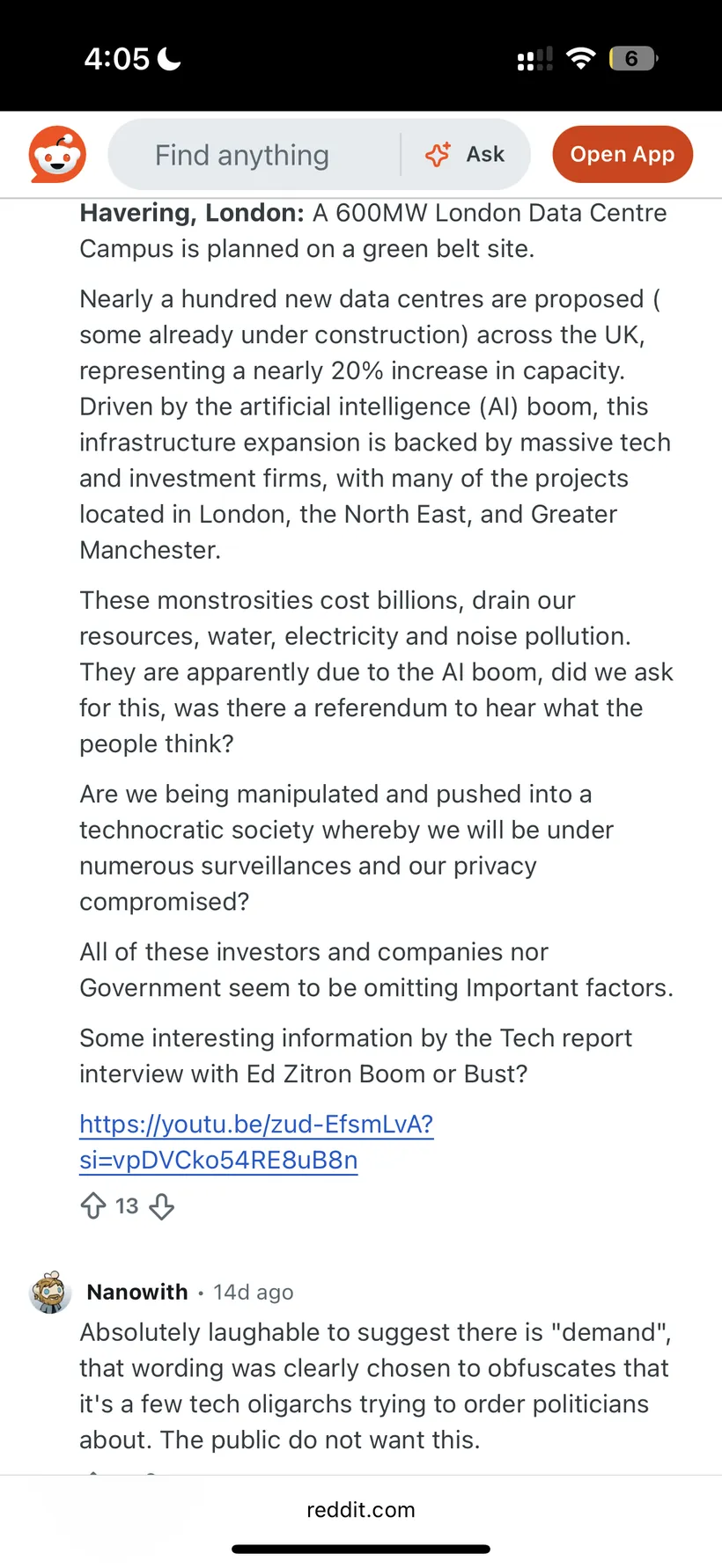
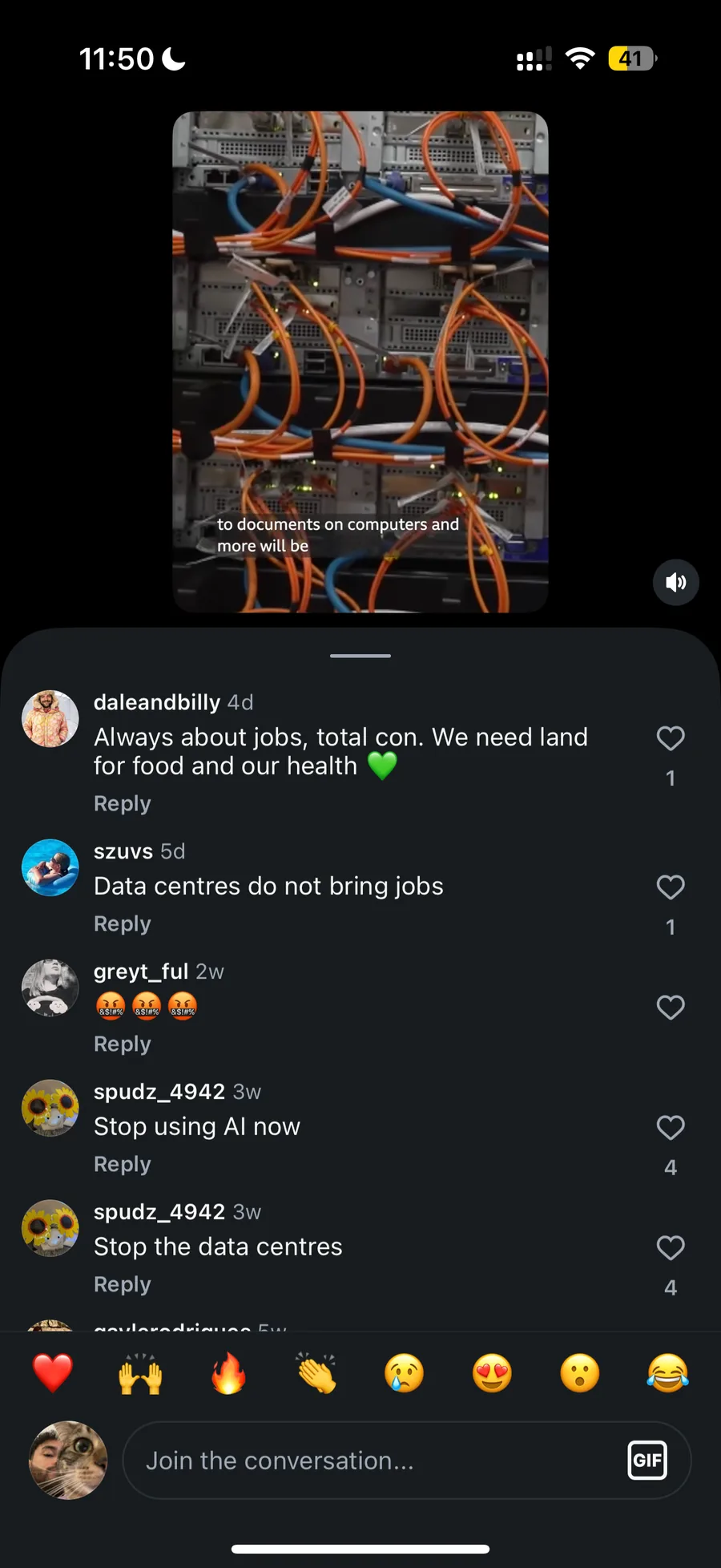
And the comment sections are not neutral. They are overwhelmingly hostile, and they are where the received wisdom is set: that data centres drink the water, boil the planet and give nothing back. It does not stop at outrage. The wins get their own victory laps, packaged for the algorithm, a moratorium turned into a montage.
That buried comment in the thread above is the whole problem. The accurate answer exists, it is often posted, and it is structurally invisible, arriving late, low on emotion, and buried by an algorithm that never rewarded it. The industry's instinct is to write a better technical rebuttal. The battlefield does not run on rebuttals. It runs on feeling, format and frequency, and on those three the sector is not competing.
The exhibits · three accounts, one playbook
The intercept · case file
Inside a clip farm, in its own words
To see the machine from the inside, our field investigator approached one of its operators, posing as a small clipper looking to scale. What follows is taken from the recording, edited only for length. The operator is anonymised; where a claim can be checked, it is tagged.
Line
Recorded · 21:08 BST
Investigator
Frankie McCann, detective constable, Metropolitan Police, embedded for this investigation and posing as a small clip-account operator.
Counterparty
Operator of a multi-account clip network. Millions of views a month, thousands of engagements per post. Identity withheld.
Note
Transcript taken from the recording, edited for length. The operator’s monetisation figures are their own and are unverified.
McCann
I’ve got a small page, about 18k followers. Clips, mostly gaming. I want to scale it properly.
Operator
You don’t have a distribution problem, you have a consistency problem. You’re not running a page, you’re running a network. One clip underperforms, another picks it up. Same asset, multiple shots, different captions. You’re testing reactions, not content.
Contested
Coordinated inauthentic behaviour. One operator running many “independent” accounts breaches every major platform’s stated policy, and is rarely enforced. The organic-looking crowd can be a single hand.
McCann
I’ve been thinking of branching out. AI, data centres, that space.
Operator
That’s where the growth is. People don’t understand it, but they react to it. Fear, mostly, or outrage. This thing is affecting you and you didn’t know. That angle travels.
McCann
Even if it’s not entirely clear?
Operator
Clarity kills momentum. You want tension. Strong framing.
Misinformation
The incentive, stated plainly. The system rewards reaction, not accuracy, so an accurate infrastructure story is reshaped into a false but shareable one. The distortion is the strategy, not an accident.
McCann
And the money?
Operator
Two lanes. Clipping agencies pay per million views, or a monthly retainer to push a creator. Then platform funds, ad splits, bonuses. Across a network, not one account, it adds up.
Contested
The clip economy is real; the numbers are not confirmed. These are the operator’s own figures. Entelligencia has not verified the rates or totals quoted.
McCann
You mentioned something beyond that.
Operator
Nudges. Someone wants a topic moving. A company, an agency. You don’t get a contract, you get a direction, and a few days of leaning into it. They track outcomes. If it trends, you get called again.
Misinformation
Undisclosed paid influence. No label, no disclosure, presented to the public as organic opinion. This is the point where a comment war quietly becomes covert PR.
McCann
The data-centre angle, is it sustainable?
Operator
It’s perfect. Policy lag, public confusion, big money. You can run both sides, pro and anti, and it all feeds the same machine. Stay faceless and people argue with each other, not with you.
Misinformation
Manufactured controversy. The debate a resident or a councillor sees may be one operator monetising both audiences at once. The argument itself is the product.
McCann
And if there is real-world impact? A project stalled, a town turned?
Operator
By then you’ve already moved on to the next clip.
The read
There is no accountability in the loop. The clip outlives the correction, and the person who made it is long gone before the consequence lands next to somebody’s home.
Source · Sociogencia field investigation, 2026. Counterparty anonymised and the transcript taken from the recording and edited for length; the operator’s monetisation figures are reproduced as stated and are unverified. The Verified, Contested and Misinformation tags are Entelligencia’s assessment.
Fighting where nobody is
The sector defends itself in the outlets it trusts. The audience it needs is somewhere else, and the politicians already know it.
Ask where the data-centre industry makes its case and the answer is the trade press, the broadsheet business desk, the panel at the conference. Ask where the public actually forms its view and the answer is the feed. Those are not the same place, and the gap is now enormous. Trust in mainstream media has fallen to 30 per cent in the UK and 25 per cent in the US, a ten-year low, while 5.66 billion people use social platforms and nearly two-thirds of Britons under 35 now get their news mainly from them. The sector is buying billboards in a town the audience left.
Figure Trust fell. Reach moved.
5.66bnpeople on social platforms, an average 2h 39m a day. The half of the room the sector still argues in is the half that is emptying.
Trust: share who trust most news most of the time, a ten-year low, Reuters Institute Digital News Report 2026. Audience: Reuters DNR · DataReportal 2026.
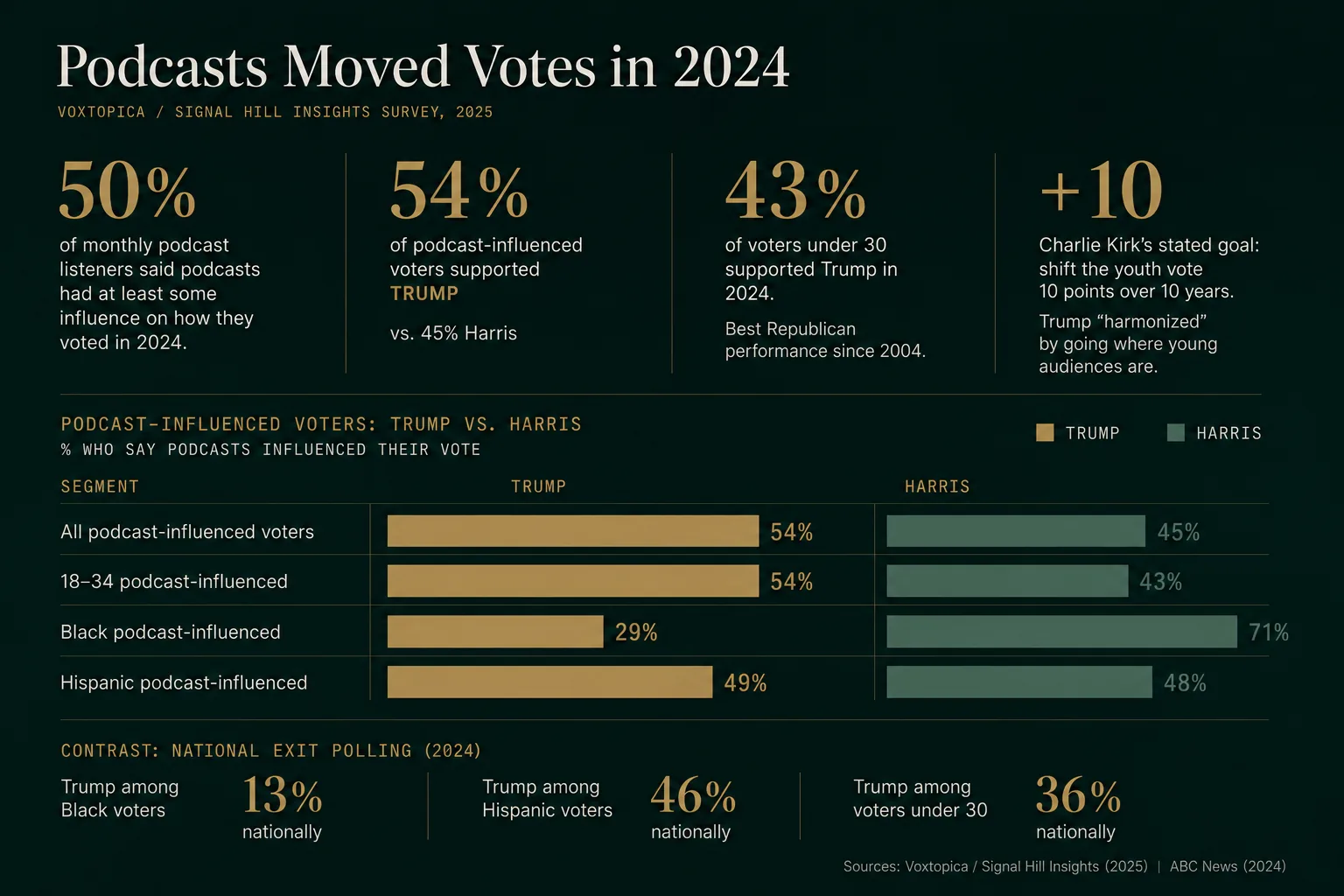
Politics has already made this migration. The 2024 US cycle was fought on podcasts as much as on television, with Donald Trump's Joe Rogan appearance alone passing 50 million views, and the cycle now remembered as the podcast election. Closer to this report's subject, Andy Burnham's recent media run, LBC, Times Radio, Novara Media, the Guardian's Today in Focus and BBC Newscast, shows a serious politician working the modern surface area on purpose. The people whose job is winning public consent have concluded that the room moved. The data-centre industry, whose licence to build depends on exactly that consent, is behaving as though it did not.
Figure The podcast vote, measured.
Share of podcast-influenced voters and the under-30 swing, 2024. Voxtopica · Signal Hill Insights 2025; national exit polling via ABC News 2024.
VerifiedUK trust in news 30%, US 25%, both a ten-year low; 5.66bn global social media users. Reuters Digital News Report 2026; DataReportal 2026.
VerifiedTrump’s Joe Rogan appearance passed 50 million views; nearly two-thirds of Britons under 35 get news mainly from social.
VerifiedLong-form podcast appearances were a defining, widely-cited feature of the 2024 US election.
The two-audience problem
The same sector, heard clearly by one audience and barely at all by the other. The gap is not competence. It is which room each side is standing in.
Verified Reaches the boardroom
Investors are well served
CNBC, the BBC business desk, the FT and LinkedIn are excellent at reaching investors, executives and analysts. For that audience the sector’s case is clear, sober and largely accurate, and it lands.
Misinformation Reaches everyone else
The public and the policymaker are not
The household next to the substation, the resident scrolling at night, and the councillor or MP forming a view get their information somewhere else, the feed, and there it is vast, emotive and often false. The investor hears the truth; the neighbour and the lawmaker are fed the misinformation.
The read · The power shift
Legacy media is losing to the individual
Traditional platforms, the BBC, the broadsheet, the bulletin, are ceding the room to new media and to individuals: podcasters, creators and people with an audience of their own. The politicians already followed them there. The data-centre industry stayed in the room the broadcast is emptying. Scroll the migration, and why, in my read, the sector’s approach will not hold.
01
The podcast election
The 2024 US cycle was fought on podcasts as much as television. Trump’s Joe Rogan appearance alone passed 50 million views. The room where public consent is won had already moved, and the winners knew it.
02
Burnham works the surface
Andy Burnham’s media run, LBC, Times Radio, Novara, Today in Focus, BBC Newscast, is a serious politician working the modern surface area on purpose. Not a statement desk. The feed.
03
Affinity beats the press release
The migration is to personality and affinity: creators, long-form, comments and duets. High-trust, hard to counter, and nothing like a right of reply in the trade press.
04
The sector answers somewhere else
Data-centre leaders defend the build in the business desk, the trade press, the conference panel. Correct, sober, evidenced, and aimed at a room the deciding audience has already left.
05
Why it will not work, in my read
Being right is not enough when perception becomes policy in a room you are not in. The politicians who win consent are already on the feed. Until the sector shows up there, the facts keep losing to the caption.
This is the turn the whole piece rests on. The engineering case is sound and the numbers are on the sector’s side. The distribution is not. Right on the facts, missing from the fight.
When the public turns, policy follows
Perception is not a soft problem to be managed after the fact. It is the upstream cause of the hard ones: moratoria, refusals, and a licence to build that quietly evaporates.
The history of infrastructure is full of technologies that lost the public before they lost the argument, and had policy turn against them regardless of the evidence. Germany's nuclear exit within months of Fukushima, the EU's block on GMOs, England's seven-year de facto ban on onshore wind, the 5G health panic, are the canonical cases: in each, sentiment hardened, and law and permitting followed the sentiment, not the science. Data centres are now walking the same path, faster, because the feed compresses the timeline.
The evidence is no longer anecdotal. A Gallup poll this March found 71 per cent of Americans oppose a data centre in their area, 48 per cent strongly, which makes them more unpopular than a nuclear plant. The most-cited reason, named by 50 per cent, was their effect on resources, the water-and-power story the companion brief shows is largely mismeasured. That sentiment is already converting into policy: the anti-data-centre movement has driven 93 local moratoriums across 35 US states, 62 still active and seven outright bans, from Seattle and Denver to permanent bans in New Jersey and North Carolina. Ireland paused new grid connections for four years; Amsterdam now allows no new data centres at all; Virginia's Loudoun County, the densest cluster on earth, stripped them of by-right development. And brands have begun to monetise it. When an 89-year-old camera company decides its sharpest marketing angle is attacking data centres, the culture has moved, and the sector is the villain by default.
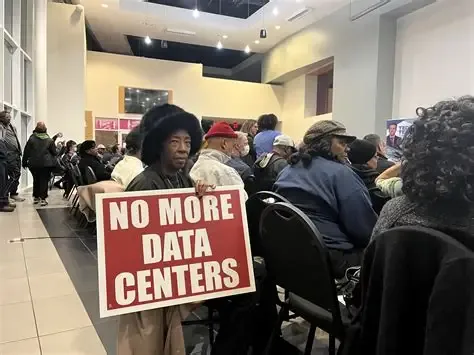
Figure The public, in the room.
A resident at a data-centre planning hearing, 2026. This is where perception becomes policy.
The backlash, itemisedENT-DC-BACKLASH-2026
Six objections. Two the sector can win.
This is the mechanism the industry underrates. A hostile comment section is not noise, it is the leading indicator of the next refused planning application, the next moratorium, the next line in a manifesto. Perception is the top of the funnel; permitting is the bottom.
Not every complaint is equal. Graded against the evidence, the backlash splits into fights the sector can win on the facts, and fights it can only win by delivering. The mistake is answering all six the same way, with a statistic.
6
objections, graded
2
winnable on the facts
4
won only by delivery
71%
oppose a nearby data centre (Gallup)
VerifiedGallup, March 2026: resource use was the most-cited reason for anti-data-centre views, near 50 per cent.
VerifiedThe US anti-data-centre movement has secured moratoria in multiple towns and cities.
ContestedThat the resource case against data centres is accurate as popularly stated. See The Wrong Numbers.
This is the short version. The full objection-by-objection breakdown, with the water and power numbers laid out, is the subject of the companion brief The Wrong Numbers; the on-the-ground opposition is tracked market by market across the report.
The reframe, made literal
The same medium, aimed the other way. On the left, a real campaign that cast data centres as the villain. On the right, an Entelligencia reimagining: the same quiet infrastructure, framed as the thing that lets the analogue life run.
The original
A camera brand’s anti-AI campaign, built on the water-and-power story, with the data centre cast as the thing to fear.
The reimagining
The same format, reframed: the infrastructure reads as the quiet engine behind the analogue life, not its enemy. This is the move the sector has not made.
The read
Show up where the fight is
Entelligencia · Adam Roberts
The industry’s problem was never that its facts are wrong. It is that it brings facts to a fight about feeling, on a battlefield it abandoned.
The instinct after reading this is to commission another white paper on closed-loop cooling. That instinct is the disease, not the cure: a message perfectly designed for a room that emptied a decade ago. The sector has every advantage it needs, capital, genuine good news, and opponents whose best arguments are, on the merits, wrong. It is simply not showing up.
Showing up means going where the audience is, funding creators and native formats rather than a corporate account posting PDFs. It means fighting feeling with feeling, the jobs, the resilience, the scan that ran on that rack, because emotion is not beneath the argument, it is the argument. It means being fast and native, a correction in the first hour and in the format of the attack, not a right of reply three days later. And it means attributing the demand honestly and delivering a real local win, so the villain narrative loses its subject.
Concretely, it means stopping some things. Cancel the next conference panel and shelve the next white paper, and move that budget into ten creators on retainer, a rapid-response desk that can answer inside the hour, and one campaign that reframes the building the way the section above does. The reframe is not a thought experiment. It is the brief.
In conclusion
The escape is the tell
My own read is blunter than the analysis above. The escape to orbit is the honest admission underneath all of this: the sector would rather spend billions leaving the planet than spend a fraction of it winning the room.
On the current trajectory, that choice is a forecast of who writes the rules, the people in the comment section, or the people who never joined it. Being right has stopped being enough. The room moved, and the industry stayed behind.
So the mandate is plain. Data-centre stakeholders have to start talking to the world directly: stronger social campaigns, native marketing, real creators, and the sector’s own voice in the feed where consent is now won and lost. Fund it like it matters, move at the speed of the clip, and show up. Or keep handing the room to the people who already did.
And it should not fall to the sector alone: governments ought to teach how the modern world actually runs, the data centres behind it, the energy it costs, and the real environmental and technology trade-offs, starting in the classroom, while the industry funds that public understanding and fights with the right tactics rather than the old ones.
The Next Hotspot · dropping
One study down. The map is next.
Losing the Room is a Sociogencia case inside The Next Hotspot, an interactive read on where the world actually builds AI infrastructure. The full edition is live, and the remaining drops are dated below.