Connected,
not yet powered.

Twelve cable systems and a pipeline five to six times the installed base, but only 38 MW of new connections approved and a grid short of firm energy to 2030.

44.3 to 58MWInstalled · contested
38of 157 MWApproved by UPME · verified
12Cable systems · verified

What the Colombia picture actually shows.

A hotspot of announcements with a few megawatts of delivery. Power is the gate.

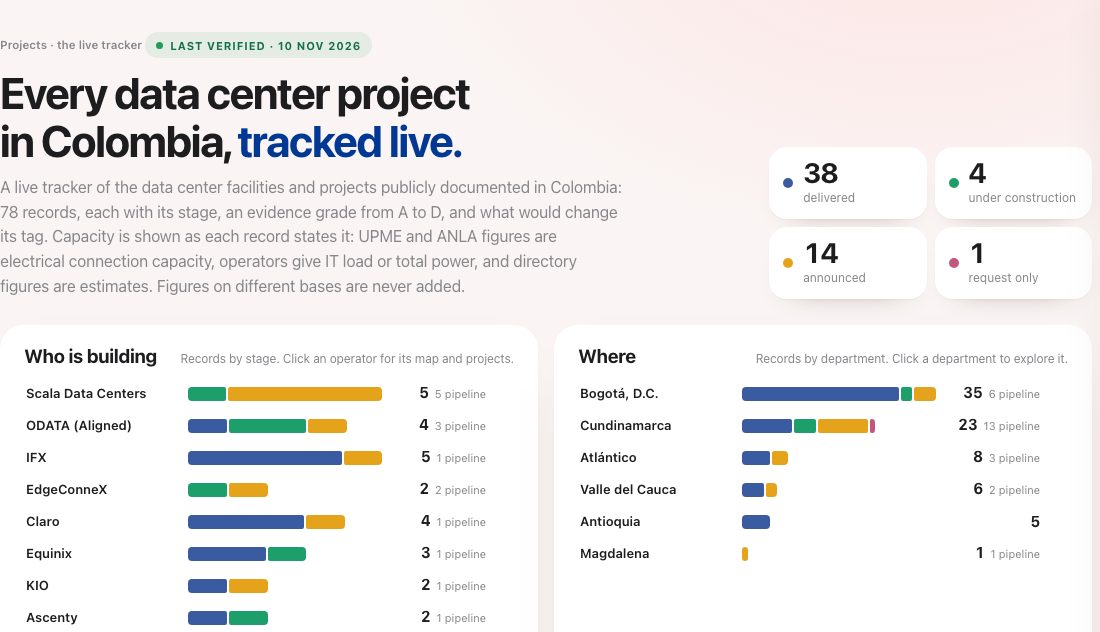
Colombia in November 2026 is a small, single-metro data center market. Named sources put installed capacity between 44.3 MW (CBRE, Q1 2026) and 58 MW (Cushman and Wakefield, H1 2026), almost all of it in Bogotá and five Sabana municipalities; the figure is contested and this page shows every source. Against that sit 250 to 390 MW under construction or planned, depending on the source. About half belongs to one developer, ODATA, whose 120 MW Tenjo campus holds a licensed grid connection of 50 MW.

The constraint is not national energy in the abstract. It is deliverable, firm capacity at a handful of named Sabana substations. The grid operator's bulletins, as relayed by the press, show demand above firm energy in every year to 2030. Spot power rose from COP 113 per kWh in June 2025 to COP 947 per kWh in August 2026. In the one connection cycle on record the planning agency UPME approved 38 MW for ODATA and Scala, with in-service dates of 2028 and 2030, conditional on two transmission lines approved more than a decade ago and still unbuilt. A wider reading, that requests linked to data centers in that cycle total about 397 MW, depends on an inference about three applicants that UPME does not make.

Connectivity is the strong card: twelve cable systems and about 57 ms to Miami. Eleven of the twelve land on the Caribbean, about 700 km from the market, and 57 ms is also the argument for serving Colombia from Florida. Bogotá is the cheapest regional market to build in, at US$7.49 per watt on Turner and Townsend's index, and proven demand is thin: vacancy of 18.7% and 1.1 MW of quarterly absorption on CBRE's count.

The government of President Abelardo de la Espriella, in office since 7 August 2026, has promised a strategy for computing and data centers and filed a tax bill that would, as reported, create a 20% regime for large investments, with the digital economy among the eligible sectors. As of 10 November 2026 neither exists in law. Its first months were also shaped by the earthquake of 10 August 2026, magnitude 7.4, with 287 dead and 194 missing at 16 August on official figures. The thesis of this chapter: the pipeline that matters is the connection queue, and the next eighteen months hold three datable tests. Whether the system gets through the dry season of 2026 to 2027 without rationing. Whether ODATA energises anything in Tenjo or Mosquera. Whether Congress passes instruments that name data centers.

How this chapter is graded. Verified means the research opened the primary document or the issuing body's own page. Announced means a statement by the company or government concerned, not yet delivered, including press relays of such statements. Contested means sources disagree, and each is shown. Estimated covers broker and analyst figures, grid operator figures that reached the research through press relays, and Entelligencia arithmetic. There is no Contributed content for Colombia yet. The evidence base is uneven: permits and zoning, subnational offers, regulated tariffs and hyperscaler region plans are thin and are flagged where they appear.

Entelligencia desk · Colombia · 10 November 2026
Start with the map

Every site, pinned against the grid that decides it.

Each pin is a real facility, project or announcement, coloured by what it is today. Megawatts appear only where a source gives them. Choose a region or a numbered cluster to zoom, open a pin for the brief, and switch the overlays on.

Region
Overlays
Cable landings
Connection decisions
Grid constraint
Seismic hazard
La GuajiraMagdalenaAtlánticoCesarBolívarSucreCórdobaNorte de SantanderAntioquiaSantanderAraucaChocóBoyacáCasanareCaldasRisaraldaVichadaCundinamarcaBogotá, D.C.QuindíoTolimaValle del CaucaMetaGuainíaHuilaCaucaGuaviareNariñoVaupésCaquetáPutumayoAmazonas VENEZUELAECUADORPERUBRAZILPANAMACaribbean SeaPacific Ocean
Verified
Project
Location

Body.

Operating 14 Under construction 3 Planned or announced 4 Contested or unverified 5 3Sites that overlap at this zoom
Pins in view26Dominant constraintFirm power

Method. Department boundaries are Natural Earth, generalised, and are not legal limits; neighbouring countries are Natural Earth, shown for context. San Andrés and Providencia are off the frame. Pin positions are the research’s approximate placings at park or municipality level, nudged apart on screen where sites share a park, and grouped into a numbered cluster where they overlap at the current zoom; they are good enough for a country map and not for a site plan. Announcements with no site are placed at city or department level and say so. Megawatt figures mix bases (IT load, total facility power) and are never summed. Cable landings are town-level points from TeleGeography; only the Salgar station is registry grade. The grid overlay tints the Caribbean departments indicatively: XM’s count of 352 of 367 disconnection instructions on the coast to 15 October 2026 came via Portafolio without a department list. Seismic categories are shown only for the four cities the research sources (El Universal, 7 July 2026); Barranquilla and Cartagena are not formally categorised in those sources.

Power, on the instruments.

A working file in five entries. Each opens into its own chart, with the grade, the source and the date printed beneath it. One source per series.

Colombia power monitor · working file as of 10 November 2026ENT-CO-PWR-2026.11

Colombia’s preconditions, scored.

Each spoke is one precondition, scored 0 to 10 for like-for-like reading. The scores are Entelligencia’s editorial judgement, graded Estimated, and not a published index; the evidence behind each is cited in its row. Select any spoke or row to read the factor.

Eight findings behind the constraint.

Compiled 10 November 2026
The licensed grid tie, Tenjo1,037 m at 220 kV, 50 MW assigned. ANLA, 16 September 2026.The Sabana de Bogotá from the air. Photo: EEIM, CC BY-SA 3.0, Wikimedia Commons
Five systems on one shoreBarranquilla and Puerto Colombia, along the Salgar shore. TeleGeography, 10 November 2026.The pier at Puerto Colombia. Photo: Kamilokardona, CC BY-SA 3.0, Wikimedia Commons
The queue, on paperResolution 342 of 13 May 2026: 38 MW approved for two operators.Illustration, not a Colombian site. Photo: Novoklimov, CC BY 4.0, Wikimedia Commons

The paper trail, annotated.

Three primary documents the research opened: the planning agency’s connection ruling, the licence for the Tenjo line and the national AI policy. Each line is Entelligencia’s summary of what the document establishes, graded claim by claim; none of it is quotation. Choose a document, then select an underlined claim to read the analysis.

 marked by Entelligencia

The market behind
the power gate.

Colombia has the cables, the cost base and the announcements. Ten stages on what stands between them and operating megawatts: the connection queue, the reservoirs, two late transmission lines and a new government. Every entry carries its grade and its source.

Scroll to begin
Where the capacity sitsSix clusters in Bogotá and the Sabana · research registry, placings approximate
BogotáZona Franca de Bogotá6 MW class sitesCota and TenjoODATA, Tigo TitaniumFunzaClaro TriaraMosquera10 to 24 MW sitesTocancipáTier IV positioningBogotá cityCarrier and telecom sites
Bogotá at night, from Plaza de Bolívar. Photo: ProtoplasmaKid, CC BY-SA 4.0, Wikimedia Commons
Planned against connectedCircle areas proportional to megawatts · solid: connection granted · ANLA; ODATA; UPME
50 MWconnection assigned120 MW IT plannedODATA BG03, Tenjo · Announced24 MWODATA BG02, MosqueraAnnounced20 MWScala, TocancipáApproved for 203018 MWODATA, IntexzonaApproved for 2028
The Sabana de Bogotá from the air. Photo: EEIM, CC BY-SA 3.0, Wikimedia Commons
Requested against approvedMegawatts in the one resolved Bogotá cycle · UPME Resolution 342 of 2026 · Verified
ODATA, Intexzona18 of 18 MWApproved for 18 December 2028Scala, Tocancipá20 of 139 MWStage 1 approved, for 19 December 2030Pampa, Tenjo and La Constancia240 MWNo express decision · MW read from filed names38 MWapproved of 157 MW requested by ODATA and ScalaApprovedRequested
Illustration, not a Colombian site. Photo: Novoklimov, CC BY 4.0, Wikimedia Commons
The firm energy gap, by yearGWh a year of demand above firm energy · XM Boletín 364 via Portafolio · Estimated
04,0008,00012,0004,9792025 to20267,6692026 to20278,0152027 to202810,3002028 to202910,6032029 to2030
Chuza reservoir, Chingaza. Photo: Jedidiahhorne, CC BY-SA 4.0, Wikimedia Commons
The two delayed linesShare built · Portafolio, 2 August and 10 September 2026 · schematic, not a map
Chivor IINorteBacatá230 kV · Grupo Energía Bogotá, EnlazaAbout 80% builtNot in serviceDated 17 August 2027SogamosoNorteNueva Esperanza500 kV · Grupo Energía Bogotá, EnlazaAbout 66% builtNot in serviceHoped for in 2027
Illustration, not a Colombian site. Photo: Stefan Andrej Shambora (St_A_Sh), CC BY 2.0, Wikimedia Commons
CARIBBEAN LANDINGS11 OF 12 CABLE SYSTEMSBOGOTÁ AND THE SABANA44.3 TO 58 MW INSTALLED · CONTESTEDABOUT 700 KMBUENAVENTURA · 1 PACIFIC SYSTEM
Motion graphic · schematic, not to scale
Three changes of control in 2026As reported · TelecomTV; Total Telecom; TeleSemana
July 2026AIP, MGX and GIPbought AlignedODATABG01, BG02, BG03October 2026SoftBankbought DigitalBridgeScalalistings onlyJanuary to April 2026Millicomreached 100%Tigo and MovistarTitanium and others
Illustration, not a Colombian site. Photo: BalticServers.com, CC BY-SA 3.0, Wikimedia Commons
The first 100 daysMinTIC; Portafolio; Revista Mercado
7 Aug 2026Government takes office2 Sep 2026Plan TIC 2026 to 2030 opened for co-design16 Sep 2026Technology pact with five companies29 Oct 2026Bill 477 filed in the HouseAbout 15 Nov 2026Day 100: data center strategy falls dueNot published at 10 November 2026
Casa de Nariño, Bogotá. Photo: Juanjo70000, CC BY-SA 4.0, Wikimedia Commons
Income tax ratesEstatuto Tributario, article 240-1; Revista Mercado, as reported
General corporate rate · in force35%Free trade zone, export income only · in force20%Proposed regime for large investments · pending20%Proposed general rate from 2028 · pending31%Whether "digital economy" covers data centers is not confirmed: bill text not opened
Capitolio Nacional, Bogotá. Photo: Rikimedia, CC BY-SA 3.0, Wikimedia Commons
The calendar to June 2028UPME; Portafolio; El Colombiano; TeleGeography
Jan 2027Jul 2027Jan 2028Jun 2028Dry season under El NiñoFirst regular UPME filing windowChivor II to Norte to Bacatá, reported dateHidroituango units 5 to 8, announcedMANTA cable ready for service, announced
Bogotá, Santa Fe. Photo: Steffen Schmitz, CC BY-SA 4.0, Wikimedia Commons
Bogotá and the Sabana · one metro

One metro, six clusters.

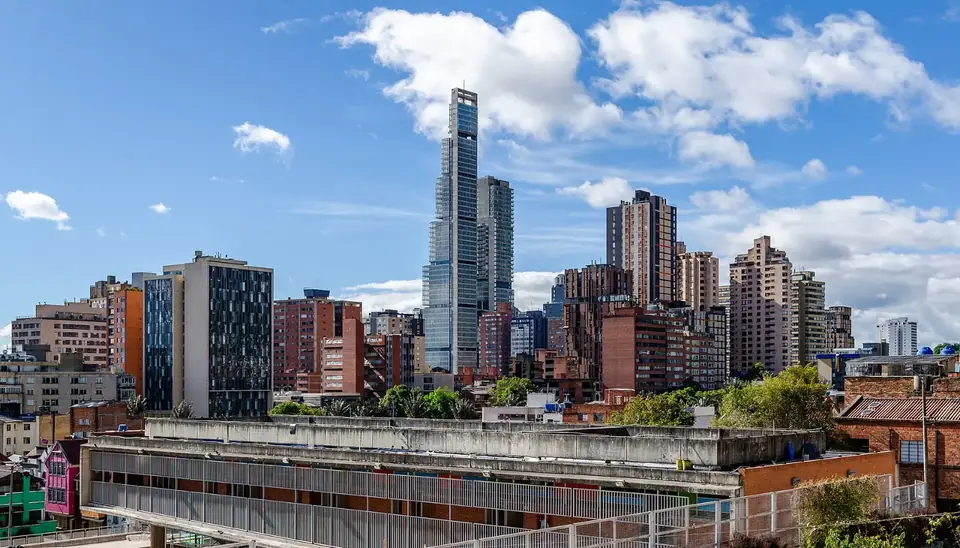
Almost all of Colombia's commercial data center capacity sits in Bogotá and five Sabana municipalities. Published estimates of what is installed differ by a factor of two, mostly because they count different things.

The clusters follow free trade zones, carrier density near El Dorado airport and, for the newest sites, transmission substations in the western Sabana.

44.3MWCBRE inventory, Bogotá, Q1 2026
58MWCushman and Wakefield operating, H1 2026
Contested
Facility counts in circulation
25 (Arizton) · 30 in Bogotá (Cushman and Wakefield) · about 42 (Víctor Muñoz) · no public registry exists
Contested
Claro: about 50% of installed capacity
Company claim, no megawatt figure published
Announced
Bogotá share of operating IT load
Arizton: "nearly 88%" (June 2026, via Research and Markets)
Estimated

The pipeline is one project deep.

Only one project above 20 MW has regulator-grade evidence: ODATA BG03 in Tenjo, planned at 120 MW of IT load. Its 220 kV grid tie was licensed on 16 September 2026 with an assigned connection capacity of 50 MW.

The gap between 120 and 50 is the honest measure of what is real today. Switch between the three grades to read the rest.

120MWODATA BG03, planned IT load, announced
50MWConnection capacity assigned, ANLA, 16 September 2026

38 MW approved, in service 2028 and 2030.

Large loads apply to the planning agency UPME for transport capacity. The one resolved Bogotá cycle on record, Resolution 342 of 13 May 2026, approved 18 MW for ODATA at Intexzona and 20 MW of a 139 MW Scala request at Tocancipá.

Four further requests by three other companies, 240 MW by their filed names, received no express decision. Whether those companies are data center developers is not stated by UPME.

38MWApproved for ODATA and Scala
157MWRequested by ODATA and Scala
ODATA, Intexzona 115 kV
18 MW approved with conditions · in service 18 December 2028
Verified
Scala, Zona Franca de Tocancipá
20 MW of 139 MW approved · in service 19 December 2030
Verified
Pampa 120 MW, Tenjo 60 MW, La Constancia 20 and 40 MW
No express decision · promoters not identified by UPME as data center developers
Verified
About 397 MW of data center-linked requests
Only if the three other promoters are data center vehicles: an inference from names
Estimated

A very strong El Niño meets a hydro system.

The grid operator XM projects demand above firm energy in every year to 2030, and each 2026 bulletin has widened the gap. NOAA put the Niño-3.4 index at +2.1°C on 8 October 2026.

The counterweight belongs in the account: reservoirs entered the dry season at about 78%, and, as one sector analyst reads XM's simulations, XM is not forecasting rationing: its warning is conditional on a dry season as severe as the worst on record.

7,669GWhDemand above firm energy, 2026 to 2027, XM Boletín 364 via Portafolio
78%Reservoir level, about 6 November 2026, via La República
Firm energy gap, 2026 to 2027
7,669 GWh (8.3%) · XM Boletín 364, 16 October 2026, via Portafolio
Estimated
Firm energy gap, 2029 to 2030
10,603 GWh · same bulletin
Estimated
Niño-3.4 index at +2.1°C
NOAA discussion of 8 October 2026
Verified
Spot price, August 2026
COP 946.6 per kWh, up 278.2% on August 2025 · XM via Portafolio
Estimated
No rationing forecast, on an analyst's reading of XM
Risk conditional on a record dry season · Valora Analitik, 17 June 2026
Estimated

The two lines Bogotá needs were approved more than a decade ago.

Both belong to Grupo Energía Bogotá through Enlaza. Chivor II to Norte to Bacatá (230 kV) is about 80% built and now dated 17 August 2027. Sogamoso to Norte to Nueva Esperanza (500 kV) is about 66% built and hoped for in 2027.

UPME writes both lines into its connection approvals as conditions.

80%Chivor II to Norte to Bacatá, built
66%Sogamoso to Norte to Nueva Esperanza, built
Chivor II to Norte to Bacatá, 230 kV
About 80% built · dated 17 August 2027
Estimated
Sogamoso to Norte to Nueva Esperanza, 500 kV
About 66% built · hoped for in 2027
Estimated
Approvals conditional on both lines
UPME Resolution 342
Verified
About 60% of 42 national transmission projects delayed
XM tracking, via Portafolio, 31 August 2026
Estimated

Twelve cables on one coast.

TeleGeography lists 12 systems touching Colombia on 10 November 2026: nine in service and three still flagged as planned. Eleven are Caribbean, one touches the Pacific, and none lists a hyperscaler as an owner.

The landings are about 700 km in a straight line from the Bogotá market. Bogotá to Miami measured 57.5 ms on 9 November 2026 on a single probe pair.

12Cable systems, TeleGeography, 10 November 2026
57.5msBogotá to Miami, WonderNetwork, 9 November 2026
Nine systems in service, three planned
TeleGeography, 10 November 2026
Verified
Cable count in circulation
12 (ministry and regulator) · 10 plus 2 or 3 (ProColombia) · 9 and 3 (Arizton)
Contested
TAM-1 status
LinkMax says in operation (September 2026) · TeleGeography says planned, December 2026
Contested
Claro and Azteca fiber integration
Regulator: Claro sole transport provider on 778 of 874 routes · competition ruling pending
Estimated

Three owners changed hands in 2026.

Foreign funds and telecom groups own the operators. In 2026 the parents of ODATA and Scala changed hands, and Millicom reached 100% of both Tigo-UNE and Movistar in Colombia.

Money reaches Colombian sites through parent-level facilities. No Colombia-specific project financing has been published, which is a finding of "not found" and not a confirmed absence.

US$1.02bnODATA green financing, September 2025, four countries, no split
3Parent chains changed in 2026
Aligned (ODATA) sold to AIP, MGX and GIP
Closed July 2026 · about US$40 billion enterprise value, as reported
Announced
SoftBank completed purchase of DigitalBridge (Scala)
Completion reported 1 October 2026 · about US$3.1 billion
Announced
Millicom at 100% of Tigo-UNE and Coltel
January to April 2026, as reported
Announced
ODATA US$1.02 billion green financing
Nine financial partners · Brazil, Mexico, Chile and Colombia · no country split
Announced

A new government, and a strategy not yet published.

President Abelardo de la Espriella took office on 7 August 2026. The ICT ministry's Plan TIC 2026 to 2030 lists "a strategy for computing and data centers" among its first 100 days actions.

As of 10 November 2026 no text of the plan or the strategy had been published, and Colombia has no data center law, decree, incentive or roadmap in force.

7 Aug2026Government took office
0Data center instruments in force, 10 November 2026
Alexandra Falla Zerrate, ICT minister
MinTIC page dated 8 August 2026
Verified
Strategy for computing and data centers
Listed as a first 100 days action · not published by 10 November 2026
Announced
Technology pact with Google, Microsoft, Amazon, Oracle and HPE
16 September 2026 · no amounts or data center commitments
Announced
CONPES 4144, National AI Policy
Approved 14 February 2025 · about COP 479,000 million (2025)
Verified

A 20% regime, if it survives Congress.

Bill 477 of 2026, the "Ley de Rescate", was filed on 29 October. As reported, it would create a regime for large investments with 20% income tax and a minimum investment of COP 290,000 million (2026) for industry and the digital economy.

The bill text was not opened by the research, so whether "digital economy" covers data centers is not confirmed. The government has no majority of its own and positions on the bill are contested.

20%Income tax in the proposed regime, as reported
35%General corporate rate in force
Bill 477 of 2026 filed in the House
29 October 2026 · as reported by Revista Mercado
Announced
Size of the bill
Figures in circulation measure different things: COP 77 trillion to be raised (La Silla Vacía); about COP 51 trillion fiscal improvement in 2027 (Presidency, via Revista Mercado)
Contested
Free trade zone rate: 20% on export income only
Estatuto Tributario, article 240-1
Verified
Positions in Congress
Senate president lists red lines · parties split · 9 November 2026
Contested

Three tests, all with dates.

Whether the system gets through the dry season of 2026 to 2027 without rationing. Whether ODATA energises anything in Tenjo or Mosquera. Whether Congress passes a tax regime and a development plan that name data centers.

The pipeline that matters is the UPME connection queue and the two lines whose completion gates it. Below, the same record as evidence, documents, people and a map.


Apr 2027End of the dry season
17 Aug2027Chivor II to Norte to Bacatá, reported date
ODATA first phases, BG02 and BG03
Company target: end of 2026 · no commissioning reported
Announced
First regular UPME filing window
January 2027, under Resolution 443
Verified
New firm energy auction circular
Announced as coming soon, October 2026; no date
Announced
MANTA cable ready for service
Q1 2028 on TeleGeography
Announced

The real pipeline is a queue. It has been read once.

Announcements say 300 MW and more. The planning agency’s one published ruling for the Bogotá area says something narrower. This console reads UPME Resolution 342 of 13 May 2026 request by request: what was approved, what was refused, what received no decision, and the rules that now apply. Megawatts shown “from the name” are read from the filed project names. Run a view, filter by grade, open a row for the read.

UPME Resolution 342 of 2026 · Bogotá area
One resolved cycle on record · 12 entries graded at row level
Illustration, not a Colombian site. Photo: Novoklimov, CC BY 4.0, Wikimedia Commons
entelligencia@queue ~ $ queue --res 342 --status approved

# Two data center operators received transport capacity in the one resolved Bogotá cycle. Both approvals are conditional on works owned by others: the two Grupo Energía Bogotá lines, the Nueva Esperanza works and Enel's 115 kV projects.

The request and the grant match: ODATA asked for 18 MW and received 18 MW. The date is the constraint. UPME's own records list a new Intexzona 115 kV substation for 31 December 2026.

# source: UPME Resolution 342 of 13 May 2026

Scala asked for 139 MW in three stages of 20, 44 and 75 MW. Only the first was granted. Scala has no operating site in Colombia and no operator statement confirms its listed sites.

# source: UPME Resolution 342 of 13 May 2026; UPME notice of Resolution 342 to Scala Data Center Colombia S.A.S.

An industrial user, not a data center. Shown because it sat in the same cycle and was approved in full, which shows smaller loads can clear.

# source: UPME Resolution 342 of 13 May 2026
3 rowsENT-CO-Q-APPROVED

Three readings follow. A Sabana campus of 20 to 140 MW asks for 115 kV on the regional system, and larger projects also ask for 220 kV at Bacatá. Three to five and a half years from filing to power is the observed range. And the realistic energisation window for new Sabana campuses is 2028 to 2030, even with paperwork in hand. Only one cycle is on record: the August and December 2026 rulings were not found by the research.

12 entries, graded at row level Source: UPME Resolution 342 of 2026; Resolution 443 of 2026

Who actually decides Colombia’s data center buildout.

Twelve people chosen for their bearing on whether megawatts get built: the ministers and regulators in post, the operators and carriers, the generators and the association. Titles are as printed in the source; quotations are the wording the source printed, with a translation labelled as such. Nobody here is a contributor to this chapter. Select a person for the profile.

Portrait sources

From capital to compute · who’s active in Colombia

Colombia supply chain · evidenced names only
Hover any node · Click for detail
Owners and investors
AIP, MGX and GIP
SoftBank and DigitalBridge
I Squared Capital
Stonepeak
Digital Realty and Brookfield
Millicom
Patria Investments
Suppliers
Vertiv
Schneider Electric
Hitachi Energy
Tesla Transformadores and Rymel
STULZ
Turner and Townsend
InterNexa
LinkMax
Operators
ODATA
Equinix
Claro
Ascenty
Cirion
KIO Data Centers
HostDime
EdgeConneX
Tecto (V.tal)
Scala Data Centers
Gtd
IFX
Cloud providers
Oracle
AWS
Google
Microsoft
Corporates and state
Banco de la República · Bre-B
Nube Pública V
D1 · Rappi · Carvajal
AI workloads
OCI GPU
10 to 50 kW racks
Flow

Capital flows left to right, from owners and investors through suppliers and operators to the cloud providers, buyers and workloads that consume the stack. Only companies with evidence of a Colombian role are shown. Hover any node to trace its position. Click for the brief.

06 tiers · 36 entities

Tiers five and six are short on purpose. Hard public numbers on buyers are thin, and no training-scale AI load is confirmed in Colombia. Generator makers, general contractors, engineers of record, energy retailers and law firms without a documented Colombian data center role are left out. Lines between nodes mark a documented relationship: ownership, a named supply or hosting link, an on-ramp or a handover point.

More in Enable Colombia.

This chapter is the briefing. Colombia is covered in depth in Enable Colombia: Edition 03 of the Enable programme, running to June 2028.
Edition 01BrazilEnable Brazil
Edition 02ChileEnable Chile
Edition 03ColombiaEnable Colombia · to June 2028
Edition 03 Enable Colombia cover

Colombia, covered in depth.

Enable Colombia is the third edition of the Enable programme. It runs to June 2028, with two convenings: San Francisco in Q1 2028 and Bogotá in Q2 2028. Dates and venues are to be confirmed.

03
Edition of the Enable programme
June 2028
Programme runs to
2
Convenings · San Francisco and Bogotá
Register interest
Two convenings
San Francisco · Q1 2028
Enable Colombia, San Francisco
Date and venue to be confirmed.
Bogotá · Q2 2028
Enable Colombia, Bogotá
Date and venue to be confirmed.
Register interest in Enable Colombia

Or write to hello@entelligencia.co.uk.