The market behind
the power gate.
Colombia has the cables, the cost base and the announcements. Ten stages on what stands between them and operating megawatts: the connection queue, the reservoirs, two late transmission lines and a new government. Every entry carries its grade and its source.
One metro, six clusters.
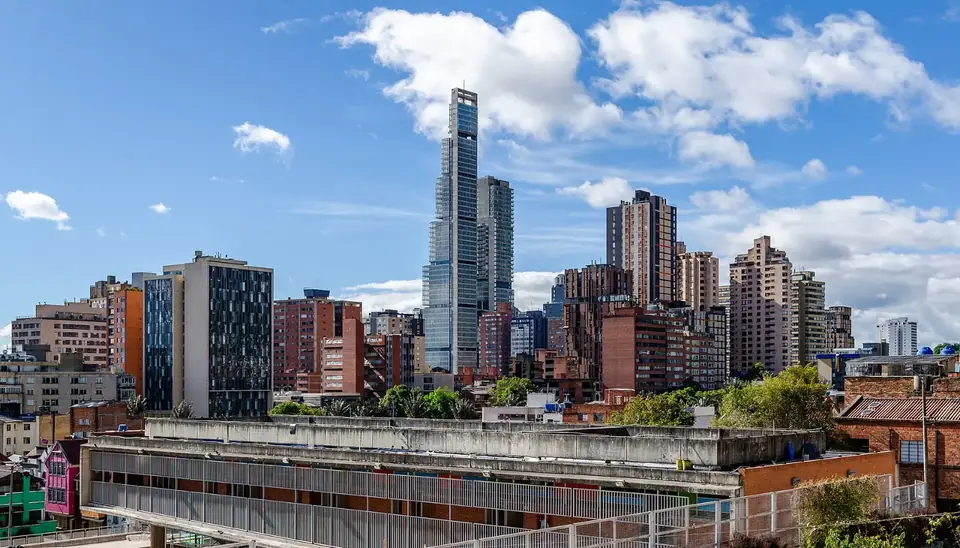
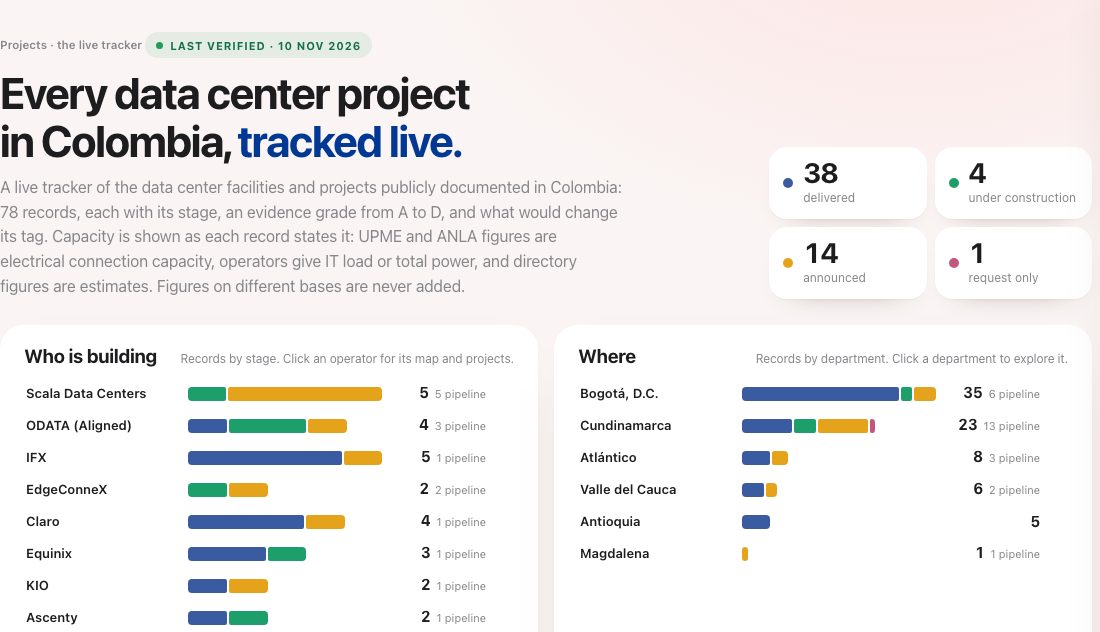
Almost all of Colombia's commercial data center capacity sits in Bogotá and five Sabana municipalities. Published estimates of what is installed differ by a factor of two, mostly because they count different things.
The clusters follow free trade zones, carrier density near El Dorado airport and, for the newest sites, transmission substations in the western Sabana.
The pipeline is one project deep.
Only one project above 20 MW has regulator-grade evidence: ODATA BG03 in Tenjo, planned at 120 MW of IT load. Its 220 kV grid tie was licensed on 16 September 2026 with an assigned connection capacity of 50 MW.
The gap between 120 and 50 is the honest measure of what is real today. Switch between the three grades to read the rest.
38 MW approved, in service 2028 and 2030.
Large loads apply to the planning agency UPME for transport capacity. The one resolved Bogotá cycle on record, Resolution 342 of 13 May 2026, approved 18 MW for ODATA at Intexzona and 20 MW of a 139 MW Scala request at Tocancipá.
Four further requests by three other companies, 240 MW by their filed names, received no express decision. Whether those companies are data center developers is not stated by UPME.
A very strong El Niño meets a hydro system.
The grid operator XM projects demand above firm energy in every year to 2030, and each 2026 bulletin has widened the gap. NOAA put the Niño-3.4 index at +2.1°C on 8 October 2026.
The counterweight belongs in the account: reservoirs entered the dry season at about 78%, and, as one sector analyst reads XM's simulations, XM is not forecasting rationing: its warning is conditional on a dry season as severe as the worst on record.
The two lines Bogotá needs were approved more than a decade ago.
Both belong to Grupo Energía Bogotá through Enlaza. Chivor II to Norte to Bacatá (230 kV) is about 80% built and now dated 17 August 2027. Sogamoso to Norte to Nueva Esperanza (500 kV) is about 66% built and hoped for in 2027.
UPME writes both lines into its connection approvals as conditions.
Twelve cables on one coast.
TeleGeography lists 12 systems touching Colombia on 10 November 2026: nine in service and three still flagged as planned. Eleven are Caribbean, one touches the Pacific, and none lists a hyperscaler as an owner.
The landings are about 700 km in a straight line from the Bogotá market. Bogotá to Miami measured 57.5 ms on 9 November 2026 on a single probe pair.
Three owners changed hands in 2026.
Foreign funds and telecom groups own the operators. In 2026 the parents of ODATA and Scala changed hands, and Millicom reached 100% of both Tigo-UNE and Movistar in Colombia.
Money reaches Colombian sites through parent-level facilities. No Colombia-specific project financing has been published, which is a finding of "not found" and not a confirmed absence.
A new government, and a strategy not yet published.
President Abelardo de la Espriella took office on 7 August 2026. The ICT ministry's Plan TIC 2026 to 2030 lists "a strategy for computing and data centers" among its first 100 days actions.
As of 10 November 2026 no text of the plan or the strategy had been published, and Colombia has no data center law, decree, incentive or roadmap in force.
A 20% regime, if it survives Congress.
Bill 477 of 2026, the "Ley de Rescate", was filed on 29 October. As reported, it would create a regime for large investments with 20% income tax and a minimum investment of COP 290,000 million (2026) for industry and the digital economy.
The bill text was not opened by the research, so whether "digital economy" covers data centers is not confirmed. The government has no majority of its own and positions on the bill are contested.
Three tests, all with dates.
Whether the system gets through the dry season of 2026 to 2027 without rationing. Whether ODATA energises anything in Tenjo or Mosquera. Whether Congress passes a tax regime and a development plan that name data centers.
The pipeline that matters is the UPME connection queue and the two lines whose completion gates it. Below, the same record as evidence, documents, people and a map.