Brazil has the cleanest hyperscale-scale grid in the world and one of the world's tightest water-efficiency thresholds written into tax law. Both could anchor a decade of buildout. Neither has yet produced a financed pipeline at the scale of the announcements.
Installed · end 2025approx 1,000MW
Announced · 2030approx 13,200MW
Financed to completion40-55%
Binding constraintEnvironmental licensing
A note from Entelligencia
Brazil in depth, in Enable Brazil.
This chapter runs a little lighter than the others in the report, by design: Brazil is covered in full depth in Enable Brazil. This page sketches the picture; the flagship maps it, operator-by-operator, named interviews, the people of the market. Publishing Q3 2027.
Convenings
New York · May 2027Brazil Week·São Paulo · September 2027
Analyst overview · 4 Aug 2026
What the Brazil picture actually shows.
The structural advantages are real. The pipeline is not.
Brazil enters 2026 with the cleanest hyperscale-scale grid of any major market, approx 85% renewable, anchored in hydroelectric capacity that no peer can match. Microsoft and Amazon have committed a combined USD 4.5 billion in cloud-and-AI capex. The Provisional Measure that became ReDATA put one of the world's tightest WUE thresholds into law. The country has, on paper, the foundation for the largest renewables-anchored AI infrastructure market in the southern hemisphere.
And yet the regime has taken a year to arrive: the provisional measure lapsed in February 2026, the replacement bill only cleared the Senate on 1 September, and the implementing regulation that sets the thresholds has still not been written. Fitch and other observers have flagged the delay. Projects announced since early 2025 remain on hold pending clarity on the thresholds. The headline 13.2 GW MME grid-connection queue, repeated across global press as Brazil's 2030 number, is, on Entelligencia's modelling, only 40 to 55 per cent financed to completion. The rest is conditional on incentives, offtake, or capital that has not yet closed.
The thesis for the chapter is this: Brazil's binding constraint is not power, water, capital, or land. It is regulatory clarity, plus a transmission build-out from the renewable-rich Northeast to the demand-rich Southeast that has not been committed at the scale required. Until both move, the gap between Brazil's announced and delivered capacity will continue to widen, and the operators who actually deliver, verified below, will hold disproportionate market share.
Entelligencia desk · South America · chapter 04 of 10
At a glance · the index
Brazil’s preconditions, scored.
Each spoke is one precondition, scored 0 to 10 for like-for-like reading – indicative editorial weighting, not a published index. Select any spoke or row to read the factor.
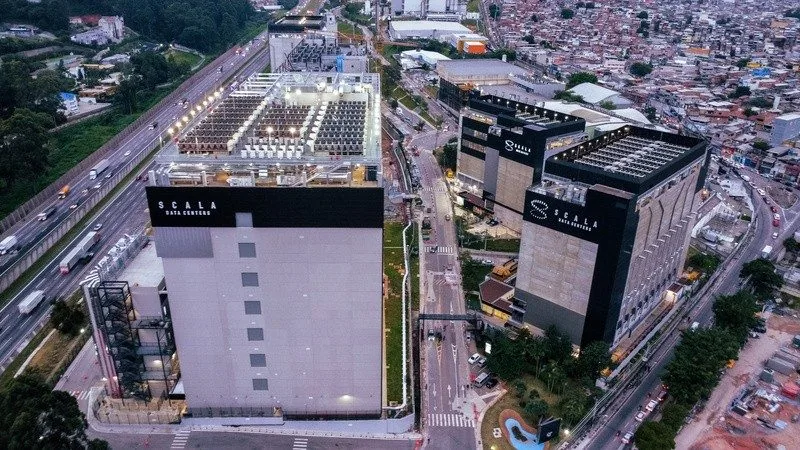
ContributedScala Data Centers, on the operator’s own account of its campus
The operator’s seatENT-BR-OP / REGULATION, THE QUEUE AND THE COST OF A MEGAWATT
Brazil is not short of power. It is short of
regulatory predictability.
Ten files from the operator side, and the longest contribution this
report has received. Luciano Fialho scores Brazil 80 out of 100 toward having a
window, then argues the constraint is neither power nor capital but two things
written in law: the tax stack on imported hardware, and a grid access process that returns
connection dates measured in years. Along the way: why Scala filed for 600 MW in 2022,
why capital underwrites precedent rather than potential, what ReData must get right and the
two things it does not solve, why Brazil can win the tariff and lose the deal, and the two
risks he says the market is not pricing. Open any file for the read.
Luciano Fialho
Senior Vice President · Scala Data Centers
RegulationGrid accessAnchor tenantsCost of ownership
Charts and latest figuresENT-BR-OP-EV
The desk has built out three of his points as charts, with the latest
published figures alongside. His reading holds across all three. Where a newer
release has landed since he submitted, the newer number is the one shown.
The cost gap, and what closes it
Cost premium on a 100 MW project against the North American benchmark. ReDATA alone does not close it. Parity needs the state ICMS as well, which Congress cannot waive.
Source · FGV Projetos with Brasscom, preliminary · commissioned by Scala and Norgás
Clean power, and the part that is thrown away
Brazil ran at 86.8 per cent renewable electricity in 2025 and curtailed about a fifth of potential wind and solar output, a loss put at R$6.5bn. That is generation already built and not used, which is the load case in one line.
Source · EPE BEN 2026 · Volt Robotics curtailment balance, January 2026
What a 100 MW project actually moves
Against R$25bn of total investment, of which R$5bn is the operator’s physical plant and R$20bn the customer’s IT equipment. GDP impact including induced effects, R$2.86bn.
Source · FGV Projetos, tables 1 and 3
Charts built by this desk from the sources named · the FGV study was commissioned
by Scala and Norgás and that interest is declared Latest figures · renewables on the 2025 release, transmission and vacancy
updated as published · this page is kept current as new data lands
Contributed analysis, produced from Luciano Fialho’s contribution
to The Next Hotspot, submitted 28 August 2026 and attributed as elected: named, with firm
and title. Nothing on this page is a verbatim quotation. The text is the
desk’s account of his submission, written up in house style. Findings are graded
Contributed. Where he cites the FGV Projetos benchmark, that study was
commissioned by Scala and Norgás and the Brasscom cost comparison within it is
described as preliminary; those figures are graded Estimated and the commissioning
interest is declared on the file. Scala’s own projects appear in the ledger below and
are graded there on the same basis as every other entry.
The operator’s seat
Heading
The desk’s note
Contributed · the cost seat
A cost lead’s read on Latin America, contributed to The Next Hotspot
The cost model is usually the risk.
This chapter has argued that Brazil’s constraint is regulatory clarity, and that only 40 to 55 per cent of announced 2030 capacity is financed to completion on Entelligencia’s modelling. Here is that gap read from the cost desk instead. Jose Castro Vila prices builds across the region. Schedule remains a real risk on any Latin American build; his point is that cost uncertainty is typically the greater one, and he puts it at 70 out of 100. His three Brazil-specific findings sit below. The full mechanism runs in Capital.
Jose Castro Vila
Sub-Regional Cost Management Lead · Microsoft
01Contributed
Brazil’s difficulty is commercial, not physical
“A regional benchmark rarely works.”
He separates the three LATAM markets by the kind of difficulty rather than the degree. Brazil is commercial and regulatory complexity. Mexico is growth-driven capacity constraint. Chile is a thin supply chain and contractor market. Similar projects carry materially different cost structures depending on local labour, tax, procurement and market conditions, and he names this as the biggest surprise for newcomers.
Read against this chapter, it is corroboration from an unexpected direction. The regulatory read here was built from the decree and the transmission auctions. He reaches the same conclusion from a cost model, and had not read the chapter.
Checked against the recordSupported
18months
Typical utility interconnection queue in Mexico, pushing developers onto diesel that adds up to 25 per cent to capital cost. Brazil holds about 39 per cent of regional investment on regulatory complexity rather than capacity.
Source · Mordor Intelligence, Latin America data centre market, 2026. Gathered by the desk; the contributor was not shown it.
02Contributed
There are enough contractors. That is not the constraint.
“The key risk is not finding a contractor, but finding the right contractor with proven capability to deliver at the required level of performance.”
On his account Brazil has sufficient contractor and subcontractor depth to support continued data-centre growth. What varies enormously is standard and quality, delivery maturity, safety culture, risk-management capability and mission-critical experience across that market.
This complicates the chapter rather than confirming it. The delivery pessimism above is drawn from financing and grid timing. He is saying the labour and trade base is not what breaks Brazilian projects, which narrows where the 45 to 60 per cent that does not complete actually fails.
03Contributed
The percentage matters less than the method behind it
“A contingency tailored to the project’s actual risk profile provides a more realistic basis for decision-making.”
Asked what a realistic contingency looks like against an optimistic one, his answer moves the question. It matters less what the percentage is than how it was derived. A percentage contingency drawn from historical benchmarks and applied one-size-fits-all is useful early in a project, and a weaker basis for a decision, because it describes developments that already happened rather than the one being priced.
What he argues for instead is a deterministic contingency built from an integrated risk assessment, with each risk identified, evaluated and quantified against probability and impact, producing a number that belongs to that development rather than to an average.
It matters for this chapter because it names where the optimism actually enters. Only 40 to 55 per cent of announced Brazilian capacity is financed to completion on this desk’s modelling. On his account that gap does not open because anyone estimated badly. It opens because a percentage carried forward from elsewhere was never a statement about this project.
Checked against the recordSupported
60–100% of CIF
Effective Brazilian import burden on data-centre equipment once II, IPI, PIS/COFINS and ICMS cascade. The ReDATA exemption lapsed in February 2026 when Congress did not convert MP 1.318/2025. The successor bill, PL 278/2026, passed the Senate on 1 September 2026 and awaits presidential sanction.
Source · Brazilian federal tax schedule; Ministry of Finance estimate; MP 1.318/2025. Gathered by the desk; the contributor was not shown it.
Contributed via the Entelligencia briefing survey, 29 July 2026, extended in follow-up and revised by the contributor on review, 30 July 2026. Nine questions were put; all nine were answered. Attribution is as the contributor elected on submission: named, with firm and title. Both findings are graded Contributed rather than Verified: no published dataset on Latin American contingency methodology or contractor delivery maturity exists to test them against, which is the reason they are worth printing. His wider argument on procurement, imported equipment and change control runs in Capital.
From announcement to live MW
Where Brazil's pipeline holds, and where it breaks.
ENT · BRAZIL · THE PIPELINE
The energy pipeline
From announcement to live megawatts.
Clean generation, transmission and the regulatory gate that throttles delivery. Open the pipeline to model where Brazil's queue holds, and where it breaks.
Brazil · May 2026
Pipeline blocked at Permitting. The decree gate is the binding constraint.
Delivered MW
approx 1,000
7.5%
of 13.2K announced
GATE 01Holds
Land
SP, RJ and the Northeast all have available industrial land. Not the binding constraint.
GATE 02Holds
Clean power
approx 85% renewable grid. Structural advantage no peer market currently matches.
GATE 03Conditional
Grid interconnect
SP queue manageable. Northeast→Southeast transmission is the bottleneck.
GATE 04Partly cleared
Permitting
PL 278/2026 cleared the Senate on 1 September 2026, but the implementing regulation setting the thresholds is still unwritten. Pipeline on hold since Q1 2026.
GATE 05Conditional
Water / WUE
0.05 L/kWh threshold rules out evaporative cooling. Closed-loop required.
GATE 06Conditional
Offtake
Hyperscale capex committed. Site-by-site offtake not yet named.
Analyst read
Brazil's pipeline is not constrained by power, land, or capital. It is constrained by the ReDATA rulebook. The bill cleared the Senate on 1 September 2026; the regulation setting the thresholds has not been written. Until it is, the announced-vs-delivered gap continues to widen.
Where it breaks · generation
Brazil has the clean power. The grid cannot carry all of it.
Brazil added around 13.2 GW of solar in 2025 to reach a cumulative 67.1 GW, but the pace is slowing. Regulatory uncertainty, grid-connection barriers for distributed generation and a sharp tariff hike have all bitten: the import duty on solar modules was lifted to 25% just as China cut its export rebate to 9%, raising utility-scale project costs by about 8%. Developers have pulled back, with Trinity Renováveis shelving major projects and ForGreen cutting planned investment by up to 35%.
The harder constraint is the wires. Transmission congestion forced 15 to 20 per cent of solar and wind output to be curtailed in 2025, more than BRL 1.7 billion in uncompensated losses for generators. The regulatory answer is storage: ANEEL has closed a second round of consultations on utility-scale batteries, proposing lower transmission fees and a simpler approval path ahead of a capacity auction, the mechanism meant to soak up curtailed power and firm the grid for the hyperscale loads now queueing for connection.
67.1 GW
Cumulative solar, end 2025
15–20%
Solar and wind curtailed, 2025
BRL 1.7bn
Uncompensated curtailment losses
25%
Solar-module import tariff
Verified and announced · ANEEL, EPE and developer disclosures, 2025 to 2026
Queue readA read from inside the Brazilian tech scene, contributed to The Next Hotspot
The queue seatENT-QUEUE / BRAZIL · INTERCONNECTION AND SOVEREIGNTY
The problem is not the power. It is the paper.
Brazil is not short of generation. It is short of the step
between authorised and connected, and read that way a high power score is a
statement about announcements rather than about electrons. This contributed brief takes the
queue apart: why the paper is the constraint, why clearing it would free more capacity than a
new transmission line, what sovereignty actually means when a hyperscaler operates the
building, and why three cities competing is not yet a strategy. He puts the odds that policy
fails to clear it at 30 out of 100, which makes him one of the more
optimistic contributors in this chapter. Open any file for the read.
Ricardo Vilella
Brazil Tech Connect · contributed in a personal capacity; the views here are his own
Interconnection reformDigital sovereigntyBrazil
Contributed analysis, produced from Ricardo Vilella’s contribution
to The Next Hotspot, submitted 15 August 2026. Attribution as elected on submission: named,
with firm. Contributed in a personal capacity; at his request no organisational position is
represented here, including in the framing of the questions put to him. All four findings are graded Contributed: they are readings of a queue
whose composition is not published, which is the reason they are worth printing. He also
corrected this desk on the name of the incentive regime, which is ReDATA; the
correction has been applied across the report.
The queue seat
Heading
Checked against the record
Association readA second Brazilian voice, and it disagrees with the first
The association seatENT-ASSOC / BRAZIL · REGULATION, REDATA AND THE CASE
A tax break nobody could rely on was worse than none.
The seat above puts Brazil’s constraint in the interconnection
queue and scores the delivery risk at 30. This one puts it in the statute book and
scores it at 50, the exact midpoint. Six files on why legal certainty rather than
power is the blocker, why the announcement of ReDATA may have done more damage than its
delay, what the regime actually offered once you read it against Ex-Tarifário and the
2027 taxes, and where Brazil genuinely beats the Gulf and Indonesia. Open any file for the
read.
Luis Tossi
Vice President, ABDC · Sales Director, Edgefy
Regulation and taxReDATAModular and edge
Contributed analysis, produced from Luis Tossi’s contribution to
The Next Hotspot, submitted 17 August 2026. Attribution as elected on submission: named, with
firm and title. He holds two positions relevant to this chapter, at the Brazilian Data Center
Association and at a modular manufacturer, and both are stated wherever his answers touch
them. All six findings are graded Contributed. Where his account of ReDATA revises
this desk’s own framing, we have said so on the file rather than quietly adjusting the
chapter.
The association seat
Heading
Checked against the record
The map
Where the power is already waiting.
Brazil’s edge is power: a clean, grid-ready supply that has pulled the densest data-centre cluster in Latin America into the São Paulo southeast, with gigawatt-scale AI cities announced in Rio and the south and a subsea gateway in the northeast. Each glowing node is a real site, colour-coded by what it is: verified live or in build, or an announced megaproject. Open one for the detail, filter by region, and toggle the cables and the renewable grid. The outline follows real national boundary data and every site sits on its true coordinates.
Brazil site map · live
ENT-BR-MAP-2026.06 · 5 hubs plotted
Region
Overlays
Subsea cables
Renewable grid
Verified · live or in build
Announced
Contested · early-stage
Verified · live or in build
Select a site
Tap any site to open its file
Hubs in view
5 hubs
Live load
>120MW
Power posture
Grid-ready, clean
The capacity ledger
Behind the gap: every project in the pipeline, tagged by what's been delivered.
Brazil capacity ledger · live
ENT-BR-LEDGER-2026.06 · 13 of 31 shown
Verified
Independently confirmed. Construction or operation visible on-site or in regulatory filings. Cross-referenced against grid-connection queues, power-purchase filings, and published reporting.
Announced
Press release, no independent confirmation. Project publicly announced but financing-to-completion, permitting, or offtake not yet verified.
Contested
Named source disputes the public figure. A senior operator, regulator, or financier has indicated the announced figure is materially overstated, conditional, or unfinanced.
Status
AllVerifiedAnnouncedContested
Region
AllSão PauloNortheastMulti-siteSouthRio
8 projects · approx 2,420 MW shown
Project
Location
Announced
Verified live or in build
Status
Binding constraint
Ascenty SP4 expansion
Digital Realty / Brookfield
Hortolândia, SP
Campinas corridor
68MW
68MW
Verified
Grid interconnect timing
What we verified
Construction visible on-site in publicly available imagery. Power allocation cross-referenced against ONS interconnection record. PPA in place with CPFL for hydro-anchored supply. Tenant migration underway from SP3.
What would change the tag
A material delay on the second 34 MW phase, currently scheduled for Q4 2026, would move that phase to Announced. The verified figure here covers only the first phase.
Sources
ONS interconnection queue · CPFL PPA filings · Reuters · Valor Econômico.
ODATA SP02
Aligned Data Centers
Santana de Parnaíba, SP
São Paulo metro
36MW
36MW
Verified
Water permitting (resolved)
What we verified
Live tenant operation. Closed-loop cooling design indicated in ODATA / Aligned public materials. Targeted to operate below the ReDATA WUE threshold of 0.05 L/kWh.
What would change the tag
Operational. A change in tag would require evidence of off-spec performance or unannounced shutdown.
Sources
ODATA / Aligned press materials · São Paulo state water authority filings · Data Center Dynamics · Reuters.
Elea AI campus, Tamboré
Elea Data Centers
Tamboré, SP
Alphaville corridor
24MW
24MW
Verified
Resolved · liquid-cooled
What we verified
Brazil's first purpose-built AI data centre on liquid cooling. CDU-based deployment delivered by Vertiv. PUE band of 1.15-1.20 referenced in Elea and Vertiv joint materials.
What would change the tag
The flagship Elea facility is live and operating. Future phases are tracked separately and currently sit under Announced.
Sources
Elea + Vertiv joint announcements · Frost & Sullivan 2025 · Data Center Dynamics · Valor Econômico.
Partner case study
The CDU rollout that anchored Brazil's first AI build
Hundreds of coolant distribution units · 100 kW per rack · Frost & Sullivan 2025 LATAM Company of the Year
1.15-1.20
Measured PUE
2024 →
Live, scaling
Read the case →
Microsoft Brazil cloud + AI commitment
Multi-site
SP / RJ, not yet named
$2.7bnCapex
–Not disclosed
Announced
ReDATA implementing decree
Why this is Announced, not Verified
The headline capex figure has been publicly committed but no MW figure has been published by Microsoft for the Brazil deployment, and the deployment timing is partially conditional on ReDATA's implementing decree. The original ReDATA provisional measure expired in February 2026 and was replaced by PL 278/2026, which cleared the Senate on 1 September 2026 and awaits presidential sanction, with the Ministry of Finance putting the incentive’s draw at up to R$2 trillion of private investment over the decade and R$5.2bn earmarked in the 2026 budget alone. The lapse and the scramble to replace it are why this stays Announced: the incentive is now law, but the regime has already been interrupted once.
What would move it to Verified
A site announcement with named operator partner, grid-interconnection filing, and the ReDATA implementing decree being issued with WUE and clean-power thresholds intact.
Sources
Microsoft press release · Fitch Ratings commentary · ReDATA public consultation documents · Reuters · Bloomberg.
Amazon Brazil cloud + AI commitment
Multi-site
SP-led
$1.8bnCapex
–Not disclosed
Announced
ReDATA implementing decree
Why this is Announced, not Verified
Capex figure committed publicly. No MW disclosure, no site selection disclosure, no operator partner publicly identified for the deployment. Sits behind the same ReDATA policy gate as the Microsoft commitment.
What would move it to Verified
Named site, named operator partner, grid-interconnection filing or evidence of construction.
Sources
AWS Brazil announcement · Reuters · Folha de S.Paulo · Data Center Knowledge.
Scala AI City
Scala Data Centers
Eldorado do Sul, RS
Greater Porto Alegre
4,750MW potential
54MW initial
Announced
Enabled; 5 GW grid pathway
Why this is Announced, not Verified
Scala and the Rio Grande do Sul government disclosed an initial US$500 million / R$3 billion investment, with 54 MW of initial IT capacity in Eldorado do Sul and expansion potential to 4.75 GW across more than 1,730 acres. The local enabling law was sanctioned in December 2024, and in May 2025 the Ministry of Mines and Energy recognised a technical solution for a 5 GW grid connection. Enabled and in development, with no operating phase or named anchor customer in the public record.
What would move the campus figure to Verified
A named anchor tenant, grid-interconnection energisation and an operating first phase. Separately, Scala's Tamboré buildings in Barueri, SP (SGRUTB09 to 11, about 84 MW) are under construction within a wider 900 MW-plus Scala programme.
Sources
Scala and Rio Grande do Sul government announcements · Ministry of Mines and Energy · ONS queue filings · Valor Econômico.
ODATA SP04
Aligned Data Centers
Osasco, SP
Greater São Paulo
48MW
48MW
Verified
Live, early 2025
What we verified
Announced March 2025 and described by ODATA as operational from early 2025. Investment of more than US$450 million, with the total campus put at R$2.6 billion in later technical material. ODATA's second verified Brazilian site after SP02, carrying the same closed-loop cooling and sustainability framing.
What would change the tag
Operational. A change would require evidence of off-spec performance or an unannounced shutdown. No anchor tenant is publicly named.
Sources
ODATA / Aligned press materials · Data Center Dynamics · Reuters.
Ascenty AI hyperscale wave
Digital Realty / Brookfield
Campinas region, SP
Sumaré, Vinhedo, São Paulo
150MW pre-leased
SPO05live
Announced
Pre-leased; phased to 2027
Why this is Announced, not Verified
In May 2026 Ascenty said it had signed 150 MW of new AI contracts with global hyperscalers, fully pre-leased on a long-term basis, supporting four new hyperscale data centres across Sumaré and Vinhedo plus a sixth São Paulo site. SPO05 has entered operation and SPO06 is under construction for May 2027. The clearest pre-leased hyperscaler-demand signal among the named operators, though customer names are not disclosed and most of the capacity is not yet energised.
What would move it to Verified
Energisation of the named Sumaré and Vinhedo phases, with grid-interconnection evidence beyond the live SPO05 building.
Sources
Ascenty May 2026 announcements · Digital Realty disclosures · Data Center Dynamics.
Elea Rio AI City
Elea Data Centers
Rio de Janeiro
Olympic Park region
1,500MW phase 1
approx 80MW in build
Announced
Phased; 300 MW+ power secured
Why this is Announced, not Verified
Announced May 2025. RJO1 is operating and RJO2, about 80 MW, is under construction for 2026, with RJO3 and RJO4 adding a further 120 MW. First-phase target 1.5 GW, long-term potential 3.2 GW. Elea's April 2026 transaction, I Squared Capital's majority-stake acquisition, cited more than 300 MW on land with secured power and more than 1 GW planned. Separately, Elea won a named anchor: the Petrobras supercomputing data centre, 30 MVA on a 17-year, R$2.3 billion contract.
What would move it to Verified
Energisation of RJO2 and a named hyperscaler anchor for the AI City itself, distinct from the Petrobras HPC contract.
Sources
Elea announcements (May 2025, Apr 2026) · Petrobras procurement · Data Center Dynamics.
Takoda dual-campus
Takoda / TIVIT
Sumaré, SP + Barra, RJ
Multi-site
160MW
36MW phase 1
Announced
RFS Q3 2027
Why this is Announced, not Verified
Takoda, the data-centre company TIVIT spun out in 2023, markets two hyperscale AI and GPU campuses: Sumaré, São Paulo at 96 MW and Barra, Rio de Janeiro at 64 MW, 160 MW in total. Phase 1 is 18 MW per campus, with ready-for-service in Q3 2027. Takoda says land, permits, critical-equipment contracts and construction contracts are already in force, but no customer is named.
What would move it to Verified
Start of construction with grid-interconnection evidence and a named anchor tenant.
Tecto, V.tal's data-centre platform, lists TGRU1 in Santana de Parnaíba as under construction for high-density AI and hyperscale loads, up to 200 MW, part of a wider US$2 billion investment plan through 2028. Tecto also markets TPOA1 in Porto Alegre, RS, 20 MW with a first phase in Q4 2026 tied to the Malbec subsea cable, and TFOR3 in Fortaleza. The platform runs on certified renewable energy; no anchor is named.
What would move it to Verified
Energisation, grid-interconnection evidence and a named tenant for TGRU1.
Sources
Tecto / V.tal site and announcements · Reuters · Data Center Dynamics.
Northeast AI corridor (composite)
Multiple announced operators
Ceará / Pernambuco / RN
Cable-landing corridor
approx 3,200MW
approx 40MW
Contested
Offtake + transmission
Why this is Contested
Aggregate announced capacity across the Northeast corridor exceeds three gigawatts. Cross-referenced against MME grid-queue filings and named financing, Entelligencia assesses a significant share of these announcements as materially overstated or unfinanced. Transmission capacity from the renewable-rich Northeast to demand centres in the Southeast has not been built at the scale required.
What would change the tag
Named transmission build-out commitments by ONS / MME, plus offtake agreements for specific named operators in the corridor.
Sources
MME grid-queue analysis · Reuters · Financial Times · Valor Econômico · Entelligencia cross-reference against publicly named projects.
Aggregate "2030 hyperscale pipeline"
Industry body composite
Brazil-wide
All regions
approx 13,200MW
approx 1,000MW today
Contested
Composite
Why this is Contested
The 13.2 GW figure is the MME grid-connection request pipeline, repeated in media as "Brazil's 2030 capacity". The Entelligencia view, cross-referenced with the named advisory council, is that 40 to 55 per cent of that pipeline is currently financed to completion. The rest is conditional on incentives, offtake or capital that has not yet closed.
What would change the tag
The ReDATA implementing decree being issued with thresholds intact, plus a wave of named offtake announcements moving aggregate financed share above 70%.
Last verified · 12 May 2026 · 8 of 31 tracked projects shown
The file
Six findings behind the gap.
Findings dossier · BRA Compiled May 2026
VerifiedAnnouncedContested
Exhibitsthree campuses behind the headline numbers
EXHIBIT A · CEARATikTok and Casa dos Ventos, PecemHeadline USD 37.7 billion, 300 to 900 MW, wind-powered, targeted 2027.EXHIBIT B · RIO GRANDE DO SULScala AI City, Eldorado do SulA 5 GW grid authorisation, one of the largest ever issued in Brazil.EXHIBIT C · SAO PAULOTambore campus, BarueriAt 450 MW IT capacity, the largest campus in Latin America.
Evidence
Source
The document
The paper trail, annotated.
Three primary sources behind Brazil’s build: the tax regime, the energy signal and the grid queue, each graded claim by claim against the record. Select a tab to bring a document forward, an underlined claim to read the analysis, or filter by grade.
Source · · marked by Entelligencia
Filter
The people
Who actually decides Brazil's data-centre buildout.
Eduardo Zago de Carvalho
Managing Director, LATAM · Equinix
Profile · 01 of 05
Eduardo Zago de Carvalho
Managing Director, Latin America · Equinix
Influence
Interconnection, ecosystem growth, LATAM expansion. 8 Brazilian DCs, a 9th in pipeline, 5 more properties acquired.
Working on
Land pipeline, tax reform as AI catalyst, hyperscale + edge + retail.
Brazil is priority region. Plenty of space and financial resources.
Reuters · Oct 2025
Christopher Torto
Founder & CEO · Ascenty
Profile · 02 of 05
Christopher Torto
Founder & CEO · Ascenty
Influence
38 LATAM data centres operating, in build or development. 750+ customers. The signature LATAM build-out story.
Working on
Disciplined scaling, AI-led demand, 100% SLA culture. View: $1bn+ deals are now the norm in Brazil.
Grow with discipline, deliver at scale, move infrastructure forward in LATAM.
The Tech Capital · 2025
Ricardo Alário
CEO · ODATA, an Aligned company
Profile · 03 of 05
Ricardo Alário
CEO · ODATA, an Aligned Data Centers company
Influence
DC SP04 Osasco: 48 MW, USD 450M, first Delta³ cooling in Brazil. 100% renewable across BR sites.
Working on
Post-Aligned integration. AI/HPC density. Land-and-power-first across the Americas.
Speed-to-market at a velocity otherwise unknown in our business.
Aligned announcement · 2024
Alex Sasaki
VP, Latin America · Vertiv
Open the voice
Profile · 04 of 05
Alex Sasaki
Vice President, Latin America · Vertiv
Influence
The enabling infrastructure layer. Frost & Sullivan 2025 LATAM Company of the Year, AI & HPC.
Working on
Scalable power and cooling for AI density. Liquid-cooled deployment economics. LATAM ecosystem.
Brazil is at a turning point to become a global data center hub.
GRI Institute · Oct 2025
João Borges
Founder & CEO · Nexus Telecom Brasil
Open the voice
Profile · 05 of 05
João Borges
Founder & CEO · Nexus Telecom Brasil
Influence
The passive layer the build depends on. A tower company managing ~150 sites, ~20 a month, anchored by Vivo, riding 5G coverage targets.
Working on
Converging power, fibre, towers and edge into one platform. Disciplined, demand-led growth over speculative capex.
Demand for data centres is growing faster than the connectivity and energy to support it.
Contributor · The Next Hotspot · 2026
The Brazilian build, in their words
In conversation · operators and the industry body
Contributions gathered through the report’s open call. Named voices appear with consent; the hyperscaler operator is verified and held on file at their request.
The supply chain
From capital to compute · who’s active in Brazil
Brazil supply chain · live
Hover any node · Click for detail
Investors
Suppliers
Operators
Hyperscalers
Corporates
AI workloads
Flow
Capital flows left to right, from investors through suppliers and operators to the hyperscalers, corporates and AI workloads that consume the stack. Hover any node to trace its position. Click for the company brief.
06 tiers · 41 entities
In conversation · contributed voice
Alex Sasaki
Sales Vice President, Latin America · Vertiv
The view from the regional front line. In 2025 Frost & Sullivan named Vertiv’s liquid-cooling portfolio the most comprehensive in Latin America. The voice is Vertiv’s; the data and the read are the Entelligencia desk’s, graded and sourced like the rest of the report. The quotes below are published statements – fresh, exclusive content to follow.
On the record · Vertiv, 2025
“
This recognition reflects the rapid evolution of AI infrastructure across Latin America and the growing need for resilient, high-performance digital infrastructure.
On the Frost & Sullivan recognition · published
“
Our focus is to help organizations in the region deploy scalable power and cooling solutions that support the next generation of AI and high-performance computing.
On Vertiv’s focus in the region · published
The data Sasaki is speaking to is the reader’s request here: how widely liquid cooling is actually used, and where the high-density projects are landing. The fuller, cross-market treatment sits in the report’s Conditions layer. Open the Conditions layer
Readers’ request · on request
Where is the density, and who is on liquid?
A continental president of data centres at a hyperscaler – whose board is weighing half a trillion dollars of cloud orders – put two questions to the desk: how widely is direct liquid cooling actually used today, and where are the high-density projects landing. The short read, on the public record. Open any highlighted panel to go deeper.
Liquid cooling · adoption today
20–22%
of operators run any direct liquid cooling, and among those nearly half use it on under 10% of racks. It stays surgical, reserved for AI and HPC islands. Surveys put adoption at 35–40% by 2026.
Today21%
By 202638%
Racks, if any<10%
Why it stays surgical
Uptime 2024 Cooling Systems Survey · n=964
Rack density · by band
Traditional, air≤20 kW70–80% of racks today
Transitional, hybrid20–40 kWenhanced air and rear-door exchangers
AI, high density40–135 kWliquid, run in dedicated pods
Frontier200 kW–1 MWdesigned liquid-first from day one
Uptime · AFCOM · Ramboll
The AI rack · scaling
In mass production110–135 kW
Next generation150–240 kW
Frontier designup to 1 MW
Average racks still sit near 8–12 kW. The head of the curve is what moves the cooling decision.
Practitioner and vendor disclosures
Where the density is landing
North America The fastest-moving lab. Hyperscale and AI colo set the bar; rear-door plus direct-to-chip lead.
China High liquid penetration on new AI builds; immersion strong in state-backed clusters.
Europe Catching up fast as regulation and power prices make liquid efficiency pay. FLAP–D plus the Nordics.
Asia–Pacific Singapore, Tokyo, Sydney and now Johor; heat and grids push hybrid and liquid earlier.
Latin America Late but leapfrogging on greenfield megawatts. Brazil and Chile lead the AI-ready builds.
Middle East & Africa Early stage, but new AI campuses are designed liquid-ready against hot climates and tight grids.
LeadingFast followerEarly stage
Case · Ascenty, Brazil
USD 1.2bn · 150 MW
A new AI build-out across Sumaré and Vinhedo, designed from the outset for liquid cooling and densities up to 1 MW per rack – a clear marker of how far new campuses are now pushed.
Open the case
The read for the boardroom
Density is rising everywhere; liquid is still surgical. Above 50–100 kW per rack, air stops being a real choice. The hedge most operators are taking is the hybrid campus – traditional halls alongside liquid-ready AI pods – timed to the local grid rather than committed all at once.
Podcast · in their words
Alex Sasaki on Latin America’s density question
Clip to come · Entelligencia
Placeholder · drop the cleared MP3 into the source path to publish the clip.
Contributed voice · the first returned response
João Borges
Founder & CEO · Nexus Telecom Brasil
The connectivity read most data-centre coverage leaves out. João Borges runs a Brazilian tower company building the passive layer the AI build depends on – and he is the first contributor to return the report’s survey. The firm and the role are verified; the words are his, the framing and grading are the Entelligencia desk’s. His answers are read as industry perspective, not delivered fact.
Brazil is moving in the right direction, but the connectivity and energy to support data centres are not yet keeping pace with demand. His score sits exactly on the line.
The binding constraint · the convergence gap
“
Demand for data centres is growing faster than the connectivity and energy to support it.
João Borges · contributed
01EnergyGrid connection timelines, transmission and power availability – today often the deciding factor for where a data centre can sit.
02Optical transportHigh-capacity, redundant, low-latency fibre between data centres, IXPs and cable landings. Without it, compute loses efficiency.
03Digital accessTowers, small cells and backhaul as 5G moves toward 6G. Capacity has to reach users, not just concentrate in one hall.
Power, fibre, towers, edge and permitting are not moving at the same speed as hyperscale demand. That gap, more than any single layer, is the bottleneck.
Under-appreciated corridors
Southeast → Northeast
Fortaleza · Recife · Salvador
Submarine-cable landings plus rising cloud demand make the northeastern axis strategic for edge deployments closer to users.
South & Central-West
Curitiba · Porto Alegre · Brasília · Goiânia
AI workloads and enterprise cloud adoption, with room for distributed edge along the São Paulo links.
Cross-border
Argentina · Chile · the Andes
As digital services go regional, resilient terrestrial routes between South American markets matter as much as subsea cables.
How the customer mix is changing
From
Telecom real estate
MNO-anchored · coverage and capacity · standard colocation and lease terms.
→
To
Digital infrastructure platform
Hyperscalers, CDNs, cloud and fintech · latency, redundancy and SLAs · anchor-tenant, take-or-pay, capacity reservations and SLA penalties.
New builds can no longer be justified on speculative demand. The value moves from owning an asset to running a platform – and it punishes weak contracts and poorly located sites.
What the market should not repeat
Volume over contract quality. Site count chased ahead of demand, power, access and genuine sharing potential.
Speculative capex. Growth without governance, fragile contracts and poorly located assets.
Edge as real estate. The value is location, power, connectivity and operations – not floor space.
Three questions before you commit · for an investor entering Brazil
01
Can I secure reliable power and diverse fibre here for the next 10 to 15 years?
The cheapest land is often the most expensive mistake if it lacks resilient connectivity and scalable infrastructure.
02
How predictable are permitting and rights-of-way?
Municipal permitting, environmental licensing, utility coordination and access rights. Delays here destroy timelines and returns.
03
Is this part of a long-term ecosystem, or an isolated asset?
The strongest sites sit inside a corridor – near cloud regions, IXPs, enterprise demand and subsea – not standing alone.
His read sits alongside the report’s own work on who funds and powers the Brazil build. Open the Capital layer
João Borges returned the report’s Brazil survey on 26 June 2026. Firm and role verified against the public company registry and Brazilian trade press. Responses are published as contributed industry perspective, graded Estimated; the corridors and figures he cites are his read, not desk-verified claims. Edited lightly for length and house style.
Tier · Investor
Company
Role
Description.
Headquarters
–
Brazil presence
–
The wider programme
More in Enable Brazil.
Brazil is one chapter. The flagship publishes Q3 2027, with four quarterly briefings and three convenings between now and then.