Announced
Market value
10 → 22USD bn
More than doubling by 2030 on a mid-teens compound path.
2025 → 2030 · IBEF / Economic Times
Open entry →That asymmetry is the whole commercial thesis: a USD 10 billion market today, on a path to USD 22 billion by 2030, capacity tripling toward 4 GW. The question is not whether India builds, but what limits the build: power, the grid, or the patience of foreign capital.
India is not an early-stage data-centre story. It is a scaling story, where the demand floor is already built and the binding question is supply: megawatts, grid capacity, and whether 80% foreign capital keeps flowing at the pace the announcements assume.
The demand side is the most secure in any emerging market we cover. A population of 1.46 billion, 958 million internet users, and a digital public infrastructure stack – Aadhaar, UPI, ONDC – that generates billions of authenticated data events a day. UPI alone processed 228.5 billion transactions in 2025. That demand does not depend on the corporate spending cycle, which is what makes the build-out underwritable.
The supply side is where the real contest sits. Capacity additions more than doubled in 2025 (387 MW, against 191 MW in 2024), and the headline announced pipeline runs past USD 200 billion. But KPMG, Deloitte and CBRE now agree that power, not land, is the single most binding constraint, with AI racks drawing many times the power of a conventional rack. The 21-year tax holiday in Budget 2026 is the policy lever designed to keep capital patient long enough to solve it.
This chapter reads the market through four instruments: a live dashboard of the ten numbers that matter, a cluster map of where the megawatts actually land, a forensic file on the bottleneck question, and the people and supply chain who decide it. Every modelled figure is tagged; every projection is framed as such.
Every gigawatt this chapter counts has to land somewhere: on real land, water and communities. Dirty Data, an investigation by the Environmental Reporting Collective, follows the people living beside one of the world’s largest data centres. We feature it as a counterpoint to the numbers in the dashboard below.
Dirty Data is an independent investigation by the Environmental Reporting Collective, a cross-border network of journalists reporting on the environmental cost of global infrastructure. It is featured here as editorial counterpoint and is not commissioned by, or affiliated with, Entelligencia. The film is embedded through YouTube’s standard player and credited to its makers.
Featured third-party film. Dirty Data is an independent investigation by the Environmental Reporting Collective, embedded under YouTube’s standard player and credited to its makers; it is not commissioned by or affiliated with Entelligencia, and is shown as editorial counterpoint to the chapter. Poster image is the film’s YouTube thumbnail.
A working file in five entries. Each opens into its own facts, interactive charts and comparisons, tagged Verified, Announced or Estimated throughout.
More than doubling by 2030 on a mid-teens compound path.
The share of announced megawatts we model actually getting built.
The verified live layer beneath the pipeline headline.
More than double the 191 MW added the prior year.
Base case quadruples to 4 GW; AI case runs to 8 GW plus.
Of the USD 14.7 bn invested 2020–25, four-fifths was foreign.
DC, cloud and AI pipeline assembled by Davos 2026.
Two metros hold the majority of national capacity.
Up 33% year on year. The structural demand floor.
Up from 10–15 TWh in 2024 as AI load arrives.
Each card is an entry in its own right. Click any one for the working, the interactive chart behind it and the source. Figures are tagged Verified, Announced or Estimated throughout.
The headline is the pipeline. The number that decides the returns is the gap between announced gigawatts and operational load. India generates about a fifth of the world’s data and hosts about three percent of its compute; closing that gap is the whole thesis. Hover any point on the curves.
Of everything announced, Entelligencia models 45–60% reaching financed completion by 2030. The spread between announced pipeline and operational load is where grid-connection delay, water stress and stranded-capex risk live.
Open the model →Announced and contracted figures are operator, IBEF and tracker reported. The conversion band is Estimated. The operational line reflects CareEdge and CBRE readings of live IT load.
India is not competing on cost or on a single hub. It is competing on scale and demographics: the largest population, a young median age, and a demand floor no peer can match. The supply base is still small relative to that demand, which is the gap the capital is chasing.
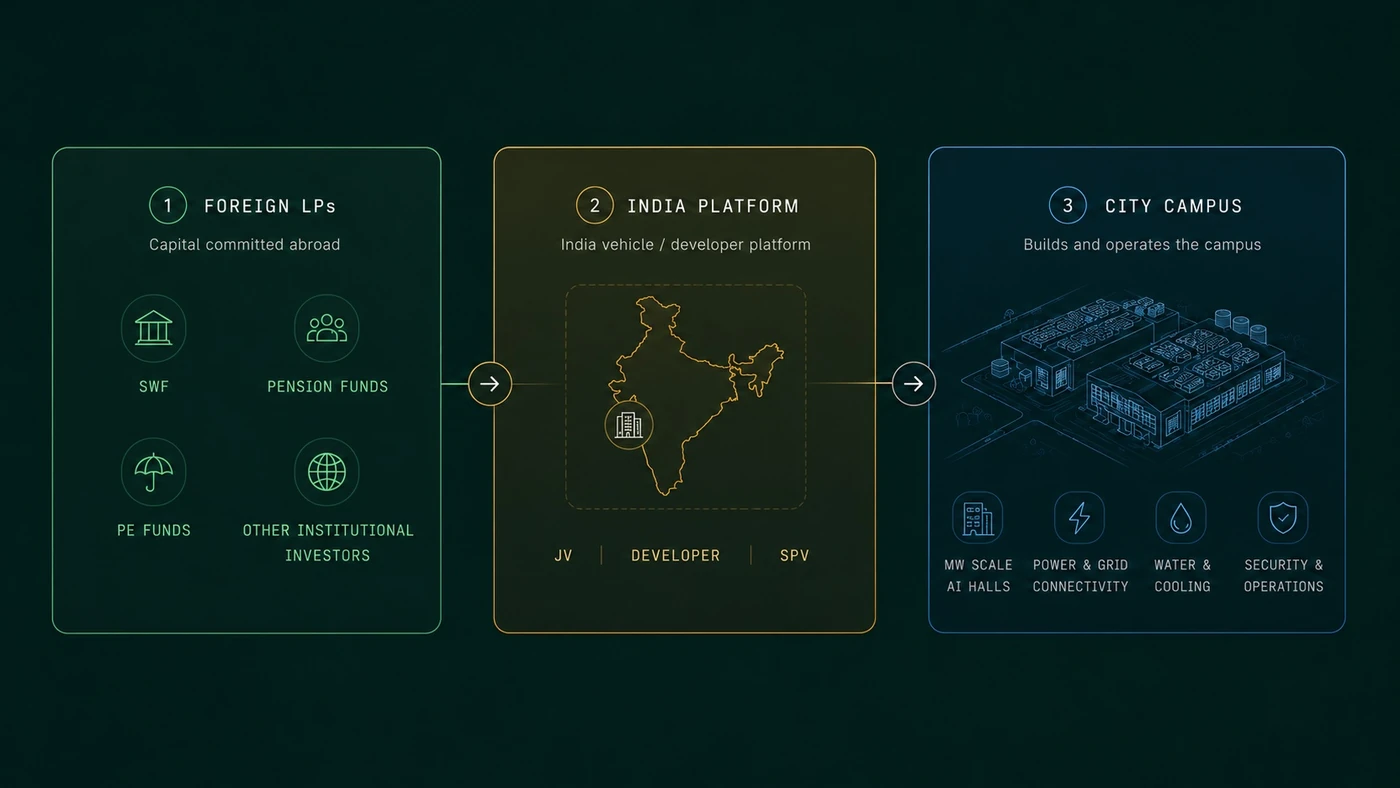
Roughly 80% of the USD 14.7 billion that entered Indian data centres between 2020 and 2025 was foreign and institutional. It did not arrive as speculative real estate. Per KPMG, sovereign and pension capital treats Indian data centres as a core utility, the same allocation logic that built Northern Virginia and Frankfurt. It clusters into three repeatable structures.
No two houses agree on 2030, and the spread is the story. The disagreement is almost entirely about how much AI-native capacity lands, which is itself a function of power.
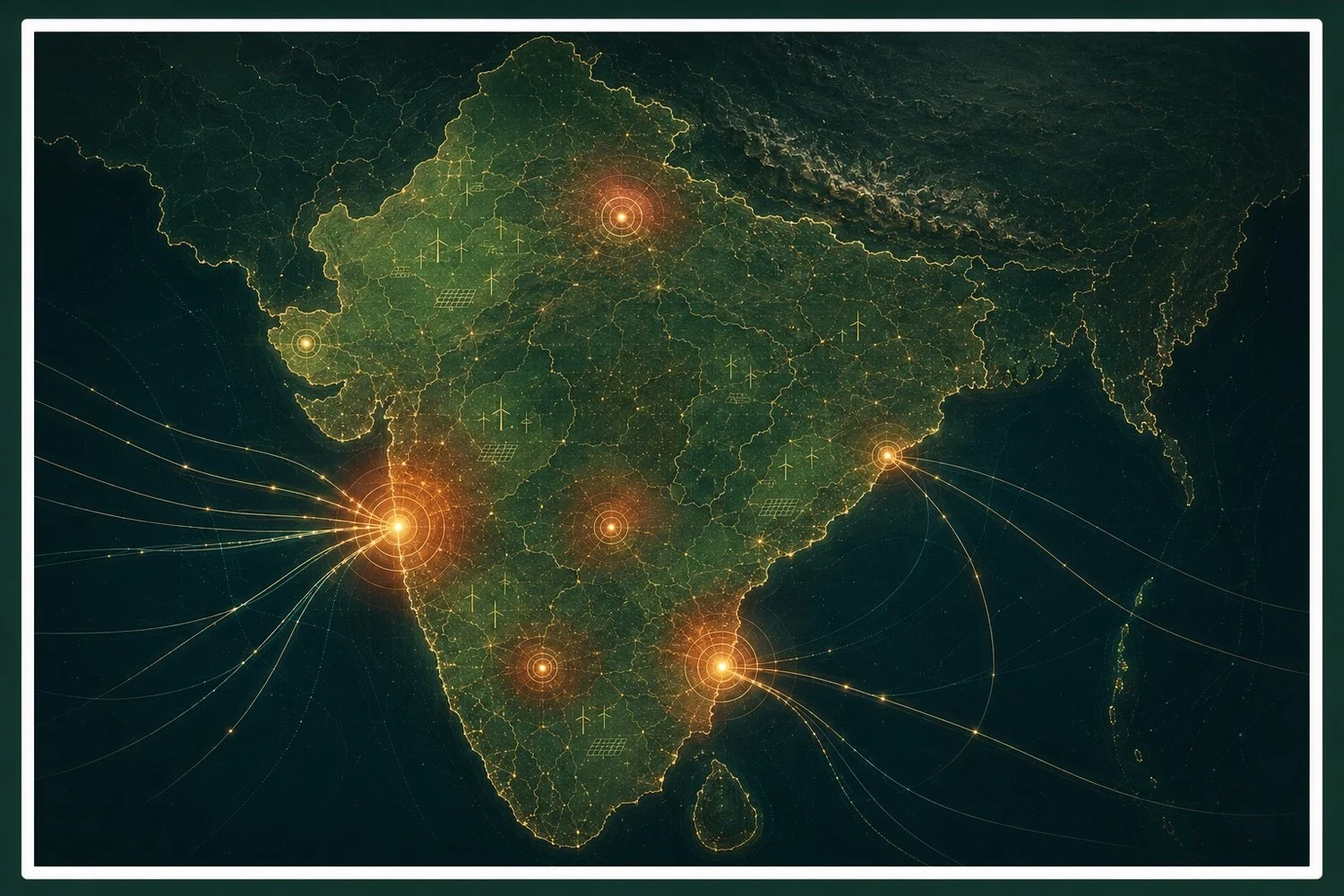
India does not build evenly. Mumbai and Chennai hold the majority of national capacity; the rest is a handful of metros and two gigawatt-scale bets on the east coast. Each glowing node is a real cluster, colour-coded by what it is: verified live capacity, announced, or a contested or early-stage site. Open one for the detail, and toggle the overlays to read the build against grid stress, the cable landings and the renewable zones. The outline follows real national boundary data and every cluster sits on its true coordinates.
While private capital argues over megawatts, the state moved first on silicon. The IndiaAI Mission, run by MeitY, has onboarded 38,231 GPUs and spread them across 14 empanelled commercial data centres rather than one national supercomputer, from Mumbai and Hyderabad to Noida and Jamnagar. Access is subsidised to around ₹65 an hour, roughly a third of the prevailing global rate, to pull startups and researchers onto domestic compute.
The load is small but pointed: those GPUs draw about 48 MW of high-density, AI-ready power today. The signal is the forecast behind them. The Ministry of Power now models 13.56 GW of data-centre demand by FY2031-32, and as of March 2026 that figure is not a slide projection but an operating assumption inside the national transmission planning cycle, binding state utilities to build for it.






The grid has to release connection capacity and firm renewable supply faster than AI load arrives. The states have to converge on something close to a single window, so a campus is not re-permitted five different ways. And the 21-year tax certainty has to hold long enough for sovereign and pension capital to underwrite twenty-year positions. The demand is not in doubt. The supply, the power and the patience are the open questions.
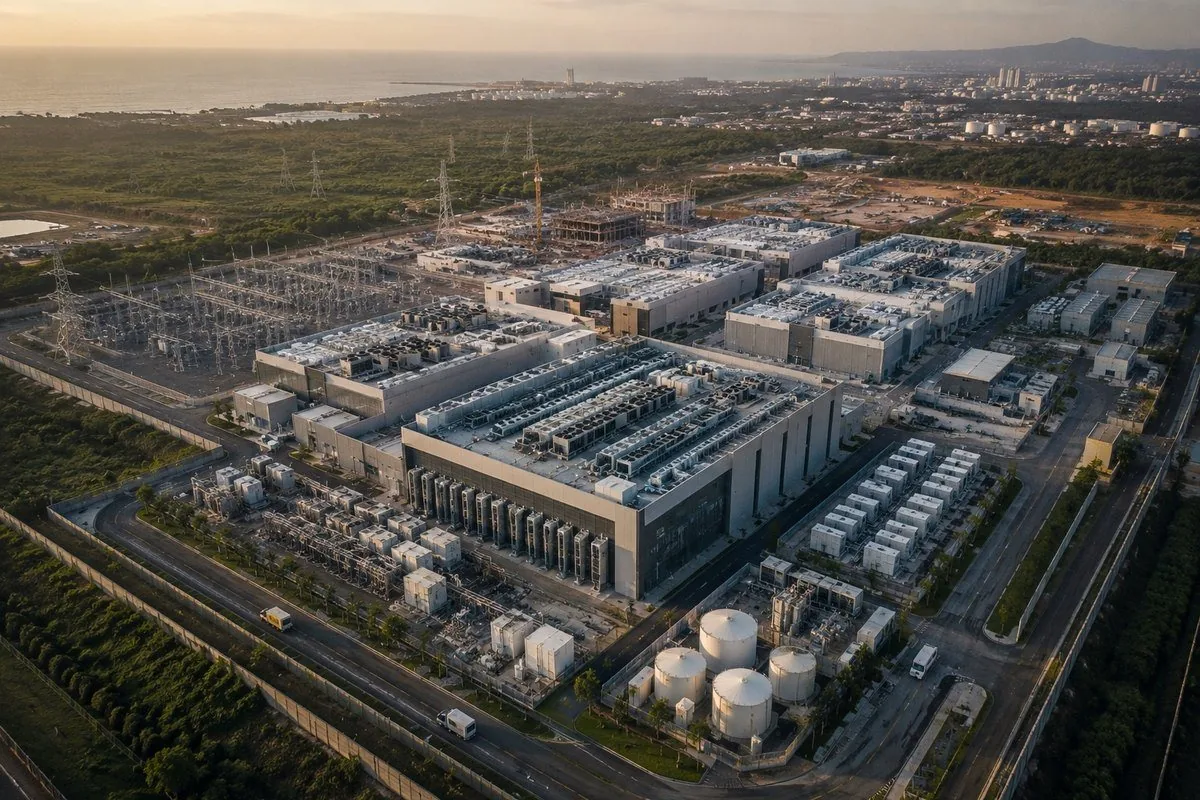
An aerial of an Indian hyperscale campus of the kind rising around Navi Mumbai, Chennai and Visakhapatnam. Gold points are plant: how the building makes cold and takes power. Blue points are the site and its location. Element labels are Entelligencia visual inferences.
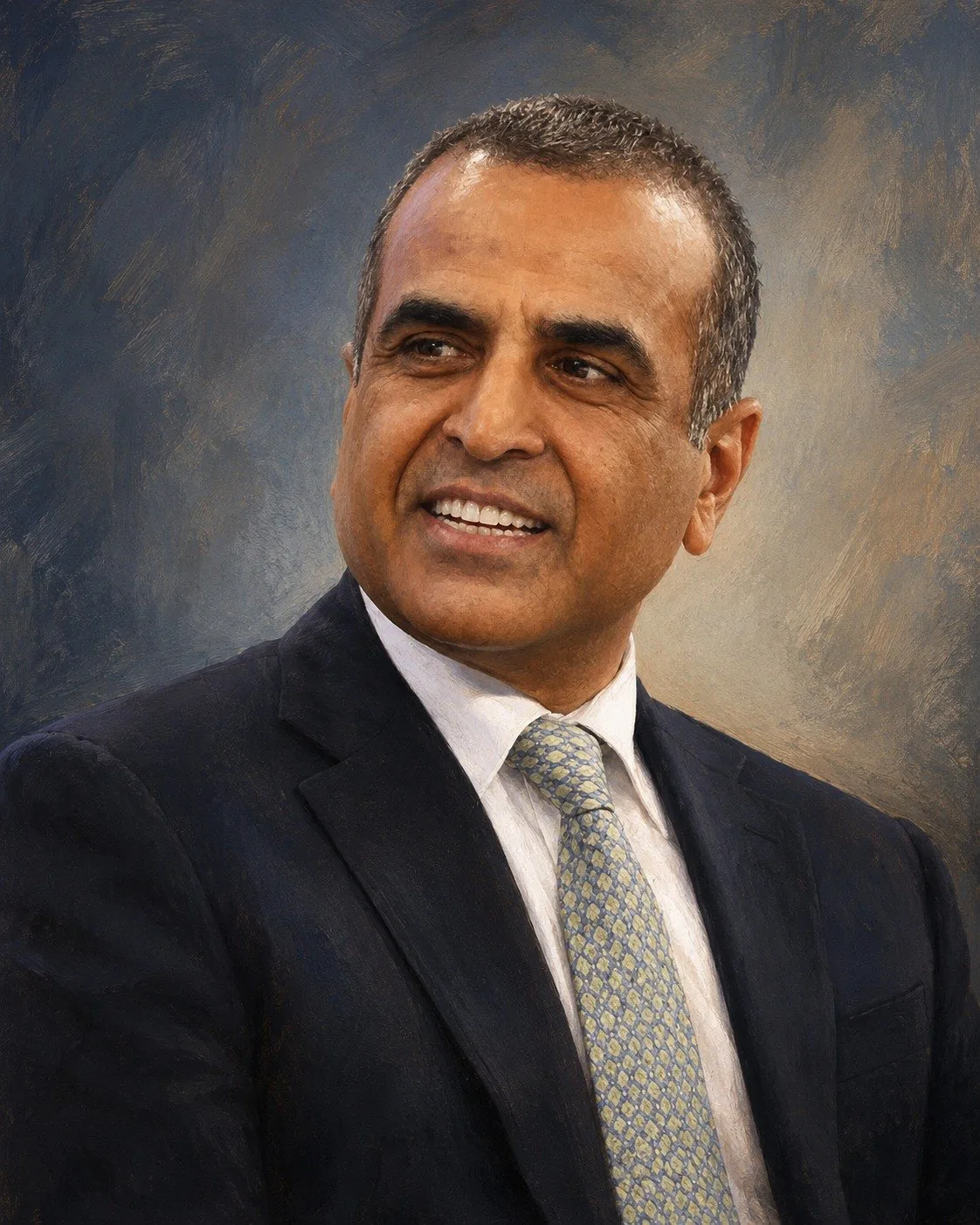
Five named figures across operator, conglomerate, capital and policy roles. Each card carries a real role and a public-record position, never an invented quote.


























Capital and suppliers feed the power layer and the operators, who anchor the hyperscalers and enterprise demand. The Indian signature is that the largest operators are increasingly inside conglomerates that can self-supply power, which is the whole point when power is the binding constraint.
05 tiers · 27 entitiesPower and renewable suppliers shown are indicative of the categories active in the market. Connections are Entelligencia’s reading of public deal and partnership announcements.
Where the build actually happens, and what is in the way.